Rune pairs a headscale peer network with a screen multiplexer that has nine workspace slots
the development environment for pros
At a glance
- What is it?
- unstablebuild/rune is a GPU-accelerated IDE and terminal multiplexer written in Go, licensed under the GNU General Public License version 3 or later and built by a self-funded company. Its pages describe a native OpenGL and Metal renderer with no Electron, a peer network over the project's own headscale fork, and a dependency list carrying three model provider SDKs, two diff libraries, and a debug build flag that compiles in hidden crash commands.
- Who is it for?
- Rune is an ambitious tool with an unusually candid build file, and the candid parts are where you should look first. The Makefile documents a real incident in which test timeouts leaked containers that slowed the host and caused the following timeout, and it documents a debug build flag that compiles hidden panic and crash commands into the binary.
- Can I use it commercially?
- Yes, with conditions. GPL-3.0 is a copyleft licence: if you distribute software that includes it, you must release that software's source code under the same licence. Running it internally without distributing it does not trigger that obligation.
- Is it still maintained?
- Yes. The repository last received commits 1 day ago.
- What is it written in?
- Mainly Go, according to GitHub's language statistics.
Answers come from the project's GitHub data, last synced on November 22, 2026, and from our analysis. They are not legal advice.
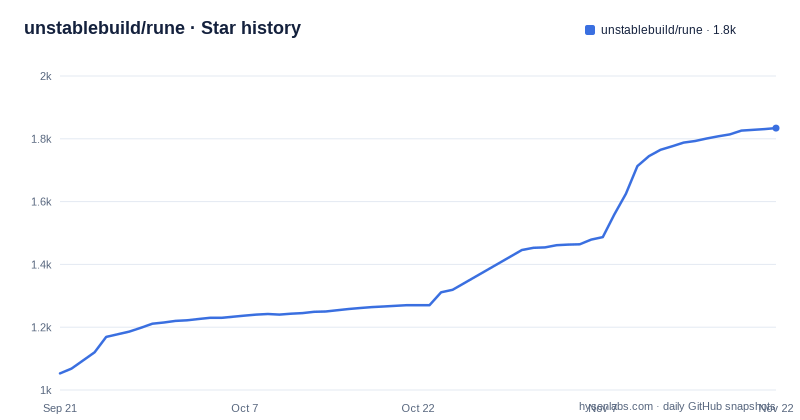
Star history
- unstablebuild/rune1,834 ★ · +781
| Repository | 2026-09-21 | 2026-11-22 |
|---|---|---|
| unstablebuild/rune | 1.1k | 1.8k |
781 Stars in the last 62 days, measured from the daily GitHub snapshot. Compare with other projects
Editorial analysis
The organizer is a screen multiplexer with nine fixed slots
The interface model is stated in one line and it is the most distinctive claim on the page: the user interface is a screen multiplexer that lets you organize freely, with nine workspace slots, infinite terminals, tabs and windows, and either a built-in agent or IDE-grade skills.
Two of those numbers sit oddly together. Nine slots is a small, fixed number, and it is not configurable anywhere on the page, while terminals, tabs and windows are unlimited and nest inside those nine. So the constraint has moved up a level from what a terminal multiplexer normally imposes, which is a useful thing to know if you are comparing this with something built around panes.
The dependency list backs the IDE half of the claim rather than the agent half. The module pulls in a debug adapter protocol library, which is the wire format editors use to drive a running program, along with the Model Context Protocol SDK, fzf for fuzzy finding, and a 2D game framework with a GPU renderer that the native pipeline is built on.
Nodes join a headscale network and their names become URLs
Every Rune instance forms an end-to-end encrypted network of peers, powered by the project's own headscale fork, which is the coordination layer for a private mesh. The headless mode is the clearest description of how that works, because it is a container:
docker run -d --name rune \
  --hostname devpod \
  -v /src/projects:/home/rune/projects \
  unstablebuild/rune

$ docker logs -f rune  # prints the sign-in code
The hostname is the identity, not a DNS convenience: it is the name the node joins the network under, and from any of your machines the command workspaceopen on a rune:// URI of that name plus the mounted path opens the projects. Authentication starts by reading the sign-in code out of the container's logs. The page also points at a guide for running the node as a service under systemd, launchd, OpenRC or runit, and for adding toolchains to the image, which tells you the intended deployment is a long-lived machine rather than a laptop that sleeps.
Three model providers, two diff libraries, one binary
The dependency list is where a terminal multiplexer stops looking like one. It includes the Anthropic SDK for Go and the OpenAI Go SDK, plus the AWS SDK v2 with both the Bedrock and BedrockRuntime service clients. Three model providers are compiled into the same executable that draws your terminal.
Elsewhere in the list, capability appears twice. Two different diff libraries are required, one from sergi and one from sourcegraph, which is duplication a project usually collapses. An SSH server library is there for the peer network, and WebRTC and media device libraries are there for something the page never mentions: no feature bullet describes calling another machine's camera or microphone.
There are also two clustering sets. A token counting library and its loader sit together, which fits an agent that budgets context, and readability extraction, HTML to Markdown and a query library sit together, which fits an editor that pulls web pages into a workspace. The list is long enough that it describes a product, and only some of it is described on the page.
The test timeout was raised after leaked containers caused the next timeout
The Makefile carries a comment explaining a number, which is rare and useful. The default test flags are the race detector plus a five minute timeout, and the comment says that budget is per test binary rather than for the whole suite, because it exists to dump goroutines when a package hangs.
It records the measurements behind the number: the median package takes about five seconds, the ninety-fifth percentile about thirty-four, and the slowest, the IDE internals and the main binary, sit at roughly eighty-five to a hundred. It also records the failure that changed it. A hundred and eighty seconds left those under twice their real duration, so on a loaded machine they timed out, and a timeout skipped the cleanup function, which leaked docker containers, which slowed the host, which caused the next timeout.
That is a cascade, documented and fixed by raising the limit to three hundred. The end-to-end suites get their own nine-minute budget, with the note that they take about two minutes for the containers alone and that the first run also builds the SSH daemon image.
A build flag compiles hidden panic and crash commands into the binary
There is a variable that flips a feature flag inside the compiled program, and the comment above it explains the mechanics. Setting it to true exposes debug-only editor commands, and two of them are named in the file: one that panics the process and one that crashes it. It defaults to off, and the debug target sets it through a target-specific make variable, declared as recursive so the override propagates to prerequisites.
The flag is injected at link time with a debug ldflag that sets a symbol inside the debug package of the internal tree. A second variable mirrors the first, and its comment is blunt about why: that mirroring is what makes the data race command actually crash the debug build rather than run quietly.
None of this reaches a release build, which is the correct arrangement. But it does mean the repository contains the source of two commands whose whole purpose is to break the running editor, and that the escape hatch is a single environment-style variable during the build rather than anything a user can reach.
The import path is a domain and the pins are six years apart
The module declares itself as unstable.build/rune, a vanity domain, while the development instructions clone the same code from a GitHub address. Anyone importing this as a library has to use the domain path, and the package name under cmd/ does not obviously match either URL, which is a small trap for tooling that guesses import paths from repository URLs.
The toolchain line asks for Go 1.27.1, which pins the language version precisely. The dependencies do not follow that example. One entry is a pseudo-version from November 2020, while another is a pseudo-version from February 2026, so the same require block spans six years of upstream history. One dependency is pinned to a major version with no minor at all, which resolves to whatever the newest release in that line turns out to be.
A random name generator is also in there, at a February 2026 pseudo-version, which is a cheerful detail next to a debug adapter protocol client.
The repository dogfoods itself and enforces a licence header by hash
The root directory shows how the project is run rather than what it contains. There is a .rune/ directory, so the tool keeps its own configuration in the repository it is developed in. AGENTS.md sits at the top for coding agents, alongside a DCO file, which means contributions are signed off rather than merely licensed, and a CODE_OF_CONDUCT.
Licence hygiene is enforced mechanically. LICENSE_HEADER holds the header text, LICENSE_HEADER_HASH holds its hash, and a pre-commit configuration exists to apply it, with a .golangci.yml for linting and go.sum beside them. A tools.go file at the root is the conventional place to pin build-time tools in a Go module.
Two directories stand out. dist/ is committed, which is packaging output rather than source, and auth/ sits at the top level next to cmd/ and internal/, meaning authentication is a component of the product rather than an external service it calls into.
Install pipes a script from the product site, and two releases landed a day apart
Installation is one line, fetching a shell script from the project's own site and running it. Development is a clone followed by running the main package directly through the Go toolchain, and a make target builds a macOS application bundle, which is what a Metal renderer needs to become a double-clickable app.
Extensions are installed either from an official package list or straight from a Git repository, with a theme builder extension given as the working example, which is the same trust model as the installer: a URL, fetched and run.
The release history is short and dense: version 1.2.0 on 2026-09-10 and 1.2.1 on 2026-09-11, about fourteen hours apart. The licence is stated as version 3 or, at your option, any later version, while the repository metadata names version 3 alone. And the project describes itself as developed by a self-funded limited company, which is the honest way to say who pays for the work and who does not.
Editorial conclusion
Rune is an ambitious tool with an unusually candid build file, and the candid parts are where you should look first. The Makefile documents a real incident in which test timeouts leaked containers that slowed the host and caused the following timeout, and it documents a debug build flag that compiles hidden panic and crash commands into the binary. Both tell you how this project is operated. Before adopting it, settle three things. First, whether the peer network model fits you: nodes join a headscale network, the node name is baked into a rune:// URI, and the sign-in code arrives in container logs, so you are joining a network rather than opening a port. Second, the GPL terms, where the page grants version 3 or any later version at your option while the repository metadata names version 3 alone. Third, the binary's contents, since one executable carries Anthropic, OpenAI and Bedrock clients along with an SSH server and WebRTC. The nine workspace slots and the extension mechanism are the parts most likely to change how you work day to day.
Frequently asked questions
What is unstablebuild/rune?
A fast, GPU-accelerated IDE and terminal multiplexer written in Go, described as suitable both for automatic and manual programming. It is licensed under the GNU General Public License version 3 or, at your option, any later version, and is developed by Unstable Build, a self-funded limited company.
How does Rune connect several machines together?
All Rune instances form an end-to-end encrypted peer network powered by the project's own headscale fork. A headless node runs as a container whose hostname is the name it joins the network under, and from any machine a workspaceopen command on a rune:// URI of that name opens the mounted projects. The sign-in code is printed by the container's logs.
Does Rune need Electron to run?
No. It is described as a native application with a native graphics pipeline, OpenGL on Linux and Metal on macOS. Installation is a shell script fetched from the project site, and a macOS application bundle is produced by a make target.
How are Rune extensions installed?
From the official package list, or from a community package installed directly from a Git repository using the pkg install command with a repository path, with a theme builder extension given as the example. Extensions sit alongside a built-in agent and IDE-grade skills in the feature list.
What is in the Rune module dependencies?
The module is declared as unstable.build/rune and requires Go 1.27.1. Its dependencies include Anthropic and OpenAI SDKs alongside AWS Bedrock clients, the Model Context Protocol Go SDK, a debug adapter protocol library, WebRTC and media device packages, an SSH server library, two separate diff libraries, and readability and markdown conversion packages for web content.
Official sources
Add this badge to your README
If you maintain this project, the badge below links readers to this analysis and shows its maintenance status from the daily GitHub snapshot. Paste the markdown into your README; add ?metric=license or ?metric=stars to the image URL for a different field.

[](https://hysenlabs.com/projects/unstablebuild-rune)Star history chart for your README
[](https://hysenlabs.com/projects/unstablebuild-rune)Was this useful?