Plunk's default database password is a literal in the compose file, and its SMTP relay runs without TLS when no certificate is mounted
The Open-Source Email Platform
At a glance
- What is it?
- An AGPL-licensed self-hostable email platform: one image contains five applications selected by an environment variable, self-hosting needs five subdomains, a manifest key named like a comment explains a two-version validation library split, dependency installation is pinned to the build machine's architecture, and the object store image comes from a third-party namespace (pgsty/minio) rather than the upstream vendor's.
- Who is it for?
- Plunk fits a team that wants transactional email, campaigns and an SMTP relay under its own control, and the AGPL licence plus a container image is a coherent way to offer that. Four things to settle before the first deploy.
- Can I use it commercially?
- Yes, with strict conditions. AGPL-3.0 is a network copyleft licence: if people use a modified version over a network, for example as a hosted service, you must offer them its source code under the same licence.
- Is it still maintained?
- Yes. The repository received new commits within the last day.
- What is it written in?
- Mainly TypeScript, according to GitHub's language statistics.
Answers come from the project's GitHub data, last synced on November 15, 2026, and from our analysis. They are not legal advice.
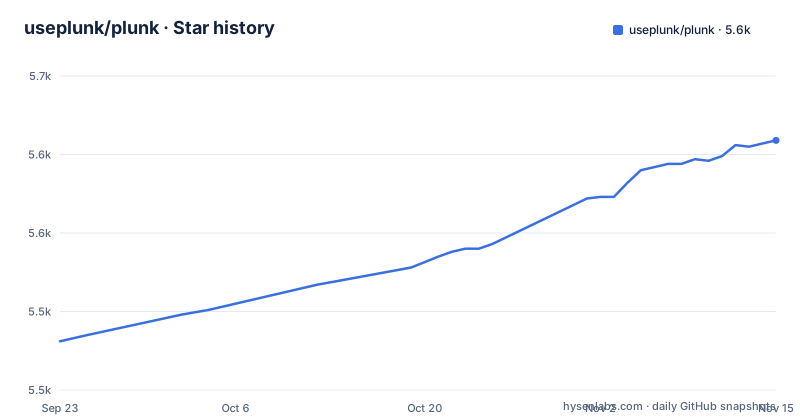
Star history
- useplunk/plunk5,609 ★ · +128
| Repository | 2026-09-23 | 2026-11-15 |
|---|---|---|
| useplunk/plunk | 5.5k | 5.6k |
128 Stars in the last 53 days, measured from the daily GitHub snapshot. Compare with other projects
Editorial analysis
The database password is a fallback literal, not a blank
The infrastructure service definitions in this project's compose file are careful about almost everything except one value.
The database is Postgres 16 on Alpine, with a named volume, a health check that asks the database whether it is ready, and a restart policy. Its three environment values are the database name, the user, and the password. The first two are the project name. The third has a default:
POSTGRES_PASSWORD: ${DB_PASSWORD:-changeme123}So an operator who brings up the stack without setting the variable gets a database whose password is a guessable string, and the service starts normally rather than refusing. A blank value would have been better in one sense and worse in another: blank fails on most images, and a failing first start is a message. A working default is silence.
The project does provide a template environment file whose name says it is for self-hosting, and the compose file's own header instructs the operator to copy it and configure it. So the intended path is to supply a password. The default exists for the case where somebody does not, and it exists in the one file that gets read every time.
The same pattern is visible in the rest of the infrastructure. The cache service is Redis 7 on Alpine with persistence switched on, a named volume, and a health check. Both services join one network. Both restart unless stopped. The difference between that care and a hard-coded credential in the same twenty lines is the whole finding.
Self-hosting needs five subdomains rather than one address
The compose file's header explains the routing model in a block of comments, and it is the part of the deployment that most surprises people.
The comment says the setup uses subdomain-based routing, and then names five of them. An API subdomain goes to the API server. An app subdomain goes to the web dashboard. A www subdomain goes to the landing page. A docs subdomain goes to the documentation. And an SMTP subdomain goes to the mail relay, on two ports, the implicit submission port and the submission port.
The usage instructions in the same header list the four steps, and step two is setting the domain names as variables. So a self-hoster needs five DNS records pointing at one host, not one record, and a reverse proxy has to be configured with all five before anything works.
The scale of that is worth pausing on for a mail platform. Sending from a custom domain is a feature the README advertises, with signing support, and the standard advice for mail delivery is that the sending domain has to be the one users see. Five subdomains is not an unusual amount for a mail stack, but it is a deployment surface, and in the repository the count appears in a comment in the compose file.
Everything runs in one container with a reverse proxy in front of it, and the root of the repository carries the proxy's entrypoint script. The SMTP piece is configured separately, and its two certificate mechanisms are named: an ACME certificate store, or a pair of PEM files mounted into a directory.
One image holds five applications and an environment variable picks which one runs
The container build produces a single image from a multi-stage build, and what runs inside it is a choice made at start time.
The header comment says the image contains all the applications, naming five: the API, a worker, the web interface, a landing page, and the documentation wiki. A single environment variable selects which service to run.
So this is not a set of images, it is one image with a dispatch. That is a good fit for a compose file that runs everything behind one proxy, and it is a poor fit for anyone who wants to scale one component, because the image contains all five regardless of which one is started.
The workspace structure explains why. Six applications in one directory pattern, and the six are the API, a model-context-protocol server, the SMTP relay, the web interface, the landing page, and the wiki. Five shared packages sit beside them: the database layer, a user-interface package, a shared package, a types package, and an email package, plus a shared TypeScript configuration package.
Three of those six applications have no counterpart in the feature list. The model-context-protocol server is a second integration surface alongside the HTTP API and the SMTP relay, and the landing page and the wiki are the two subdomains in the routing block above. So the product surface is four ways in and three ways to read about it, from one build.
A manifest key named like a comment documents a validation library split
The root manifest contains a key that is not a configuration key at all. It is a documentation block stored as a manifest field, with the name made out of a comment marker followed by a word.
What it explains is a version conflict. The model-context-protocol application needs the fourth major version of a validation library because the protocol toolkit requires it, while the rest of the monorepo is on the third. Declaring the third version in the root manifest keeps it as the hoisted copy, so the packages that import the library without declaring it keep resolving the third version. The fourth version nests inside the one application that needs it. The note ends with the condition for removing it: when the whole repository moves to the fourth.
So the hazard is a hoisting problem with a two-language solution, and the solution is documented in the place where a future maintainer will look, which is the file that declares the version.
There is one other override in the same file, and it takes the opposite approach: a documentation library is pinned to an exact version with no range at all, in a field meant for forcing a version. So one dependency is held down by an exact pin and one version conflict is held apart by a hoisting declaration and a comment.
The rest of the manifest is conventional. Build, start, development, lint and clean are all forwarded to a task runner that walks the workspace, and the test scripts are five variations on one runner rather than five tools.
Dependencies install under the build machine's architecture, on purpose
The container build pins its first stage to the build platform and explains why in a comment about avoiding emulation problems.
The stage is declared with an explicit build-platform argument on a Node 24.22.1 slim base image, and the comment says the build platform is used for dependency installation to avoid issues with emulation. So the native modules compiled during install are built for the machine doing the building, not for the machine that will run the image.
That is the correct trade for a cross-platform build: compiling native dependencies for a different architecture under emulation is slow and often broken, and most of those dependencies get recompiled or are pure JavaScript anyway.
The second thing in that stage is the Yarn setup. Corepack is enabled and a specific package manager version is prepared, and the repository's own Yarn configuration and its vendored release directory are copied in before anything else. So the package manager binary itself is part of the build context rather than something fetched at build time.
The third thing is a wall of copy commands for twelve workspace manifests, with a comment that explains why every one of them has to be there even when its application is never built. The immutable install re-resolves the whole workspace graph, and a missing manifest makes the generated lockfile differ from the committed one, which the command then rejects. The comment is one of the more useful things in the build file.
The mail relay documents itself as running without TLS when no certificate is mounted
One line in the compose file's header is the most consequential sentence in the repository's deployment story.
The SMTP server supports TLS certificates through two mechanisms: an ACME certificate store that is mounted and requires the mail subdomain to be set, or a pair of PEM files mounted into a certificate directory. And then the note: it runs without TLS if no certificates are mounted.
So the default state of a self-hosted relay, brought up with the five subdomains configured and nothing else, accepts mail in the clear on two public ports. Those are the ports an email client uses for authenticated submission, which means the credentials in that session cross the network unencrypted.
Nothing in the file makes that state an error. The service starts, and the only signal is a comment.
The mitigation is present and cheap. Set the mail subdomain, then mount one of the two certificate sources, and the relay terminates TLS. A reader who knows the two lines above will do that; a reader who has skimmed the header will bring the stack up and start testing.
The same header is otherwise exemplary. It states the routing model, names every subdomain, lists the four steps in order, and explains the persistence of the two stateful services. It is the clearest deployment documentation in the file, which makes the one unenforced line more surprising rather than less.
The object store image is a personal namespace and the compose file declares an obsolete version
Two of the infrastructure services use the obvious upstream image, and the third does not.
The database is the official Postgres Alpine image. The cache is the official Redis Alpine image. The object store, which is the third service, is referenced as pgsty/minio, a namespace that is not the project's own and not the upstream vendor's.
That is the image in the stack worth reading the source of before you deploy it, since the database and cache images are the vendors' own.
The other detail in that file is a version key. The compose file declares a format version of 3.8 in its first line, which is the obsolete top-level form that current Compose releases warn about in favour of omitting it. It is harmless and it is the first thing a reader of the file sees.
A small coda on the rest of the stack: releases are cut by an automated release tool rather than by hand, with a manifest and a configuration file both committed at the root, and the root also carries a product document, an agent instruction file, a change log and a contributing guide. The project ships its release process in the repository, which is more than most do at this size.
Editorial conclusion
Plunk fits a team that wants transactional email, campaigns and an SMTP relay under its own control, and the AGPL licence plus a container image is a coherent way to offer that. Four things to settle before the first deploy. The database password in the compose file is a fallback literal, so set the variable in your environment file before the first start or you will run a mail platform on a guessable credential. The SMTP relay is documented as running without TLS when no certificate is mounted, which is a plain-text credential path on two public ports. The object store service is referenced by an image from a third-party namespace (pgsty/minio) rather than the upstream one, so read what that image contains before trusting it with your data. And the default branch is the next one, so build from a release tag rather than from the branch head.
Frequently asked questions
What is Plunk?
An open-source, self-hostable email platform covering transactional email with templates and variable substitution, campaigns, workflows with triggers, delays and conditional logic, segments, contact management with custom fields and activity history, analytics for opens, clicks and bounces, custom domains with signing support, and inbound email with routing rules. It can also be used as an SMTP relay.
How much does Plunk cost to send email?
The hosted service is described at $0.001 per email with no contact limits. The code is AGPL-3.0 licensed and self-hostable from a container image, and the README frames the project as an open-source alternative to three named commercial senders.
What does self-hosting Plunk require?
Docker, and five subdomains rather than one address: one for the API, one for the dashboard, one for the landing page, one for the documentation, and one for the SMTP relay, which listens on two ports. A compose file at the repository root runs every service in a single container behind a reverse proxy.
Does a self-hosted Plunk accept mail over an unencrypted connection?
Yes, unless you prevent it. The compose file documents two ways to give the SMTP server TLS certificates, an ACME store or a pair of PEM files, and states that it runs without TLS if no certificates are mounted. Nothing makes the unencrypted state an error.
Is Plunk an alternative to Resend?
The README names three commercial senders it is an open-source alternative to, and one of them is Resend. Beyond that list it says nothing about any of them, and the only stated differences are the hosted price per email and the availability of self-hostable code under an AGPL licence.
Official sources
Add this badge to your README
If you maintain this project, the badge below links readers to this analysis and shows its maintenance status from the daily GitHub snapshot. Paste the markdown into your README; add ?metric=license or ?metric=stars to the image URL for a different field.

[](https://hysenlabs.com/projects/useplunk-plunk)Star history chart for your README
[](https://hysenlabs.com/projects/useplunk-plunk)Was this useful?