vira-assets: a brand asset repository, not the theme it advertises
Vira Theme is the official successor of the popular Material Theme. This premium version is actively maintained, includes hand-curated icons and more features
At a glance
- What is it?
- Eleven thousand stars on a repository whose entire tree is a README and an assets folder, which makes it one of the more misunderstood repositories on the site.
- Who is it for?
- The most useful thing to take from vira-assets is a correction to a wrong assumption. This is a brand asset host with a README and an assets directory, not a theme distribution, and not an extension you install from source.
- Can I use it commercially?
- Not without permission. GitHub finds no licence file in the repository, and without a licence all rights are reserved by default: you may read the code but not reuse it. Check the README, or ask the authors, before using it.
- Is it still maintained?
- Yes. The repository last received commits 44 days ago.
- What is it written in?
- GitHub does not report a main language for this repository.
Answers come from the project's GitHub data, last synced on November 7, 2026, and from our analysis. They are not legal advice.
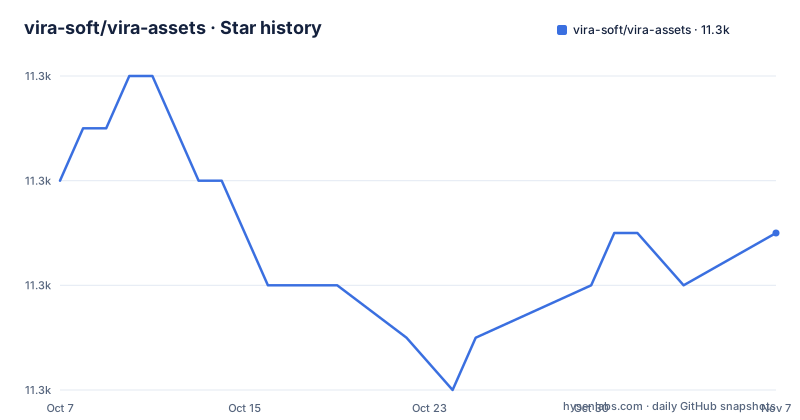
Star history
- vira-soft/vira-assets11,303 ★ · -1
| Repository | 2026-10-07 | 2026-11-07 |
|---|---|---|
| vira-soft/vira-assets | 11.3k | 11.3k |
-1 Stars in the last 31 days, measured from the daily GitHub snapshot. Compare with other projects
Editorial analysis
The tree is a README and an assets folder
The complete file listing for the default branch, which is named `live` rather than `main` or `master`, is four entries: `.gitattributes`, `.gitignore`, `README.md`, and `assets/`. There is no source code, no manifest, no build script, and no tests. The primary language is not detected, and no license file is present at the root.
That is the whole project, and it is not a strange thing for a project to be. A public assets repository exists so that other documents can reference stable image URLs without embedding binaries in every repository that wants to display a logo.
The naming follows that pattern closely. `vira-assets` under the `vira-soft` organisation, with a homepage pointing at vira.build, and a README whose title is Vira Software Public Assets.
The branch name `live` is the one small operational detail worth noticing. A branch called `live` implies something is deployed from it, or at least that the author thinks of its contents as the current published state rather than as work in progress. For a repository of static files that serves images over HTTPS, that is a sensible convention.
What the README contains and what it does not
The README is a small HTML page rather than Markdown prose. It opens with a centered logo image linking to virasoft.dev, a heading naming Vira Software Public Assets, and then a table titled Our products with two cells.
The first cell is Vira Theme, linking to vira.build. The second is Design Tokens Explorer, linking to dtexplorer.io. Both cells also contain commented-out preview image tags pointing at `.webp` files under `assets/previews/`, named `teal.webp` and `ocean.webp`, which suggests those previews were once shown and are currently disabled.
The page closes with a copyright line reading Copyright, copy symbol, Vira Software. All rights reserved.
So the README does three things: it displays the logo, it lists two products with links, and it asserts a copyright. What it does not do is explain how to use any of it, list the contents of the assets directory, or state a license under which the images may be reused. If you came here looking for the VS Code theme, this README will not resolve that, because it is a brand page rather than product documentation.
Where the description and the repository disagree
This is the most interesting fact about the project, and it is a genuine tension rather than a confusion on your part.
The repository's GitHub description reads: Vira Theme is the official successor of the popular Material Theme. This premium version is actively maintained, includes hand-curated icons and more features. That sentence describes a maintained, premium theme with curated icon assets.
The repository itself contains no theme. Its README calls it Vira Software Public Assets and lists two products as links.
Both facts are true at once, and there is a reasonable explanation that fits all of it. A successor project that has inherited an established community, and the star history that came with it, would plausibly set its description to carry over the story while hosting its brand assets in a separate public repository under the same organisation. The successor relationship is a claim about lineage. The asset hosting is what this particular repository does.
Both facts are worth knowing, and there is a practical consequence either way. If you are evaluating the theme, the description is a pointer to the product and not to the code. If you are evaluating this repository, the description overstates it. The last push to the `live` branch was on 2026-09-25, and the repository is not archived.
Why the numbers look the way they do
The statistics on this repository need a different explanation than they usually get, and getting that wrong leads to a bad read.
There are just over eleven thousand stars and a little over nine hundred forks, with zero open issues. Read naively, that is a heavily used project with a perfect issue record.
Zero open issues says little about the theme, since this repository holds no theme code.
There is a genuine open question that this repository cannot answer for you: whether the asset URLs still resolve. Nothing in the repository states a retention policy or a deprecation path. If you are depending on one of these URLs, fetching it once and confirming it works is the only verification available.
The two products the assets belong to
The product table is short enough to be worth reading closely, because these two projects are aimed at different users and only one of them is a theme.
Vira Theme, at vira.build, is the theme the repository description calls the official successor of the Material Theme, with hand-curated icons. The description calls it a premium version.
Design Tokens Explorer, at dtexplorer.io, is a separate tool with a separate name and no stated connection to Vira Theme in the description. Design tokens are the naming layer between design decisions and code values, so a tool that browses them sits closer to a design systems workflow than to a text editor colour scheme. Its presence in the same assets page tells you Vira Software is working on adjacent developer tooling rather than only on themes.
For a reader deciding where to spend time, the practical sequence is straightforward. Open vira.build for what the theme does and how it is licensed. Open dtexplorer.io for the tokens tool. Use this repository only if you need to embed the logo or the previews.
Editorial conclusion
The most useful thing to take from vira-assets is a correction to a wrong assumption. This is a brand asset host with a README and an assets directory, not a theme distribution, and not an extension you install from source. If you want the Vira Theme, the path runs through vira.build, not through cloning anything here. The last push was on 2026-09-25, and the practical takeaway for anyone evaluating it is to judge the theme on the product site and this repository on exactly one question, which is whether the asset URLs it hosts still resolve.
Frequently asked questions
Is vira-assets the Vira Theme source code?
No. The repository's own README calls it Vira Software Public Assets, and the tree contains only .gitattributes, .gitignore, README.md and an assets folder. The theme itself is a separate product at vira.build. The GitHub description describes the theme's lineage and features, which is why the repository is easy to mistake for the theme's source.
What license can I use the Vira Software images under?
The README states Copyright, copy symbol, Vira Software. All rights reserved, and no license file appears at the root of the repository or among the tree entries. There is no grant of reuse rights in the repository, so treat the images as copyrighted rather than as public domain and ask the owner directly if you need to redistribute them.
Why does vira-assets have so many stars but no issues?
The repository contains only a README and an assets folder, with no theme code, so there is little to report issues against. The star count says little about how widely the theme itself is installed or how stable it is.
What is Design Tokens Explorer, and is it part of Vira Theme?
It is a separate Vira Software product at dtexplorer.io, listed alongside Vira Theme in the repository's product table. The README gives no further description of it and makes no connection between the two beyond sharing the owner. Design tokens generally refer to named design values such as spacing and colour scales, which puts this tool in a design systems workflow rather than in editor theming.
Where can I download the Vira Theme for Visual Studio Code?
The repository points to vira.build as the product site for Vira Theme, so the distribution route is the product site rather than this GitHub repository. Nothing in the repository itself carries theme files, a manifest, or build scripts.
Official sources
Add this badge to your README
If you maintain this project, the badge below links readers to this analysis and shows its maintenance status from the daily GitHub snapshot. Paste the markdown into your README; add ?metric=license or ?metric=stars to the image URL for a different field.

[](https://hysenlabs.com/projects/vira-soft-vira-assets)Star history chart for your README
[](https://hysenlabs.com/projects/vira-soft-vira-assets)Was this useful?