v2.cn.vuejs.org: the Chinese Vue 2 documentation built on Hexo
🇨🇳 Chinese translation for v2.vuejs.org
At a glance
- What is it?
- This repository is the Chinese translation of the Vue 2 documentation, published at v2.cn.vuejs.org and built with Hexo. The README states the site is in maintenance mode, syncing upstream English changes, and the tooling is a pnpm and Hexo pipeline with a Chinese-specific linter rather than a general purpose documentation project.
- Who is it for?
- Adopt this repository if you need the Vue 2 documentation in Chinese, or if you want a working Hexo setup for a translated documentation site you can fork, since the generators, the theme folder and the lint tooling are all here. Do not adopt it as the base for Vue 3 work, because the README points Vue 3 readers at the separate `vuejs-translations/docs-zh-cn` repository, and do not expect new Vue 2 features to be documented here.
- Can I use it commercially?
- Yes. MIT is a permissive licence: you can use, modify and sell software built on it, as long as you keep its copyright and licence notices.
- Is it still maintained?
- Yes. The repository last received commits 18 days ago.
- What is it written in?
- Mainly JavaScript, according to GitHub's language statistics.
Answers come from the project's GitHub data, last synced on November 7, 2026, and from our analysis. They are not legal advice.
Star history
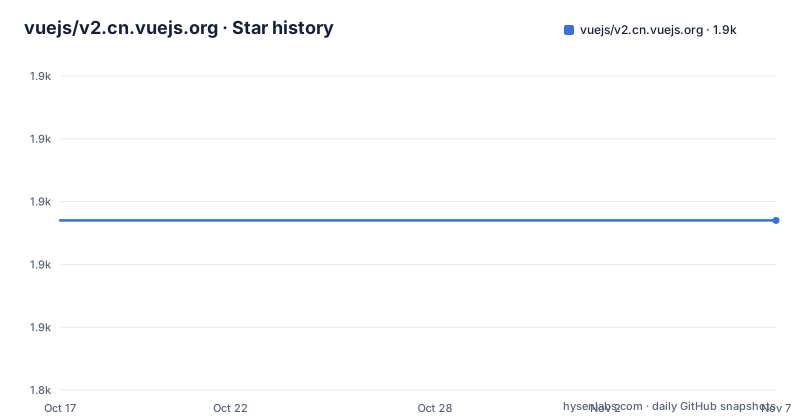
- vuejs/v2.cn.vuejs.org1,867 ★ · +0
| Repository | 2026-10-17 | 2026-11-07 |
|---|---|---|
| vuejs/v2.cn.vuejs.org | 1.9k | 1.9k |
0 Stars in the last 21 days, measured from the daily GitHub snapshot. Compare with other projects
Editorial analysis
A translation mirror, not a documentation source
The scope of this repository is narrow and the README is upfront about it. It holds the Chinese translation of the Vue 2 documentation, the site is published at v2.cn.vuejs.org, and the header states that the site has entered maintenance mode, meaning the English upstream is the source of truth and this repository follows it.
The English original lives at the `vuejs/v2.vuejs.org` repository, and the README makes the direction of travel explicit: contributions here are expected to be translations of upstream changes, corrections of typos and wrong formatting, and issues discussing wording or the deployment process. The sync is described as periodic, covering both the documentation content under `src` and the front-end code under `themes/vue` in the English repository.
There is also a scope rule that matters for anyone about to open an issue. The README says that in principle only translation work happens here, and that if the English text itself could be improved, or if an idea would help every language version, it should be raised in the English repository instead. Questions about using Vue are explicitly redirected to the official forum and the chat room. For a Vue 3 project, the README names the destination outright: the Vue 3 Chinese documentation moved to `vuejs-translations/docs-zh-cn`.
The tree matches that role. It is a documentation site, with `src/` for content, `themes/` for the site chrome, `_config.yml` for Hexo configuration, `writing-guide.md` for translation conventions and a `pnpm-lock.yaml` for reproducible installs.
Hexo with a pinned generator set, including one dependency from a fork
The site is a Hexo site and the dependency list in `package.json` shows how it is assembled. There is `hexo` itself at version `^7.2.0` and `hexo-server` at `^3.0.0` for the development server, a set of generators for archives, categories, feeds, indexes and tags, and renderers for EJS, Markdown and Stylus. The `hexo` config block in the same file pins `version` to `6.2.0`, which is a separate knob from the installed package and is the field Hexo uses to decide how the site directory is laid out and which features to enable.
Two dependencies are worth flagging. `hexo-generator-alias` is not taken from the npm registry but from a git URL pointing at a fork hosted under the `chrisvfritz` account, which is the mechanism that turns the English documentation's link structure into working Chinese paths. And `hexo-renderer-marked` is pinned at the older `^0.3.2`, which is a conservative choice for a documentation site where a renderer upgrade can silently change how every page renders.
The remaining utilities are small and telling. `axios` and `hoek` are present, `js-yaml` handles configuration, and `zhlint` at `^0.6.0` is the Chinese typography linter that gives the project its most distinctive tool. The `engines` field asks for Node `>=14.0.0`, and the package is marked `private` with `true`, so it is never published to a registry; it exists to be deployed as a site.
Running the dev server with pnpm, and what you should see
The README gives the development setup in two commands, and the second one carries the detail that saves you a search.
$ pnpm install
$ pnpm start # 开发服务器地址为 http://localhost:4000
The development server listens on `http://localhost:4000`, and the repository ships a `pnpm-lock.yaml`, so `pnpm install` produces a deterministic dependency tree rather than resolving fresh versions. The lock file matters more than usual here because of the git-sourced generator dependency, which has no version range that a registry could pin.
The npm scripts add a little more than the README shows. The `dev` script is not a bare `hexo server`, it first runs a sponsor sync step.
node _scripts/sync-sponsors.js && hexo serverThat script in `_scripts/` fetches the sponsor list so the acknowledgements page stays current without a human editing it. The `build` script does the mirror image before generating, running a pre-deploy script and then a clean and a generate.
node _scripts/pre-deploy.js && hexo clean && hexo generateThe `_scripts/` directory is therefore part of the build contract, not a collection of one-off helpers. A fork that skips the pre-deploy step will produce a site that differs from the published one, whatever the Markdown content says.
The lint step only covers three directories, and that is deliberate
Chinese documentation has typography problems that a JavaScript linter cannot see, and `zhlint` is the tool this project reaches for. The `lint` script is scoped to a precise glob.
zhlint 'src/v2/{guide,api,style-guide}/*.md'The scope is the interesting part. The glob covers `src/v2/guide`, `src/v2/api` and `src/v2/style-guide`, and it stops at the top level of each directory, so nested Markdown files are outside it. A `lint:fix` variant runs the same command with `--fix`, which means the tool can correct what it flags instead of only reporting it.
Two consequences for a contributor. First, a passing lint run is not a statement about the whole site, so a change outside those three directories is not checked by the linter at all. Second, the pattern of Chinese documentation work is to fix spacing and punctuation between Chinese and Latin text, and the automated check catches the mechanical part of that, while `writing-guide.md` and the wiki linked from the README cover the judgement calls the tool cannot make.
The README asks contributors to raise an issue when they want to discuss wording or formatting conventions, which suggests the maintainers treat translation style as something to be settled collectively rather than in a pull request comment.
Deployment, and one inconsistency worth checking
The README says the site is deployed automatically to the `master` branch through CircleCI. The repository tree, however, also contains a `vercel.json` at the top level, and `package.json` defines a `deploy` script that runs the build and then `hexo deploy`.
Those two statements do not line up neatly. A CircleCI pipeline keyed to the `master` branch and a Vercel configuration file in the root are two different hosting arrangements, and the README does not explain whether the Vercel file is a current deployment target, a leftover from a migration, or a configuration used for preview builds. The repository does not include a CircleCI configuration directory in the top-level listing, though a `.github/` directory is present and could hold the workflow.
If you are deploying a fork, this is the first thing to resolve. The `deploy` script in `package.json` relies on Hexo's own deploy mechanism, which needs a remote configuration in `_config.yml` that is not reproduced in the files listed for this project, while an automated pipeline needs whatever the hosting service expects. Anyone who assumes the README sentence describes the whole setup can end up with a site that builds but never updates.
The `build` script is the part worth copying regardless, since the pre-deploy script runs before `hexo clean` and `hexo generate`, and skipping it changes the output.
What a contributor actually does here
The contribution loop is short, and the README names the steps. Sync the latest changes from the English site, fix typos or incorrect formatting, open an issue to discuss wording or formatting, or open an issue to discuss deployment and collaboration process. The README also asks contributors to read the wiki linked at the end of that section before translating, and it points at an acknowledgements page at `/about/` that records who did the original whole-site translation.
The acknowledgements deserve a mention because they explain the history of the project. The README says the site was founded with a lot of help from many people who divided the work and completed the translation of the whole site together, and the current state is that the site is in maintenance, with the latest documentation and translation contributions visible on the GitHub contributors page.
Maintenance status itself is worth stating plainly. The last push to the repository was on 2026-10-16, and the repository is not archived, so it is receiving updates. But the README describes those updates as a periodic sync of an upstream that is itself in maintenance mode, which is a different thing from the project being under active development. There are no GitHub releases attached to the repository, so version history is not tracked here either. The `writing-guide.md` file and the wiki are the practical references for making a contribution that matches the existing style, and a pull request is the mechanism the README asks for.
Editorial conclusion
Adopt this repository if you need the Vue 2 documentation in Chinese, or if you want a working Hexo setup for a translated documentation site you can fork, since the generators, the theme folder and the lint tooling are all here. Do not adopt it as the base for Vue 3 work, because the README points Vue 3 readers at the separate `vuejs-translations/docs-zh-cn` repository, and do not expect new Vue 2 features to be documented here. Before contributing, read `writing-guide.md` and the linked wiki, and run `pnpm run lint` on your changed files, since the `zhlint` script only covers `src/v2/{guide,api,style-guide}/*.md` and will not check the rest of the tree.
Frequently asked questions
How do I run the v2.cn.vuejs.org documentation site locally?
Run `pnpm install` and then `pnpm start`, which starts the Hexo development server on `http://localhost:4000`. The `dev` script in `package.json` first runs `node _scripts/sync-sponsors.js` and then `hexo server`.
Where should I find the Chinese documentation for Vue 3?
The README states that the Vue 2 Chinese documentation is in maintenance mode and that Vue 3 readers should go to the `vuejs-translations/docs-zh-cn` repository. This repository only covers Vue 2.
What is zhlint used for in this project and what does it check?
zhlint is the Chinese typography linter in the dependencies. The `lint` script runs `zhlint 'src/v2/{guide,api,style-guide}/*.md'`, which means it checks Markdown files at the top level of the guide, api and style-guide directories, and `lint:fix` runs the same command with `--fix`.
What should a contribution to the Chinese Vue 2 docs contain?
The README asks for syncing the latest changes from the English site, fixing typos or incorrect formatting, and raising issues to discuss wording or the deployment process, and it asks contributors to read the linked wiki before translating. The principle stated is that only translation work belongs here, and suggestions that would help every language version should go to the English repository.
How is the v2.cn.vuejs.org site deployed?
The README says the site is deployed automatically for the `master` branch through CircleCI. The repository also contains a `vercel.json` and a `deploy` script that runs the build and then `hexo deploy`, and the README does not explain how the two arrangements relate.
Official sources
Add this badge to your README
If you maintain this project, the badge below links readers to this analysis and shows its maintenance status from the daily GitHub snapshot. Paste the markdown into your README; add ?metric=license or ?metric=stars to the image URL for a different field.

[](https://hysenlabs.com/projects/vuejs-v2-cn-vuejs-org)Star history chart for your README
[](https://hysenlabs.com/projects/vuejs-v2-cn-vuejs-org)Was this useful?