A Chinese account of job hunting in Australia, still being pushed to in 2026
Work in Australia as a Developer.
At a glance
- What is it?
- One developer's long first-person record of leaving Chengdu for work in Australia, covering job boards, interview rounds, visas and pre-departure logistics. The repository holds a single Markdown file, has been committed to as recently as 2026-09-11, and has produced exactly one release, tagged in 2022.
- Who is it for?
- Treat this repository as a dated first-person record rather than as current guidance. It is worth reading for the shape of the process it describes, since the sequence from job board to phone screen to pair programming to a visa conversation is specific and internally consistent, and for the parts where the author is candid about what he had not prepared.
- Can I use it commercially?
- The repository metadata does not identify a licence. Check the project’s published terms and any component-specific licences before reuse.
- Is it still maintained?
- Yes. The repository last received commits 74 days ago.
- What is it written in?
- GitHub does not report a main language for this repository.
Answers come from the project's GitHub data, last synced on November 24, 2026, and from our analysis. They are not legal advice.
Star history
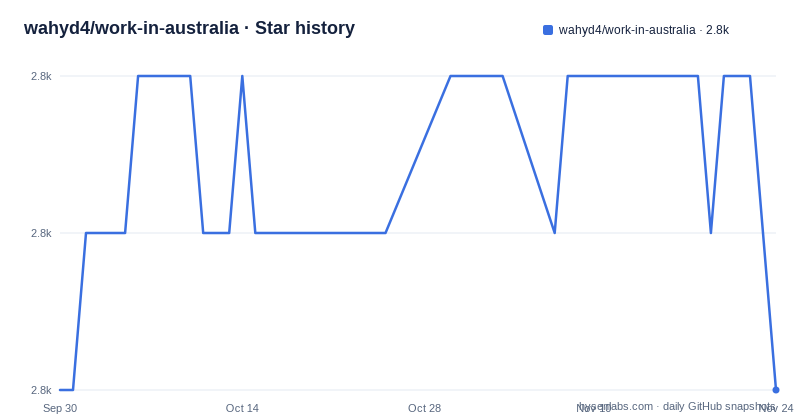
- wahyd4/work-in-australia2,816 ★ · +0
| Repository | 2026-09-30 | 2026-11-24 |
|---|---|---|
| wahyd4/work-in-australia | 2.8k | 2.8k |
0 Stars in the last 55 days, measured from the daily GitHub snapshot. Compare with other projects
Editorial analysis
Four entries at the top, one release, and four years of commits
The repository is four items: a .gitignore, an images directory, readme.md, and wepay.jpg, which is a donation image. There is no source directory, no build file, no test suite, and no LICENSE file, and no license is named in the repository metadata either, so nothing in the tree states the terms for reusing the text. What readme.md contains is a long first-person account, written in Chinese, by one developer about leaving Chengdu to work in Australia. The file has been pushed to as recently as 2026-09-11, yet the only release is v1.0.0, tagged v1.0.0-20221029 and published on 2022-10-29. Close to four years of commits have produced no second tag, which is the first thing to weigh before treating any part of the document as current.
The advice is anchored to 2017 and leans on two visa subclasses
The text dates itself carefully, and it dates its advice heavily. The author says the account is based on his own preparation and interviews during 2017, describes it as a recollection of something that had already happened more than half a year earlier, and explains that the decision to write came after he replied to a V2EX thread about working abroad in March 2018. A video covering largely the same text followed in early 2020. Immigration is where the age shows most clearly. The account presents subclass 457 as a medium-term work visa offering a route to permanent residence, and elsewhere names subclass 482 as the visa whose English requirement is four fives in IELTS. Two different subclass numbers carry the argument, both written from a 2017 vantage point, and the document never tells the reader to re-check them.
One job channel is struck through and its anchor stays behind
The job search section names its channels, and the table of contents records the state of each one. Seek.com.au and au.jora.com are the two job boards, LinkedIn is the third, and alongside them come headhunters, company websites found by hand, and companies that may be willing to sponsor a visa. The remaining entry, Stack Overflow Jobs, is wrapped in strikethrough markers in the contents list while the anchor link to its section remains in place, so the document marks that channel as dropped while leaving the link live. Nothing in the contents list indicates when any other entry was last checked. Read the whole section as a snapshot of what worked in 2017 rather than as a maintained list of places to look today.
Six interview rounds, and the preparation began after a failure
Interviews get six headings of their own, and the sequence is specific enough to plan against. A phone screen comes first, then a written assignment, then an algorithm test, then the technical interview, then pair programming, and finally a round with a manager or a director. Timing is treated as a preparation item in its own right: the author notes that Australia runs at most three hours off China, and about two hours for much of the year, which he weighs as a real advantage for staying in touch, unlike the United States and Canada where he describes the gap as closer to half a day. He also records that people he knew obtained visas through remote interviews. What he admits having no plan for was his own preparation, which he began only after a first remote pair programming session went badly.
Two CV versions, because he was applying for Java and Ruby
The resume advice splits by the kind of employer, and the author had prepared for both cases. Startups are described as more open and more receptive to something short and refined, while traditional companies and the recruitment agencies that front for them want more detail; he records one headhunter sending a company template and asking him to reshape his resume to match it before submitting. He suggests attaching a GitHub address on the grounds that it shows both ordinary code quality and how a person treats open source work. On cover letters he is openly dismissive, calling them of little use for IT roles by his own admission, while still adding a few lines when applying through a traditional job board. He kept two versions, one aimed at Java roles and one at Ruby, each adjusted to what that category seemed to want.
The knowledge notes left a mind map because of constant zooming
The section on organising what you know describes a migration between tools. He began with MindNode, a mind mapping application, and abandoned it for one stated reason: as the notes accumulated, reading any single one of them meant zooming in and out constantly to find anything. He moved to Docsify, a documentation tool that renders Markdown, and published the result on a site of his own. His framing is that the choice of tool matters less than having any working system, since the purpose is to make the material stick rather than to look well organised. One concrete recommendation comes out of it, to write the notes in English using short sentences and bare keywords, on the grounds that keywords are enough to wake up the relevant memory. He notes that this was a weak spot for him at the beginning.
Blocked services and an unstable VPN are part of the stated reason
The account does not confine itself to career reasons, and some of what he weighs is about access. The author describes being unable to use any Google service, and later finding Flickr, Tumblr and Instagram unavailable too, while a VPN was unreliable and hosting one himself carried what the text calls 喝茶, its euphemism for being summoned for questioning. Around that he builds a picture of daily life in Chengdu with figures attached. Winter PM2.5 readings above 200 once or twice a year. A commute that went from an easy 8:15 departure in 2014 to leaving at 7:30 and queuing from the top of the third ring road by late 2017, with the ring expressway backing up for hours after any crash. Parking at the ThoughtWorks software park at 5 or 6 yuan a day, against 4 yuan an hour at a startup whose building had the surrounding car parks under contract. Housing near Huayang at roughly 8,000 a square metre in 2015, past 20,000 inside the ring road later.
A continuing series and paid consultation sit in the same file
Two details at the end of the document change how it should be read. The author points to a follow-up series called Live in AU, hosted as issues in this same repository, and says he will try to publish more than once a week, which makes this file an entry point to an ongoing sequence rather than a finished document. He also invites issues for discussion and adds sections for WeChat tips and for paid consultation, so the repository doubles as the front desk for a service he sells. A badge near the top points at a hit counter on his own domain rather than at a public badge service. The video versions of the text sit as bare links to Bilibili and YouTube with no anchor text inside them, so neither reads as a link when the page is rendered.
Editorial conclusion
Treat this repository as a dated first-person record rather than as current guidance. It is worth reading for the shape of the process it describes, since the sequence from job board to phone screen to pair programming to a visa conversation is specific and internally consistent, and for the parts where the author is candid about what he had not prepared. Do not rely on it for anything a rule can change. It names two different visa subclasses in the same argument, draws salary and housing figures from 2013 to 2017, lists one job channel it has already struck through, and has been committed to for close to four years without a release since 2022. Check the current subclass requirements and the live job boards yourself before acting on any of it, and note that no license file exists, so the reuse terms are unstated.
Frequently asked questions
What is the work-in-australia repository?
A single Chinese-language Markdown file, readme.md, in which one developer writes about preparing for and interviewing for jobs in Australia from Chengdu. Alongside it the repository holds only .gitignore, an images directory and wepay.jpg, a donation image. It contains no source code and no license file.
Which job boards does work-in-australia name?
Seek.com.au and au.jora.com, with LinkedIn, headhunters, company websites found by hand, and companies that may sponsor visas listed alongside them. A Stack Overflow Jobs entry appears in the table of contents wrapped in strikethrough markers, so the document marks that one as dropped while keeping its anchor.
What visa subclasses does work-in-australia mention?
Subclass 457, described as a medium-term work visa with a route to permanent residence, and subclass 482, named as the visa whose English requirement is four fives in IELTS. Both appear in a document written from 2017 experience, so the current rules are worth checking separately.
How current is the advice in work-in-australia?
The account is based on preparation and interviews in 2017, and the author says the decision to write it came in March 2018 after replying to a V2EX thread, with a video of mostly the same text in early 2020. The only release is v1.0.0 from 2022-10-29, while the last push is dated 2026-09-11.
Official sources
Add this badge to your README
If you maintain this project, the badge below links readers to this analysis and shows its maintenance status from the daily GitHub snapshot. Paste the markdown into your README; add ?metric=license or ?metric=stars to the image URL for a different field.

[](https://hysenlabs.com/projects/wahyd4-work-in-australia)Star history chart for your README
[](https://hysenlabs.com/projects/wahyd4-work-in-australia)Was this useful?