go-captcha declares Go 1.16 and pins its font library to a 2017 commit
🖖 GoCaptcha: A high-performance, interactive behavior captcha library for Go. Supporting click, slide, drag-drop, and rotation modes to secure your applications with ease.
At a glance
- What is it?
- An Apache-licensed Go library that generates behaviour captcha images in four interaction styles, from a two-dependency core and a repository root that holds little more than a manifest. The interesting parts are where the work actually lives: verification is a separate project, the assets are a separate project, and six more projects exist to wrap the result in six front-end frameworks.
- Who is it for?
- Use this if you want to generate captcha images and nothing else, because that is precisely its scope, and two dependencies is a pleasant thing to inherit. The parts to check before you build a sign-up flow on it.
- Can I use it commercially?
- Yes. Apache-2.0 is a permissive licence: you can use, modify and sell software built on it, as long as you keep its copyright and licence notices.
- Is it still maintained?
- Activity is slowing. The repository last received commits 8 months ago.
- What is it written in?
- Mainly Go, according to GitHub's language statistics.
Answers come from the project's GitHub data, last synced on November 23, 2026, and from our analysis. They are not legal advice.
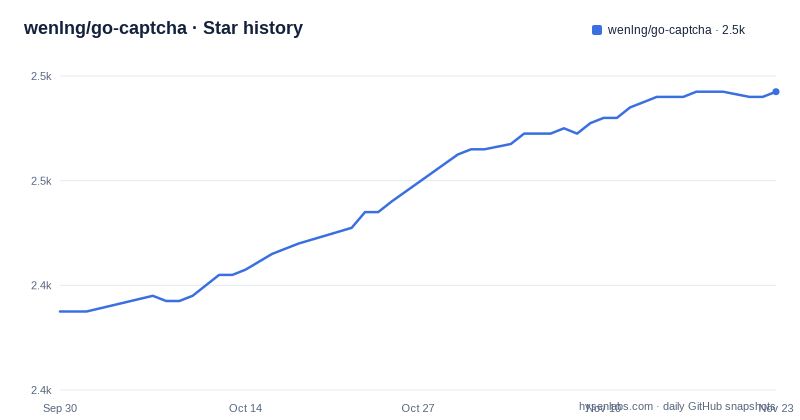
Star history
- wenlng/go-captcha2,477 ★ · +42
| Repository | 2026-09-30 | 2026-11-23 |
|---|---|---|
| wenlng/go-captcha | 2.4k | 2.5k |
42 Stars in the last 54 days, measured from the daily GitHub snapshot. Compare with other projects
Editorial analysis
The manifest says Go 1.16 and one dependency is a 2017 commit
The entire dependency list of this library is two entries, and both are worth reading closely. One is the standard image extension library at a specific release. The other is a font rendering library referenced not by version but by a pseudo-version whose date is part of the string, a mid-2017 commit. The module directive above them declares Go 1.16, which is the language version from early 2021. So a library at release 2.0.5, cut in March 2026, declares a 2021 language level and compiles against a font library frozen in 2017. That is not necessarily wrong: the language directive is a floor rather than a target, and a font rasteriser has changed little in nine years. It does mean the module makes no claim to current toolchains, and an operator auditing supply chain age will find the oldest input in the two lines of the manifest rather than somewhere in a large tree.
The repository root is a manifest and a directory called v2
The top level of the tree is unusually short: attributes and ignore files, a licence, two readmes in English and Chinese, the module manifest and its checksum file, and one directory named v2. Everything else in this project is that one directory. There is a version-numbering wrinkle worth understanding, because Go's module system has a rule about it: a module publishing version two or later is expected to carry a suffixed path, so a two-part release from an unsuffixed import path is the situation that rule exists for. The manifest shown declares the unsuffixed path, and the file listing does not show whether the directory carries a manifest of its own with a suffixed path inside. The badge row compounds the ambiguity, because the licence badge is fetched from a ref named for the second version rather than from the default branch. None of this stops the library from working; it does mean the import path a consumer should write is not the one printed in the manifest, and that is worth resolving from the repository rather than guessing.
Verification is a different repository
The description says the library secures applications, and the feature list talks about generating images. Nothing visible here describes checking an answer. What the ecosystem table does show is a separate service project, described as supporting binary and Docker image deployment, providing both HTTP and RPC interfaces, and running in standalone and distributed modes with service discovery, load balancing and dynamic configuration. There is an SDK toolkit beside it, with matching request interfaces and support for a static mode, service discovery and load balancing. So the architecture implied by the table is: this repository draws the picture, a separate service decides whether the picture was solved correctly, and a separate SDK lets your application talk to that service. If you adopt only the image generator you have not adopted a captcha, you have adopted the drawing half.
Fourteen sibling projects, six of them frontend wrappers
The ecosystem table is the widest thing in the repository and it is worth reading as an org chart. It lists a documentation site, an online demo, an example application combining a language backend with web and mobile clients, a repository of embedded resource assets, this library, and then one project per front-end framework: JavaScript, Vue, React, Angular, Svelte, Solid, and a cross-platform one for apps, mini-programs and fast apps. Then the service and its SDK, and a final row containing nothing but an ellipsis. So this repository is the bottom of a fourteen-row stack: the image generator, sitting under six wrappers, an assets repository, a distributed service and an SDK. That has two practical consequences. Your integration cost is the number of rows you actually need, which for a server-rendered application is probably two, the library and the assets. And the wrappers are separate version lines with their own release schedules, so a framework upgrade is not obviously a library upgrade.
The documentation and the demo are served over plain HTTP
Both links in the ecosystem table that point at the project's own site use plain HTTP rather than HTTPS: the documentation entry and the demo entry. The homepage recorded for the repository uses the same scheme. For a security component, that is an odd place to be casual, because the demo is the page a reviewer visits first to judge whether the captchas are solvable, and a page that can be altered in transit is not evidence of anything. It also means the online demo is not a place to test a real integration, since the widget it serves would arrive over a channel any network on the path can rewrite. Nothing suggests the library itself is affected, since it runs in your process and generates images locally. The distinction is worth keeping straight: the shipped artefact is a local image generator, and only the documentation and the demo are remote.
Four interaction styles and two libraries behind all of them
The four types are described as click, slide, rotate and drag-drop. Click means the user clicks specified points or characters on a main image, with both text and graphic modes. Slide means dragging a puzzle piece to the correct position, with a basic mode and a drag-drop mode. The image processing list explains what the generator produces: a main image, thumbnails, puzzle pieces, and shadow effects, all generated dynamically rather than selected from a fixed set. That list maps directly onto the two dependencies. The font library exists because click mode can ask for characters to be found in the image, which means drawing glyphs. The image library exists because everything else, the puzzle piece cut-out, the thumbnail, the shadow, is compositing. So the dependency list is not an oversight to be modernised; it is the shortest possible description of what the library does.
Customisation depends on an assets repository you may not have
The customisation story is a sentence: flexible configuration of images, fonts, colours, angles and sizes, through two objects named options and resources. Neither object is a file in this repository. The ecosystem table names a separate project whose description is embedded resource assets for the language, which is where backgrounds and typefaces would live, and a separate example repository that wires a backend to web and mobile clients. So the library ships the renderer and the option knobs, while the content it renders is somebody else's repository or your own directory. That is a sensible split for a redistributable library, since it keeps megabytes of imagery out of the module, and it is also the first thing to get wrong on installation: a fresh checkout with no assets renders nothing, and the failure looks like a bug in the generator rather than a missing input.
Editorial conclusion
Use this if you want to generate captcha images and nothing else, because that is precisely its scope, and two dependencies is a pleasant thing to inherit. The parts to check before you build a sign-up flow on it. First, where verification lives: nothing visible in this repository describes checking an answer, and the ecosystem table points at a separate service project with its own HTTP and RPC interfaces, its own deployment modes and its own SDK, so you are adopting at least two projects rather than one. Second, where the images come from: the configurable surface is images, fonts, colours, angles and sizes, which means either shipping the sibling assets repository or supplying your own. Third, the maintenance facts, stated plainly: the newest release is 2.0.5 dated 2026-03-07, the last commit carries the same date, and the manifest's language directive and font dependency are both years older than the release that ships them.
Frequently asked questions
What is go-captcha?
It is an Apache-2.0 licensed Go library for generating interactive behaviour captchas in four styles: click, with text and graphic modes, slide to a position, rotate, and drag-drop. It builds the images itself, including main images, thumbnails, puzzle pieces and shadow effects, and exposes configuration for images, fonts, colours, angles and sizes through options and resources.
Does go-captcha verify whether a captcha was solved?
Nothing visible in this repository describes checking an answer. The ecosystem table points at a separate service project that supports binary and Docker deployment, provides HTTP and RPC interfaces, and runs standalone or distributed with service discovery, load balancing and dynamic configuration, alongside a separate SDK toolkit. This repository is the image generator.
What Go version does go-captcha target?
The module manifest declares Go 1.16 and requires two packages: the standard image extension library at a specific release, and a font rendering library referenced by a pseudo-version dated 2017. So a library whose newest release is 2.0.5, dated 2026-03-07, compiles against a language level from 2021 and a font library from 2017.
Which front-end frameworks have a go-captcha wrapper?
The ecosystem table lists separate repositories for JavaScript, Vue, React, Angular, Svelte, Solid, and a cross-platform package for apps, mini-programs and fast apps, plus a separate repository of embedded resource assets and an example application combining a language backend with web and mobile clients. Each wrapper is its own project with its own release schedule.
Where can I see the go-captcha demo?
The ecosystem table links an online demo alongside the documentation, and both of those links, as well as the homepage recorded for the repository, use plain HTTP rather than HTTPS. For a security component that is worth noting, since a demo page delivered over an alterable channel is not good evidence that its captchas are solvable.
When was go-captcha last released?
The newest release is v2.0.5, dated 2026-03-07, and the repository's last commit carries the same date. Before that came v2.0.4 in May 2025 and v2.0.3 in February 2025, so the gap since the last release is about seven months.
Official sources
Add this badge to your README
If you maintain this project, the badge below links readers to this analysis and shows its maintenance status from the daily GitHub snapshot. Paste the markdown into your README; add ?metric=license or ?metric=stars to the image URL for a different field.

[](https://hysenlabs.com/projects/wenlng-go-captcha)Star history chart for your README
[](https://hysenlabs.com/projects/wenlng-go-captcha)Was this useful?