AboutSecurity stores pentest methodology as SKILL.md files and lets a script flatten them
Everything for pentest. A penetration-testing knowledge base, with security methodology captured in a format executable by AI agents.
At a glance
- What is it?
- A knowledge base of several hundred security methodologies, dictionaries, payloads and per product vulnerability entries, written for agents to read rather than for people to browse. Everything here is reference material for work inside an authorized engagement, and the repository offers no way to run any of it against a target.
- Who is it for?
- AboutSecurity is useful as a reference and as a way to get a consistent methodology in front of an agent during an engagement you are authorized to run, and it is not a scanner, a framework or anything that touches a host on its own. Three things to settle first.
- Can I use it commercially?
- Not without permission. GitHub finds no licence file in the repository, and without a licence all rights are reserved by default: you may read the code but not reuse it. Check the README, or ask the authors, before using it.
- Is it still maintained?
- Yes. The repository last received commits 29 days ago.
- What is it written in?
- Mainly Python, according to GitHub's language statistics.
Answers come from the project's GitHub data, last synced on November 22, 2026, and from our analysis. They are not legal advice.
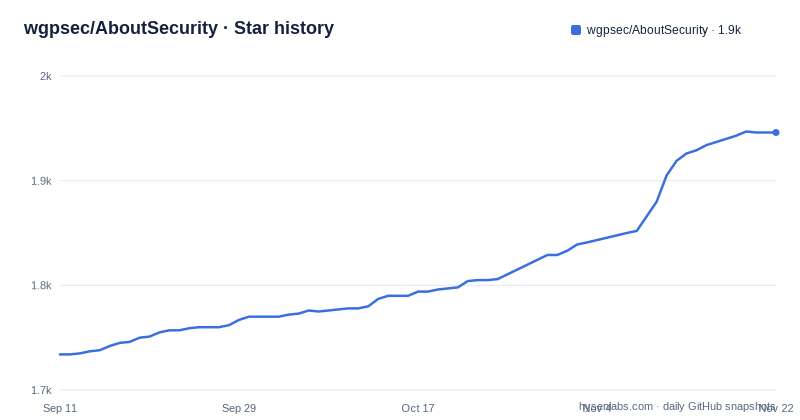
Star history
- wgpsec/AboutSecurity1,946 ★ · +212
| Repository | 2026-09-11 | 2026-11-22 |
|---|---|---|
| wgpsec/AboutSecurity | 1.7k | 1.9k |
212 Stars in the last 72 days, measured from the daily GitHub snapshot. Compare with other projects
Editorial analysis
Skills and Vuln are two different layers, and the repository says which is which
The one distinction the project insists on is between the two halves of the tree, and it puts it in a single sentence: skills tell you what to do after you are in, while the vulnerability entries tell you how to get in. The post-exploitation skills cover the layer that runs once access exists, so operating system level escalation, credential handling, persistence and product specific tactics. The vulnerability tree is data rather than methodology, one entry per affected product carrying the affected versions and proof of concept material for that specific issue. That separation is the most useful design decision in the repository, because it lets a reader take the methodology half without inheriting a catalogue of product specific exploitation notes, and it is why the two directories have different internal shapes rather than being one merged index.
Four stores, two naming conventions and one optional index
The knowledge base is four top level stores with different conventions. The skill tree is nested by category, so a methodology file sits several directories deep under a family such as web methodology, lateral movement or digital forensics, and the families are the ones a practitioner would name first: recon, cloud, code audit, competitions, evasion, hardware, malware analysis, mobile and so on. The dictionary and payload trees use lowercase hyphen-separated directory names, and every directory in both carries a metadata file, which is what makes them machine readable rather than just a pile of text files. The vulnerability tree is organised by product family instead, with categories for AI products, cloud platforms, middleware, network devices and web applications. Only the dictionary and payload trees carry that per-directory metadata convention; the skill tree is organized for a human browsing by category, and that difference is what the sync step has to reconcile.
The agent integration is a symlink farm, not a copy
Getting the methodologies in front of an agent is one script.
git clone https://github.com/wgpsec/AboutSecurity.git
cd AboutSecurity
./scripts/sync-claude-skills.sh --target /path/to/your-project
The script does not copy files, it creates symbolic links. The reason is a layout constraint on the consuming side: an agent coding tool recognises skills only in a flat structure, one directory per skill directly under a known root, while this repository groups them in nested categories for human browsing. The script bridges the two by creating the flat links. Two details are worth noting. Omitting the target argument syncs into the repository itself, which is why a Claude configuration directory is committed at the top level, so the skills are available for work inside the knowledge base rather than only inside a consuming project. And the instruction is to re-run the script after adding or removing skills, which means the link set is a snapshot that has to be refreshed by hand.
Dictionaries and payloads are read in place and never synced
The other two stores take a different route entirely. They are not synced anywhere and not linked, because the guidance is that an agent reads them straight out of the clone using ordinary file tools as long as it is given the repository path. That is a materially different trust property from the skill layer. A skill is a methodology document that shapes what the agent decides to do, and it is installed into the project where the agent works. A dictionary or payload file is inert text that the agent may or may not open, and it stays in the original clone. The dictionary tree is split into generic collections, network data, per service collections covering nineteen service types, and web material; one subdirectory holds default credential material for vendor appliances and office systems, which is the sort of list that belongs in a lab with written authorization rather than anywhere else. Nothing in the repository automates their use, which is the correct posture for that content.
Depth sits in middleware, breadth sits everywhere else
The distribution of effort across the vulnerability tree is lopsided in a way that tells you what the project is actually useful for. The middleware category carries 394 entries and names familiar names in it, so a reader looking for coverage of message brokers, configuration services, dashboards and build servers will find depth there. The other categories are much thinner and are listed by example instead: the AI category names four products, the cloud category names one managed gateway service, the web category names a panel, a blog engine and an enterprise framework, and the network category is described as routers and switches. The skill tree is broader than that, covering areas from hardware access to threat intelligence. Reading both together, the practical picture is a project with strong per product middleware coverage, a long methodology library, and a thin cloud surface, which is worth knowing before you plan an assessment around it.
A second repository turns the file tree into a query endpoint
For anyone who does not want to sync skills into a coding tool, there is an optional service in a companion repository.
git clone https://github.com/wgpsec/context1337.git
cd context1337
make run
That single make target clones the data, builds an index and starts a server, and the project describes the result as the same idea as an existing documentation indexing service but pointed at security material. Registering it takes one more command, which adds it as a named service over HTTP transport on the local port 1337, after which the material is reachable by natural language requests through several agent tools. The tradeoff is visible in that command. A file tree consulted locally is inspectable and diffable, while an indexed service answers from a build that can be rebuilt and reindexed underneath you, so for work you need to defend in a report you would rather read the source files than trust the index.
Three releases in January 2021, commits five years later, no license
The release history is short and entirely from one week in early 2021: a 1.0.1 on the ninth, a 1.0.2 on the nineteenth, and a version two on the twenty first whose release title is a Chinese phrase describing a tool migration rather than a version bump in the usual sense. Since then the project has kept changing, with the last recorded commit on the master branch dated 2026-09-18, so the tags say almost nothing about what is in the tree now. The repository also declares no license, and there is no license file among the top level entries, which matters more here than for an ordinary library because the contents are meant to be copied into other people's working directories by the sync script. The documentation is bilingual, with a Chinese and an English readme at the top level, and the descriptive counts live in that prose rather than being produced by a script, so they drift as categories are added.
Editorial conclusion
AboutSecurity is useful as a reference and as a way to get a consistent methodology in front of an agent during an engagement you are authorized to run, and it is not a scanner, a framework or anything that touches a host on its own. Three things to settle first. The counts are written in prose rather than generated from an index, so treat 200 plus skills and 600 plus entries as the author's own approximate figures and count the tree yourself before planning coverage. The repository declares no license, so check with the maintainers before redistributing it inside an organisation. And the skill layer is written to be picked up automatically from conversation context, which means the agent chooses the methodology for you, so on a real engagement you should read what it loaded before it acts.
Frequently asked questions
What format does AboutSecurity store its methodologies in?
Each methodology is a structured SKILL.md file inside a nested category directory, and the project defines a skill as a file that tells an agent what to do when it encounters a given situation. The categories group the files by discipline, from reconnaissance to lateral movement.
How does AboutSecurity plug into Claude Code?
Through a sync script run with a target path. The agent tool only recognises a flat layout of one skill directory per name under its own configuration root, while the repository nests skills by category, so the script creates symbolic links to bridge the two. It has to be re-run after skills are added or removed.
What is the difference between the post-exploitation skills and the Vuln entries?
The post-exploitation skills are the methodology layer, covering what to do once access exists, including escalation, persistence, credential handling and product specific tactics. The Vuln entries are the data layer, holding affected versions and proof of concept material for one product each.
Do the AboutSecurity dictionaries and payloads have to be synced?
No. They stay in the clone and are read in place with ordinary file tools as long as the agent is given the repository path. Each of those directories also carries a metadata file, which is what makes them machine readable.
Can AboutSecurity be queried without installing skills into a coding tool?
Yes, through a companion service that indexes the repository and serves it as a resource endpoint over HTTP on the local port 1337, started with a single make target. The project describes it as the documentation indexing idea applied to security material.
Official sources
Add this badge to your README
If you maintain this project, the badge below links readers to this analysis and shows its maintenance status from the daily GitHub snapshot. Paste the markdown into your README; add ?metric=license or ?metric=stars to the image URL for a different field.

[](https://hysenlabs.com/projects/wgpsec-aboutsecurity)Star history chart for your README
[](https://hysenlabs.com/projects/wgpsec-aboutsecurity)Was this useful?