QP-Gallery-Releases: a QuickPic mod published as binaries, not code
A modern, lightweight QuickPic Gallery with a fast, offline-first experience.
At a glance
- What is it?
- The repository holds Images/, a directory called OTA updater/, and a README. The gallery app itself exists only as files attached to releases, and the most recently published build carries the lowest version number of the three.
- Who is it for?
- WSTxda/QP-Gallery-Releases is best read as a distribution channel rather than a project that can be evaluated: the tree is three entries, the app arrives as a prebuilt binary, and the one number that decides whether it runs at all, 32-bit support, is left to the reader to check against a device list that does not exist. Someone who already trusts the maintainer and accepts that the code is unreadable can work from the releases page.
- Can I use it commercially?
- Not without permission. GitHub finds no licence file in the repository, and without a licence all rights are reserved by default: you may read the code but not reuse it. Check the README, or ask the authors, before using it.
- Is it still maintained?
- Yes. The repository last received commits 1 day ago.
- What is it written in?
- GitHub does not report a main language for this repository.
Answers come from the project's GitHub data, last synced on November 14, 2026, and from our analysis. They are not legal advice.
Star history
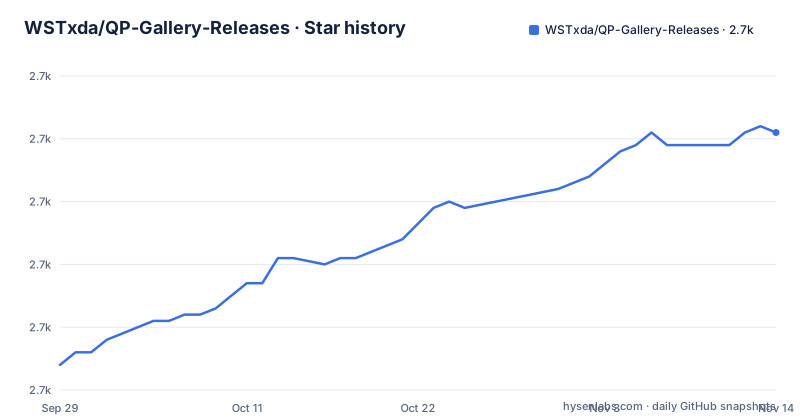
- WSTxda/QP-Gallery-Releases2,701 ★ · +37
| Repository | 2026-09-29 | 2026-11-14 |
|---|---|---|
| WSTxda/QP-Gallery-Releases | 2.7k | 2.7k |
37 Stars in the last 46 days, measured from the daily GitHub snapshot. Compare with other projects
Editorial analysis
Three entries at the root, none of them source
The repository root lists three items: Images/, a directory named OTA updater/, and README.md. There is no src directory, no build file, no manifest, no dependency list and no test suite. The default branch is master rather than main. That shape decides what kind of inspection is possible here. Nothing in the tree can be compiled, read for its logic, or diffed against an earlier version, because the gallery app is not in the tree; it exists only as files attached to release entries. A reader who wants to know what changed between two builds has nothing to compare them with. The one directory whose name suggests implementation is OTA updater/, since an over the air updater is the part of an Android app most likely to hold real code, and nothing about it appears anywhere in the written material.
The word Mod in the title has no counterpart in the tree
The heading of the README is QuickPic Gallery Mod, and its one description paragraph calls the project a modernized version of the classic QuickPic Gallery. Three concrete changes are named there: multiple bug fixes, improved compatibility with recent Android versions, and a refreshed Material 3 design, while keeping what the text calls the lightweight, fast, offline first experience of the original app. Those are the only changes the project puts forward, and none of them is attached to a commit, an issue thread, or a line of release notes. Each of the three published releases carries a tag, a display name and a date, and nothing beyond that. The problem is not that the listed changes are small. It is that no artifact in the repository ties a stated improvement to the build that is supposed to contain it.
9.7 was published after two 10.0 alphas
Three releases are visible. Tag 10.0, named 10.0 ALPHA 1, was published on 2025-05-22. Tag 10.0.2, named 10.0 ALPHA 2, followed on 2025-07-20. Then tag 9.7, named 9.7, was published on 2025-12-21, about five months after the alphas and carrying a lower number than either of them. The tag and the display name also disagree in the middle release, where a patch level tag of 10.0.2 carries the name of an alpha. Because the numbering restarted instead of continuing, version order and publication order are two different things here. Both download links point at the releases page rather than a pinned tag, so which build a reader ends up with depends on which release that page treats as most recent, and the most recent publication on record is the 9.7 build rather than any 10.x artifact.
The only device requirement is handed to the reader as a warning
The single hard technical requirement in the project is written as a warning callout: 32-bit architecture support required, check if your device is supported before proceeding to download. It is the only sentence in the whole file about device compatibility, and it sits between the description and the download heading, which makes it the last thing read before someone acts on the page. The requirement is phrased as a filter the reader has to apply themselves. No per architecture file list is published at the root, no minimum Android version is named, and no build matrix appears anywhere, so the check the warning asks for cannot be carried out from this repository. The badges above the description point at android.com and at the Android platform release notes, which is where a reader would go looking for supported versions, and the compatibility claim in the text is not tied to a stated version range.
The screenshot block opens onto nothing and the badges carry no image
Four link only badges sit on the first line of the README, pointing at android.com, at the Android platform release page, at the latest release and at the releases index. None of them has an image behind it and none of them carries text, so nothing on that line states a version, a build date or a file size. Below the description there is a collapsed Screenshots section that opens onto an empty line, while Images/ at the repository root is where screenshots would live if any were published. A reader looking for what the interface looks like is left with a directory name and an empty disclosure widget. For anyone assessing the project from its own files this matters in a small but concrete way: the two things a release page normally shows, what the app looks like and which build is current, are both missing from the README.
Distribution and updates both run outside the repository files
Under Download there are two links, one to the latest release and one to a Telegram channel. Under Donate there are two more, a PayPal donations link carrying a USD currency code and a business address in its query string, and a Buy Me a Coffee page. The project has no storefront of its own and no written description of how an installed copy updates itself. The OTA updater/ directory at the root is the only trace of an update mechanism, and no file inside it appears in the repository listing, so its contents cannot be inspected from here. An app that reads a device photo library and then accepts new code over the network is a real trust decision, and the artifacts that would let a reader judge it, a source tree, a stated update server, a signed manifest, are all missing.
No license, no upstream version, no named maintainer
The repository carries no license. There is no LICENSE file at the root, no license is recorded for the project, and the README does not name one either. It also does not name the upstream project the work was modernized from, or a version of the original app, so there is no baseline to compare against and no written description of the relationship between the two. The public counters are 2669 stars, 76 forks and 42 open issues, the repository is not archived, and the last commit on the default branch is dated 2026-08-30. For a project whose entire deliverable is a compiled binary that reimplements an application made by someone else, those gaps are the real story. A reader can see that builds are being published, and cannot see who publishes them, on what terms, or from what.
Editorial conclusion
WSTxda/QP-Gallery-Releases is best read as a distribution channel rather than a project that can be evaluated: the tree is three entries, the app arrives as a prebuilt binary, and the one number that decides whether it runs at all, 32-bit support, is left to the reader to check against a device list that does not exist. Someone who already trusts the maintainer and accepts that the code is unreadable can work from the releases page. Someone deciding whether to put an unfamiliar binary next to a photo library has three things to look for first, and none of them is in the repository: published source, a stated license, and a documented update path. The last commit on master is dated 2026-08-30, and that date is the only maintenance evidence on offer.
Frequently asked questions
Does QP-Gallery-Releases publish the source code of the gallery app?
No. The root of the repository holds Images/, a directory called OTA updater/ and README.md. There is no source tree, no build file and no dependency manifest, so the app can only be taken as a prebuilt binary attached to a release.
Which build does the QP-Gallery-Releases download link lead to?
Both download links point at the releases page rather than a pinned tag. The most recently published of the three releases is tag 9.7 from 2025-12-21, which is lower than the 10.0 alphas published in May and July 2025.
What does QP-Gallery-Releases require of an Android device?
One thing, stated as a warning: 32-bit architecture support required, with the reader told to check their device before downloading. No minimum Android version and no per architecture file list are published, so that check cannot be done from the repository.
Can the contents of a QP-Gallery-Releases build be verified from the repository?
Not from this repository. It has no build recipe, no source tree, no LICENSE file at the root and no checksum, so the three entries the repository lists are all a reader has to go on. The last commit on master is dated 2026-08-30.
Does QP-Gallery-Releases publish benchmarks or performance figures?
No numbers appear anywhere. There are no speed or size measurements in the README or the release entries, which carry only a tag, a display name and a date. The claims on offer are speed, stability, simplicity and a Material 3 refresh, none of them measured.
Official sources
Add this badge to your README
If you maintain this project, the badge below links readers to this analysis and shows its maintenance status from the daily GitHub snapshot. Paste the markdown into your README; add ?metric=license or ?metric=stars to the image URL for a different field.

[](https://hysenlabs.com/projects/wstxda-qp-gallery-releases)Star history chart for your README
[](https://hysenlabs.com/projects/wstxda-qp-gallery-releases)Was this useful?