x2rr/funds: the browser badge for Chinese mutual funds, and the two version numbers that disagree
Fund Watchlist Assistant is a Chrome extension for quickly fetching real-time data on funds you follow and viewing their real-time valuation.
At a glance
- What is it?
- A Vue 2 and Webpack 4 Chrome extension that paints estimated fund gains onto the browser tab, syncs a watchlist through an account, and ships a package.json that still says 2.5.2 while the newest tag is v3.4.4. The arithmetic on screen is an estimate until the fund publishes its real net value.
- Who is it for?
- Use it if a browser badge is the surface you want and you can accept that the number moves all day on an estimate that the extension itself has repeatedly had to fix. Do not treat its arithmetic as settled: the changelog from v1.5.3 onward is a list of estimation corrections, so a figure that looks authoritative on the tab is still provisional until the checkmark appears.
- Can I use it commercially?
- Yes, with conditions. GPL-3.0 is a copyleft licence: if you distribute software that includes it, you must release that software's source code under the same licence. Running it internally without distributing it does not trigger that obligation.
- Is it still maintained?
- Yes. The repository last received commits 123 days ago.
- What is it written in?
- Mainly Vue, according to GitHub's language statistics.
Answers come from the project's GitHub data, last synced on November 22, 2026, and from our analysis. They are not legal advice.
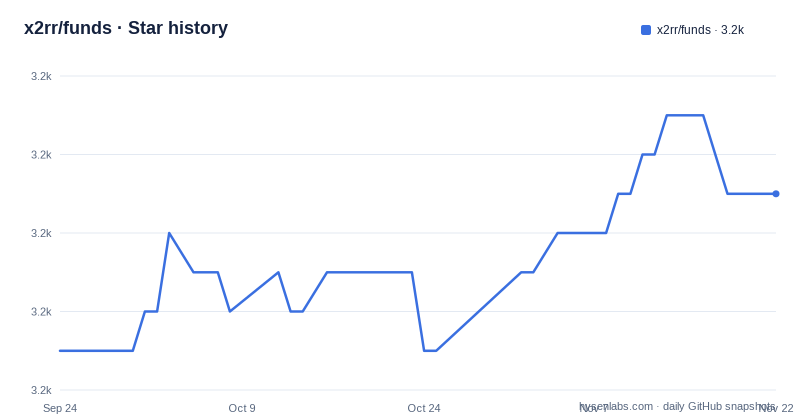
Star history
- x2rr/funds3,229 ★ · +4
| Repository | 2026-09-24 | 2026-11-22 |
|---|---|---|
| x2rr/funds | 3.2k | 3.2k |
4 Stars in the last 59 days, measured from the daily GitHub snapshot. Compare with other projects
Editorial analysis
package.json declares 2.5.2 while the newest tag is v3.4.4
The version in the repository is not the version in the store. package.json on the default master branch carries version 2.5.2 and the name choose-funds, while the release list runs v3.4.4 from 2026-07-21, v3.4.3 from 2026-04-22 and v3.4.2 from 2026-04-21. The package name is also a leftover: the changelog entry for v1.5.5 is a one line note about changing the name, so choose-funds predates the extension people actually install as a fund tracker. Nothing in the repository states where the version number is bumped, only that the packaged artifact named in the zip rule reads it from another file. For anyone building from source, the practical effect is that a local build and a store build are labelled differently, and a bug report quoting a version number can be quoting the manifest rather than the tag. The declared license is GPL-3.0 in package.json and a LICENSE file sits at the root, which is one of the few places where the metadata and the tree agree without qualification.
The zip name comes from the manifest, the engine floor is Node 10
Packaging reads two files that do not have to agree. The build recipe is a single node script, and the description of it in the repository says the archive is named from the name and version fields of manifest.json, formatted as name, a v, then version, ending in .zip. So the artifact name follows the extension manifest while package.json holds the 2.5.2 mentioned above. The script itself is not in the tree listing, only the scripts directory that holds it, and it depends on archiver, which sits in devDependencies along with copy-webpack-plugin, ejs and webpack-extension-reloader. The build recipes themselves are four npm scripts:
"build": "cross-env NODE_ENV=production webpack --hide-modules",
"build:dev": "cross-env NODE_ENV=development webpack --hide-modules",
"build-zip": "node scripts/build-zip.js",
"watch:dev": "cross-env HMR=true npm run build:dev -- --watch"
The published procedure behind them is four commands: install with npm i, run npm run watch:dev for a debug build that produces a dist folder the browser then loads as an unpacked extension, then npm run build followed by npm run build-zip for a packaged release. The declared engine floor is Node 10 or newer, and the dependency set belongs to that era rather than to today: vue sits on the 2.6 line, webpack on 4, node-sass on 4.9, sass-loader on 7, cross-env on 5 and axios on 0.19. Anyone trying to install this on a current Node will spend their first afternoon on native sass bindings before reaching a single line of extension code. There is no test script and no lint script either; the only other entries in the scripts block are prettier and its write variant.
The badge number is an estimate until a checkmark replaces it
What the tab badge shows is a running estimate, not a settled price. The changelog entry for v2.0.0 says the fund interface was adjusted to carry the actual net value for the day, and that a fund which has been updated gets a checkmark. Everything after that is a list of corrections to that arithmetic: v3.3.7 and v3.3.4 adjust how the estimate and the daily gain are computed, v3.4.1 adjusts the gain calculation again, v3.0.3 adjusts it for the manual add position feature, and v3.4.4, the newest release, says only that the estimation problem was improved. The bug entries are more telling than the feature entries: v2.0.4 fixed a NAN appearing in the badge, v2.0.5 fixed wrong estimated gains for some funds, v2.0.6 and v2.0.9 fixed badge colour problems including one triggered when an amount reached into the k range, and v3.3.3 fixed wrong badge values after the market closed. A reader should treat any figure on the tab as provisional and the checkmark as the moment the number stopped being one.
Shares or amount, and a holding amount measured on the previous settlement day
Two input fields, one meaning. The v3.0.0 entry says the edit form accepts shares or amount as a choose-one pair, and v1.5.0 introduced the earnings estimate behind a setting that has to be switched on. The v1.5.3 entry defines the arithmetic precisely: the holding amount is the value from the previous settlement day, while the estimated gain is the gain estimated for the current moment. That single sentence explains why the badge can disagree with a number typed into another tool. The main feature list adds the cost basis field for holding gain, and the manual add and reduce position controls from v3.0.0 change the cost basis by hand, which v3.0.2 then had to fix for a decimal point anomaly and v3.4.1 revisited in the gain calculation. The badge itself is configurable per fund or across all of them, switchable between gain amount and gain rate, and v3.3.3 extended it to cover every group at once.
Login is version gated and the sync host is named in the changelog
The watchlist follows the account, and that path has moved twice. The v3.0.0 entry is the one that introduced account login for cross platform sync, and it adds the corresponding host permission for bspapp.com, an Aliyun domain, which tells you the account service is not hosted by the author. The v3.4.0 entry says the account service request address was adjusted and that old versions will in future be unable to log in, with a request to update. That is a version gate enforced from the server side, so a local build pinned to an old manifest can stop syncing without anything changing in the extension. The same entries show the pressure the sync path puts on the data: v3.4.2 fixed a failure to sync from the mini program when fund data was large, and v3.4.3 fixed data loss after an update. Permissions were also trimmed in v3.3.3, so the manifest that ships today is not the one that shipped with account support.
Three struck through lines and two identical download links
The install section carries history in plain sight. The Firefox store link is struck through and annotated as withdrawn, while a second struck line promotes an older mini program name and the line above it, unstruck, promotes the current one, so the extension README now advertises a mini program twice with one of the two names crossed out. Both download addresses labelled as separate mirrors resolve to the same GitHub releases page, which matters because that page is also where a manual CRX install comes from, and a manually installed CRX does not update itself. The Chrome store route is described as the one that gives automatic updates, and the Edge listing is given as a second store. The author also states the cost of the store route in the introduction, five dollars to publish the listing. Nothing in the tree names the fund data endpoint the badge reads; the changelog only records that the fund interface was adjusted in v2.0.0.
A holiday file at the root drives the closed market state
Whether the numbers are live is decided by a data file in the repository root. The main feature list credits automatic holiday detection and switching to a market closed state, and holiday.json is the file that carries it. The changelog shows this being maintained by hand over time: v1.3.1 added a simple closed state so the badge stops updating when the market is shut, v1.5.0 improved the holiday information and added a settings control to refresh it, and v2.0.8 changed the holiday information link. The consequences show up in the badge bugs rather than in the calendar: v1.4.2 fixed badge colour while the market was closed, and v3.3.3 fixed wrong badge values after a close. Trading in this market happens on weekdays, which the introduction gives as the reason a desktop extension was wanted in the first place, and a badge is the surface that lets the numbers sit in view without a window.
Editorial conclusion
Use it if a browser badge is the surface you want and you can accept that the number moves all day on an estimate that the extension itself has repeatedly had to fix. Do not treat its arithmetic as settled: the changelog from v1.5.3 onward is a list of estimation corrections, so a figure that looks authoritative on the tab is still provisional until the checkmark appears. Before you switch to it from another tool, note three things. The last push to the master branch was 2026-07-22 and v3.4.4 shipped the day before, so builds from source and store builds can carry different version numbers. Login depends on a server address that v3.4.0 changed and told older clients to update away from, which means an old local build can simply stop syncing. And the sync path leaves your watchlist on someone else's host, while a privacy page and an import and export path exist for people who would rather not: the Excel and text export is the escape hatch to use before you sign in.
Frequently asked questions
Where does the x2rr/funds extension get its fund numbers?
The repository does not name a data endpoint. The changelog for v2.0.0 records that the fund interface was adjusted to carry the actual net value for the day, and every later entry adjusts the estimate or corrects a wrong value rather than pointing at a provider.
How is the x2rr/funds extension updated?
The Chrome Web Store route is described as the one that provides automatic updates. The alternative is downloading a CRX from the GitHub releases page and loading it by hand, which the repository notes cannot update to the newest version automatically. v3.4.4 shipped on 2026-07-21.
Can x2rr/funds run without an account?
Yes. Fund configuration supports import and export, and the changelog records Excel import and export added in v2.5.0 and fixed in v2.5.1, plus text import and export added in v2.4.2. Account login arrived later, in v3.0.0, for syncing the watchlist across platforms.
Why does the x2rr/funds badge change colour and value on its own?
The badge carries the estimated gain, which is recalculated rather than fixed. The changelog lists corrections to badge colour in v2.0.6 and v2.0.9, a NAN case in v2.0.4, and wrong values after the market closed in v3.3.3. A checkmark marks a fund whose actual net value has been published.
Official sources
Add this badge to your README
If you maintain this project, the badge below links readers to this analysis and shows its maintenance status from the daily GitHub snapshot. Paste the markdown into your README; add ?metric=license or ?metric=stars to the image URL for a different field.

[](https://hysenlabs.com/projects/x2rr-funds)Star history chart for your README
[](https://hysenlabs.com/projects/x2rr-funds)Was this useful?