ClipForge puts a confirmation screen in front of every paid model call, and refuses the usual ffmpeg build
ClipForge (formerly "daihuo-jianshou"): an open-source AI tool for e-commerce short videos. Upload one product photo and it extracts selling points, writes a promotional script, keeps the product image undistorted, and adds visuals/voiceover/subtitles to generate ready-to-post short videos for Douyin Shop, Kuaishou, Xiaohongshu and TikTok Shop. Zero-cost batch generation, open-source with no watermark, self-hostable, and can also generate a video from a single topic prompt.
At a glance
- What is it?
- ClipForge is a Chinese-first, AGPL-3.0 video generator for e-commerce sellers that runs as a Next server, an Electron desktop app, an MCP server and a CLI over one SQLite file. The instructive code is not the model calls: it is the gates in front of them, the judges that can throw away their own rewrites, and a Dockerfile that rejects the usual static ffmpeg build for a documented reason.
- Who is it for?
- A seller who already publishes on short video platforms will get real value from the paid track, because the confirmation gates, the rule that candidates and masters are never overwritten, and the server-side batch resume all survive volume. Anyone who needs a turnkey English toolchain should read the file layout first: the primary README is Chinese, the English files sit next to it, and the feature list on the landing page stops inside its first bullet.
- Can I use it commercially?
- Yes, with strict conditions. AGPL-3.0 is a network copyleft licence: if people use a modified version over a network, for example as a hosted service, you must offer them its source code under the same licence.
- Is it still maintained?
- Yes. The repository last received commits 2 days ago.
- What is it written in?
- Mainly TypeScript, according to GitHub's language statistics.
Answers come from the project's GitHub data, last synced on November 22, 2026, and from our analysis. They are not legal advice.
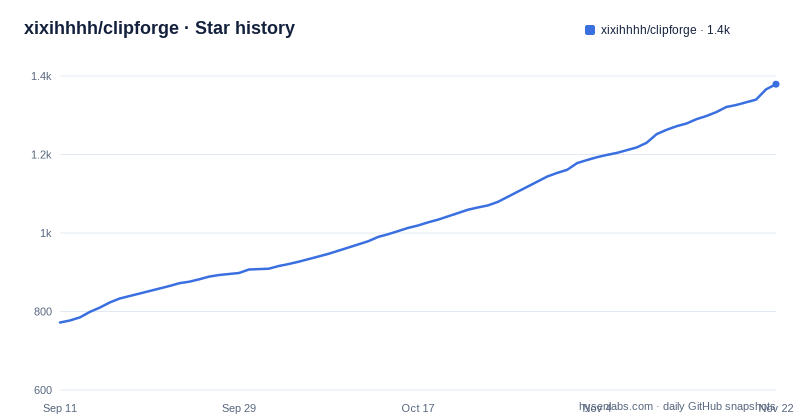
Star history
- xixihhhh/clipforge1,379 ★ · +607
| Repository | 2026-09-11 | 2026-11-22 |
|---|---|---|
| xixihhhh/clipforge | 772 | 1.4k |
607 Stars in the last 72 days, measured from the daily GitHub snapshot. Compare with other projects
Editorial analysis
Two output tracks, and a price tag on only one of them
Creation asks two questions: how the video gets made, and how the selling angle is framed. The first has two answers with different price tags. The free track is labelled zero cost and about two minutes, and it runs fully automatic from start to finished cut, using free footage, free voice and local composition. The AI track is billed per second, and the price is printed on the option itself. Money moves at exactly one point. The free script is treated as a text plan: you read the voiceover copy, then a single click on the AI generation button runs the 3x3 storyboard lock step and then the one-click whole film. Bring your own key means the fee goes to whichever model platform you picked, while the tool charges nothing itself. The no-watermark claim is paired with self hosting and an AGPL licence, so a shop unwilling to hand product images to a third-party service has a documented path to run the pipeline on its own machine. A second mode takes a single sentence as the topic and makes a film about something other than a product.
Every route that spends money ends at a confirmation screen
The payment gates are the actual architecture, and they are scattered across five feature entries. The shot quality gate keeps every candidate version of every shot, scores each one on image, timing, script adherence, character and product, action, continuity and on-screen text, and only a candidate a person adopts enters the real composition. Regeneration or a model switch produces advice, never an automatic charge. Precise shot repair opens a local window at the failing timestamp, lets you append character, product or composition anchors, and shows the interval, the model duration, the price and any degradation before you confirm; only the broken segment is regenerated and stitched back locally with its original audio, and the original candidate is kept. The continuity pass defaults to analysis with no model call at all: it samples both sides of each real splice point and reports brightness, colour and saturation jumps with a timestamp, a score and evidence, plus whole-film EBU R128 loudness. De-flicker is never switched on by the machine. The production console is candid in one line, showing a price range when a model price is unknown rather than inventing a precise number.
The container refuses the bundled ffmpeg, and the comments say why
The Dockerfile is the most useful file in the repository because its comments record a failure that cost real time. The linux static binary from ffmpeg-static, a FFmpeg 7.x build by johnvansickle, ships without harfbuzz, so the drawtext filter does not exist at all and every composition containing text dies with a missing filter error. Burned subtitles, price stickers, covers, text-image cards and end cards all depend on that one filter, so the image installs the Debian ffmpeg package instead, which carries harfbuzz, freetype and fontconfig and keeps drawtext, xfade, zoompan, subtitles, ass and loudnorm present. Two more decisions are spelled out: apt stays on http because bookworm-slim has no ca-certificates and apt verifies packages with GPG signatures, so switching to https breaks the build instead of securing it; and the Chinese font needs no system package, because public/fonts/subtitle.otf ships in the repository and the resolver prefers it. The builder installs python3, make and g++ because better-sqlite3 is a native module, and sets ELECTRON_SKIP_BINARY_DOWNLOAD since the container only runs the web side. The apt mirror is a build argument, defaulting to the official host and switchable to a regional mirror.
Self hosting is one published command, and the header comment states what you get before configuring anything: open the local port and the free track already produces a video, because it uses free materials plus Edge TTS and needs no key. The named volume keeps data outside the container.
docker run -d -p 3000:3000 -v clipforge-data:/data ghcr.io/xixihhhh/clipforge:latestThe runtime stage notes that the application falls back to whatever ffmpeg is on PATH when no explicit path is set, which is why the build argument exists at all, and the last visible line of the file asks the binary to print its own filter list so a broken image can be diagnosed from a shell instead of from a failed render.
An ffmpeg 8 change sits next to two local composition presets
The product link importer carries a fix note that explains a class of breakage precisely. When a free material source delivers a GIF, composition always failed, and from ffmpeg 8 onward the gif demuxer rejects the `-loop` option on image2 inputs; GIF now travels through an input chain with no loop at all. That matters because the pinned npm dependency is ffmpeg-static at 5.x, while the container installs a distribution package. A version 8 binary is therefore something a desktop install or a host with a newer ffmpeg on PATH can supply, not something the lockfile requests. Local composition has two named presets. Quick preview reuses the real 720p, veryfast, CRF26 profile and does not regenerate any AI material, which is what makes a preview free. The platform double compression look goes the other way, using 720p with CRF27 to imitate an upload a platform has already squeezed once. Loudness is measured as EBU R128 across the whole film, and both reminders are documented as comments and release titles rather than as a constraint the build enforces.
Four judges in the summary table, five in the details
The feature summary says four judges, one each for rhythm, spoken language, creativity and structure, review the script before anything is generated. The later entry adds a fifth, the picture judge, whose only question is who is doing what in this second; sentences such as show the product effect or build trust are rejected as not being pictures, named shot by shot and rewritten into visible actions. Two rules make this layer unusual. Every critique must quote the original fragment and say what does not hold, and an opinion without a citation is void. Every rewrite is then checked server-side token by token for numbers such as price and specification, and losing one number discards the whole sentence. Critiques and rewrites carry an adoption level: hard defect, should change, and taste. The five one-click chains apply the first two automatically and only display the third, so a stylistic rewrite never fires on its own. When no language model is configured, the panel skips silently and never blocks the chain. The default model moved to DeepSeek V4 Pro for a stated reason: the thinking text from the previous default polluted JSON output. The visible feature list ends inside its first bullet on this discipline pack.
Retention rules in the script prompt, and the fake comments left out
The hook library grew from ten entries to sixteen, six of them built around trust and social proof, and the notes attach a blunt observation to one of them: praising something without pause is the first signal viewers use to recognise an advertisement. The script prompt then injects timing rules that read like a media plan. The product has to be on screen within the first three seconds, which the text ties to a figure about high-click videos. Anything past twenty seconds needs a rescue hook at roughly the forty to sixty percent mark. The call to action lands twice, once mentioned early in a natural way and repeated in the last shot with a gesture. Urgency is tiered, the default is a soft personal feeling, and false hard selling is called out as a violation of advertising law, with the structure judge watching the middle of the film. Alongside that sits the publishing package: a pinned self question and answer, templates for common objections, and a deliberate refusal to plant fake comments, with a compliance note attached. Compliance defaults are on out of the box, covering AIGC labelling, a banned advertising word scan and a publish check. Link import fetches the product page with SSRF protection and drops the extracted fields into an editable form for human verification, with the category called out for checking.
Batch runs that survive a closed browser
The free one-click chain was moved out of the browser into persistent server-side execution, and the failure paths are the point. An interrupted chain offers two radio buttons, resume from the breakpoint as the default or start over, and completed stages are not repeated. Batch work persists per item and per stage, so returning to the page offers a continue option that skips finished items, reuses the original configuration and the anti-homogeneity scheduling, and adds an abort button. Every output links its project and film identifiers back to the batch, which is what makes a hundred variants findable a week later. The task centre spans projects, keeps discovering work while idle, holds the last state when a network call fails and offers retry, and keeps failure notices until a new round replaces them. One detail is defensive by design: the model catalogue resets the moment the service address or key changes, so a stale list or a late response cannot steer a selection. Local transcription runs in fixed memory chunks up to two hours, cancellable and resumable, deleting text deletes the picture, and old footage and old drafts are never overwritten. Export goes out as OTIO, EDL or CSV, and the local speech models come in Tiny, Base and Small sizes with word timestamps, measured error rate, runtime and memory use, with Small optional and a light model as the default.
One pipeline behind four entry points
The web app, the MCP server, the CLI and the packaged skill are described as sharing one production capability, and the manifest agrees. Three scripts map the entry points directly, the desktop shell is the package main entry, and the container skips the Electron binary precisely because it only serves the web half.
"mcp": "node mcp/clipforge-mcp.mjs",
"cli": "node bin/clipforge.mjs",
"electron": "electron ."
The stack is Next 16.2.1 with React 19.2.4, drizzle-orm 0.45.1 over better-sqlite3 12.11.1 with a migration directory and a config file at the root, zustand for state, and the transformer library pinned to an exact 4.2.0 for the local speech work. pnpm 10.33.0 is the package manager, with Node 20 and pnpm 10 as floors. The manifest marks the package private and declares AGPL-3.0-only, and a LICENSE and a NOTICE file sit at the root beside the Dockerfile. The tree also carries agent instructions, a plugin directory, a skills directory holding a standalone judge skill, a rendering directory, an end to end directory and a documents directory. The primary README is Chinese, with English equivalents listed beside it. Two commercial realities sit underneath all of it: the free materials, the voice clone library and the three releases shipped on the same September afternoon, minutes apart, which read as a team iterating on a render pipeline rather than publishing milestones.
Editorial conclusion
A seller who already publishes on short video platforms will get real value from the paid track, because the confirmation gates, the rule that candidates and masters are never overwritten, and the server-side batch resume all survive volume. Anyone who needs a turnkey English toolchain should read the file layout first: the primary README is Chinese, the English files sit next to it, and the feature list on the landing page stops inside its first bullet. Before wiring a paid model key into a self-hosted copy, check which ffmpeg the host actually resolves to, because the drawtext requirement and the ffmpeg 8 GIF change live in different builds than the one package.json pins.
Frequently asked questions
What is ClipForge?
ClipForge is an open source generator for e-commerce and user generated short video, formerly named daihuo-jianshou. It takes one product photo, writes a selling script, keeps the original product image from distorting, and adds footage, voiceover and subtitles for Douyin, Kuaishou, Xiaohongshu, WeChat Channels and TikTok Shop. It runs as a Next app, an Electron desktop app, an MCP server and a CLI.
Does ClipForge need a model API key before it can produce a video?
Not for the free track. The self-host note in the Dockerfile says that opening the local port already outputs a video with no key, because that track uses free materials plus Edge TTS. The AI track is bring your own key: the fee is charged by the model platform you chose, and ClipForge itself is free.
Why does the ClipForge container install ffmpeg instead of using the bundled static build?
The Dockerfile states that the linux static binary from ffmpeg-static, a FFmpeg 7.x build by johnvansickle, has no harfbuzz, so the drawtext filter does not exist and any composition with text fails. Burned subtitles, price stickers, covers and end cards all need drawtext, so the image installs the Debian ffmpeg package, which keeps the whole filter set the pipeline uses.
What licence and packaging metadata does ClipForge declare?
package.json sets version 0.9.10, marks the package private and declares the licence as AGPL-3.0-only, with pnpm 10.33.0 as the package manager and Node 20 or newer as the engine floor. LICENSE and NOTICE sit at the repository root next to the Dockerfile.
Official sources
Add this badge to your README
If you maintain this project, the badge below links readers to this analysis and shows its maintenance status from the daily GitHub snapshot. Paste the markdown into your README; add ?metric=license or ?metric=stars to the image URL for a different field.

[](https://hysenlabs.com/projects/xixihhhh-clipforge)Star history chart for your README
[](https://hysenlabs.com/projects/xixihhhh-clipforge)Was this useful?