bypass: examining its provider adapters and build instructions
Integrates reverse-engineered chat APIs from OpenAI, Coze, DeepSeek, Cursor, Windsurf, Qodo, Blackbox, You, Grok, Bing Image Creator and more AI tools, adapted to a standard OpenAI API-compatible server.
At a glance
- What is it?
- This project adapts reverse-engineered consumer AI chat endpoints into an OpenAI-compatible server, so the interesting content is in the plumbing rather than the API. The module, the container image, the systemd unit and the documentation all carry a different name from the repository. The build requires a toolchain wrapper on every invocation, and the documented build command is not one of the targets the Makefile defines.
- Who is it for?
- The repository describes an OpenAI-compatible adapter for several reverse-engineered services. Check provider terms, credentials and security implications before use.
- Can I use it commercially?
- Yes, with conditions. GPL-3.0 is a copyleft licence: if you distribute software that includes it, you must release that software's source code under the same licence. Running it internally without distributing it does not trigger that obligation.
- Is it still maintained?
- Yes. The repository last received commits 150 days ago.
- What is it written in?
- Mainly Go, according to GitHub's language statistics.
Answers come from the project's GitHub data, last synced on November 21, 2026, and from our analysis. They are not legal advice.
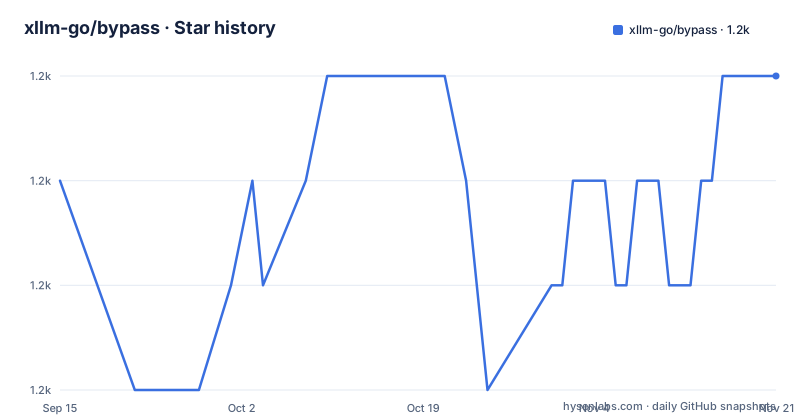
Star history
- xllm-go/bypass1,246 ★ · +1
| Repository | 2026-09-15 | 2026-11-21 |
|---|---|---|
| xllm-go/bypass | 1.2k | 1.2k |
1 Stars in the last 67 days, measured from the daily GitHub snapshot. Compare with other projects
Editorial analysis
The module, the image, the unit file and the docs all carry a different name
The repository is called bypass and its homepage points at one documentation site. Everything inside it disagrees. The Go module is declared without a domain path under the name of a different project. The container image the run command pulls is published under a third identity, in a registry namespace that is not this organisation. The systemd unit's description line names a fourth thing. The configuration link at the top of the page points at a documentation site hosted under a fifth identity, and the three research threads linked at the bottom live in a discussion board belonging to that same fifth identity. So there are six names in play: this repository, the module, the image namespace, the docs domain, the discussion board, and the project name they all describe. Anyone trying to verify this software's provenance has six places to check and no single one that is authoritative.
The documented build target has no recipe
The README suggests `make install`, `make build`, and then running a platform binary. The current Makefile declares `build` as phony but supplies no recipe or prerequisites, so it can succeed without creating a binary. It defines separate Linux amd64, Linux arm64, macOS amd64 and Windows amd64 build targets, and an `all` target that invokes all four after installation. Check the current Makefile and test the appropriate target on your own system.
Every build and every run has to pass through a toolchain wrapper
The unusual requirement is stated plainly: an intermediate tool is installed first, either by installing a command or through the install target, and then every subsequent build and run has an extra flag added to it. The original command is shown next to the modified one for both the build and the run case, so the difference is visible at a glance.
# ----- go build ------ #
# 原指令 #
go build ./main.go

# 附加指令 #
go build -toolexec iocgo ./main.go

# ----- go run ------ #
# 原指令 #
go run ./main.go

# 附加指令 #
go run -toolexec iocgo ./main.go
All four platform targets in the Makefile carry that same flag. What the wrapper is doing is not explained on the page, and the dependency list is where the answer lives: a software package manager for Go bytecode, a plugin module for it, and a runtime that executes compiled modules. Combined with the repository's own directory names, the picture is a server whose logic ships as something other than readable Go source, which is why a custom toolchain flag is mandatory rather than optional.
The install target wipes the whole build cache before it runs
The clean target runs the language's cache-clearing command, and the install target depends on clean. The aggregate target lists both `clean` and `install`, and `install` also depends on `clean`; Make normally runs the shared prerequisite once per invocation. Every reinstall therefore throws away cached compilation for the whole module and its dependencies, which on a cold cache means the dependency set is recompiled from scratch. Two smaller details in the same file are worth knowing. The output directories are separated per platform, and the Windows branch rewrites the environment-variable syntax for the platform by defining an extra variable that holds the command separator, since the recipe sets environment variables inline. The build flags themselves are consistent across all four targets: symbols stripped, paths trimmed, and the toolchain wrapper passed through.
The wire layer is the actual reverse-engineering, and it has its own directory
The repository splits its code into a core, a relay, and a wire directory, plus a deploy directory, and the wire layer is the interesting one. The dependency list makes the technique explicit without documenting it: a TLS client that impersonates other clients, a lower-level HTTP stack, and a transport-fingerprint library. On the research side the page links three threads by title, and the titles are the disclosure. One is on transport fingerprints, one is on a specific consumer assistant, and one is on two code editors, with the wire format named in parentheses as protocol buffers over compression. That is what adapting a private endpoint actually requires: reproducing the shape of the request on the wire, not calling a documented API. The page frames this as shallow personal experience notes, and points to the documentation site for configuration. It does not reproduce the method here, and neither should a reader expect it to.
The two deployment examples disagree about the port
The container run command publishes one port and mounts a single YAML configuration file from the host into the application path. The systemd example that follows configures a different port, and its working directory and executable are both placeholders rather than real paths, so it is a shape to fill in rather than something to paste. Between them they are the only two deployment instructions on the page, and there is no third option: no bare-metal service file, no reverse proxy example, and no note about what to do about the container publishing the port on all interfaces by default. The configuration file being a single mounted YAML is the one genuinely good property here. It means your provider credentials and adapter settings live in one file you can template, keep out of the image, and mount read-only.
The disclaimer includes a clause requiring deletion within 24 hours
The closing block of the page is unusually long and worth reading as a document rather than skipping. It states that the code and any unlocking or decryption analysis scripts inside it are for testing and learning only, that commercial use is forbidden, and that the author cannot guarantee the legality, accuracy, completeness or effectiveness of any of it. It also restricts republication by media accounts. Then there is the clause that does not belong in a software licence at all: users are told they must completely delete the contents from their computer or phone within 24 hours of downloading. That is boilerplate from a different genre, and it sits in the same list as a takedown clause promising deletion of scripts on verified claims and a clause about indirect users who set up a server. The one durable takeaway is the first line. A library that tells you it cannot guarantee legality is telling you to check the terms yourself.
Editorial conclusion
The repository describes an OpenAI-compatible adapter for several reverse-engineered services. Check provider terms, credentials and security implications before use. Its README's `make build` target is declared phony but has no recipe in the current Makefile, so it does not itself produce the server; inspect and test the platform-specific target and toolchain on the intended environment. The repository includes GPL-3.0 text alongside README restrictions that require careful review.
Frequently asked questions
What does the bypass project actually adapt?
It exposes reverse-engineered chat endpoints from consumer AI services, including Coze, a search assistant, two code editors, another coding assistant, DeepSeek, a model arena, You.com, Grok and a Hugging Face image model, behind an OpenAI-compatible server interface with streaming and multi-turn support.
Why does building bypass need an extra compiler flag?
An intermediate toolchain wrapper is installed first, and every build and run command then passes it through a toolexec flag. All four platform targets in the Makefile carry the same flag, so a plain build without it does not produce a working binary.
How do I configure the bypass server?
With a single YAML file mounted into the container at the application config path, alongside publishing one container port. The systemd example on the page uses a different port number and placeholder paths, and is presented as a shape to fill in rather than a command to run.
Is bypass licensed for commercial use?
The page's own statement says the code and its analysis scripts are for testing and learning only, that commercial use is forbidden, and that the author cannot guarantee the legality, accuracy, completeness or effectiveness of the project. That is the author's disclaimer, not a licence grant.
What language is the bypass README written in?
Chinese. The repository has no English version of it; the tree holds one README file alongside the licence, the build files, the module files and the code directories, and the configuration documentation is hosted as a separate site.
Official sources
Add this badge to your README
If you maintain this project, the badge below links readers to this analysis and shows its maintenance status from the daily GitHub snapshot. Paste the markdown into your README; add ?metric=license or ?metric=stars to the image URL for a different field.

[](https://hysenlabs.com/projects/xllm-go-bypass)Star history chart for your README
[](https://hysenlabs.com/projects/xllm-go-bypass)Was this useful?