Mega-ASR: three sample counts, and the demo videos expired
First foundation ASR built for the real world - 7 atomic acoustic conditions, 54 compound scenarios, 2.6M samples, and up to ~30% gains over SOTA where every other model falls apart. **You'll come back to MEGA-ASR, after the rest fail in the wild. ⭐**
At a glance
- What is it?
- Mega-ASR is a research speech-recognition model trained on seven simulated acoustic conditions, with weights, dataset and benchmark all published by the same author. The repository blurb, the README and the dataset name give three different counts for one corpus, the comparison is two hand-picked samples, and the embedded demo videos point at a signed URL that expired in May 2026.
- Who is it for?
- Mega-ASR suits a speech researcher who wants a model and a corpus built around the failure modes that break general-purpose recognisers, and who will run the evaluation themselves on the released benchmark. It does not suit someone who needs a settled accuracy number, because the headline figure is a best case with no aggregate table in the document and the corpus size is stated three ways.
- Can I use it commercially?
- The repository metadata does not identify a licence. Check the project’s published terms and any component-specific licences before reuse.
- Is it still maintained?
- Yes. The repository last received commits 85 days ago.
- What is it written in?
- Mainly Python, according to GitHub's language statistics.
Answers come from the project's GitHub data, last synced on November 25, 2026, and from our analysis. They are not legal advice.
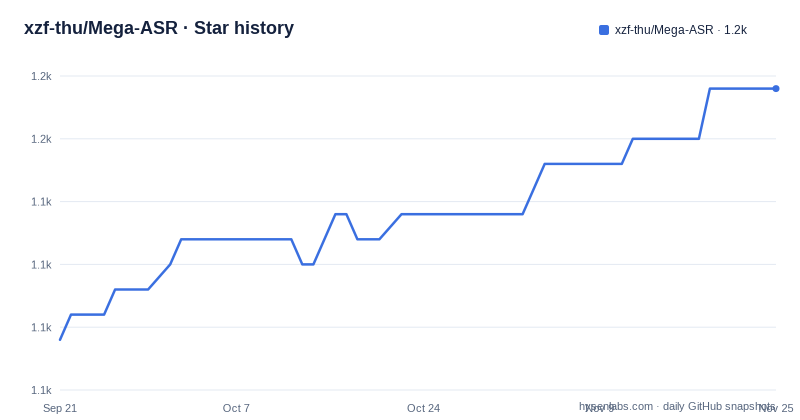
Star history
- xzf-thu/Mega-ASR1,152 ★ · +10
| Repository | 2026-09-21 | 2026-11-25 |
|---|---|---|
| xzf-thu/Mega-ASR | 1.1k | 1.2k |
10 Stars in the last 65 days, measured from the daily GitHub snapshot. Compare with other projects
Editorial analysis
One corpus, three counts
The number of training samples appears three times in three places and no two agree. The repository description says 2.6M samples. The README's own abstract paragraph says it is built on 2.4M training samples. The dataset it links to is named for 2M. So a reader trying to size the corpus has a 30 percent spread between the largest and smallest figure and nothing in the document reconciles them. The difference could be raw versus filtered versus what the final training run consumed, and any of those would be a reasonable explanation. None of them is stated. For a project whose argument is that it scales real-world acoustic simulation, the scale is the headline number, and it is the number the document is least precise about.
The comparison is two samples, and the winner scores 47.1 on one
The comparison section shows a table per sample against four named systems, and there is no aggregate table anywhere in the visible text. No test-set name, no split, no decoding configuration, no evaluation protocol. Sample one gives Mega-ASR a word error rate of 47.1, which is close to half the words wrong, against 100.0 for one competitor that returned nothing at all, 86.1, 85.3 and 92.5 for the rest. Sample two is far friendlier, at 5.9 against 64.7, 64.7 and 38.2. So the favourable reading is that the model wins both, and the careful reading is that the first sample is one where every system fails badly and the win is relative collapse rather than competence.
Weights, data and benchmark all come from one author
Four links sit in the header row and three of the four artefacts behind the result are published by the same person. The model weights, the training corpus and the benchmark repository are all under one account, and the technical report is a single-author preprint. The comparison table then places that model against three third-party systems and one large general recogniser on samples drawn from that benchmark. Nothing about this is improper, and a self-authored benchmark is a normal and often necessary thing to publish alongside a new dataset. It does mean the headline accuracy figure is measured on data whose distribution the authors also chose, and a reader who wants an independent number has to go looking for one. The document does not present it as independent, and it does not present it as self-authored either.
Two method acronyms, neither of them expanded
The abstract paragraph names the training method as two things: a supervised fine-tuning stage and a reinforcement learning stage built on a named algorithm. Neither abbreviation is expanded anywhere in the visible text, and no section describes what either does, what data it uses, or how the two stages are ordered. The seven atomic acoustic conditions are, by contrast, listed in full, and so are the phenomena they cover, which run from noise and far-field speech through obstruction, echo and reverberation, recording artifacts, electronic distortion and transmission dropout. The examples directory matches that list one for one, with a separate audio file per condition and one additional file for a combined case. So the conditions are unusually well documented and the training procedure is not documented at all.
The largest dependency is unpinned, and it belongs to a competitor
The requirements file pins the compute stack exactly, with three mutually consistent exact versions for the tensor library and its two companions. One evaluation library is also pinned exactly. Everything else floats, and the most consequential of the floating entries is the first line of the file: an automatic speech recognition package, unpinned, from a different lab. The benchmark table then lists that lab's system as one of the four baselines the model is measured against. So the model under evaluation depends on a competitor's package at an unspecified version, and the comparison against that same competitor is run at whatever version the resolver happened to pick. The evaluation libraries in the same file, a text normaliser and an edit-distance package, are also unpinned and both feed the metric being reported.
No licence field, and no licence file
The repository declares no licence, and there is no licence file at the root. What is there is a readme, a gitignore, an assets directory, a docs directory, an examples directory, three inference scripts and a web interface script, plus source and scripts directories and a requirements file. There is no package metadata of any kind: no project file, no setup script, no declared entry point, no supported Python version. So the repository is a checkout you run rather than something you install, and the question of what terms apply to the code is unanswered in the place a reader would look. That matters more than usual here, because the artefacts people actually want are the weights and the corpus, which live in three other places under three other names.
The demo videos are signed links with a five-minute life
Each sample embeds its audio as a video element whose source is a GitHub asset URL carrying a long signed query string. The signature is a JSON web token, and its payload contains a not-before and an expiry five minutes apart, with the query also carrying a five-minute window parameter. That is the correct construction for a private asset: the link is deliberately short-lived. The consequence here is that the comparison media in the readme could never have been durable, and in fact is not. The token in this document expired in May 2026, months before now, so the six sample videos do not resolve. The numbers in the tables are still there, but the audio a reader would use to judge whether the word error rates are fair is gone.
The web interface records from your microphone
Three inference scripts sit at the root and one of them is a web interface, with the remaining requirements including a Streamlit component whose purpose is recording audio from a browser microphone. So the fastest way to try the model is to stream your own voice into it, and the two documented sample files are the conditions rather than speech, one per acoustic phenomenon plus a combined case. An experiment tracker and a dataset library are in the same list, which tells you the code expects to log runs and touch data rather than run a single file. None of that is unusual for a research repository. It is worth naming because a speech model with a browser microphone capture is a different privacy shape from a speech model you feed a file, and the document does not distinguish the two.
Editorial conclusion
Mega-ASR suits a speech researcher who wants a model and a corpus built around the failure modes that break general-purpose recognisers, and who will run the evaluation themselves on the released benchmark. It does not suit someone who needs a settled accuracy number, because the headline figure is a best case with no aggregate table in the document and the corpus size is stated three ways. Check three things before drawing a conclusion from the README. Check which sample count is the real one, since three places disagree. Check what the benchmark actually measures, since it comes from the same author as the model. And check the media, because the comparison videos in the document point at a signed link whose token expired in May 2026.
Frequently asked questions
How many training samples does Mega-ASR use?
Three figures appear and they disagree. The repository description says 2.6M samples, the README abstract says 2.4M training samples, and the linked dataset is named for 2M. Nothing in the document reconciles them.
Which acoustic conditions does Mega-ASR train on?
Seven atomic conditions, combining into 54 compound scenarios: noise, far-field speech, obstruction, echo and reverberation, recording artifacts, electronic distortion, and transmission dropout. The examples directory holds one audio file per condition plus a combined case.
What models is Mega-ASR compared against?
Three named third-party systems and one large general recogniser, shown in per-sample word error rate tables with no aggregate table, test-set name or evaluation protocol in the visible text. The benchmark comes from the same author as the model and the corpus.
How do you run Mega-ASR?
From a checkout rather than an install, since there is no package metadata. The root holds three inference scripts and a web interface script, and the requirements file pins the compute stack with exact versions while leaving the rest of the dependencies floating.
Can I download the Mega-ASR model weights and dataset?
Both are linked from the README, hosted separately from the code repository. The licence for the code is not declared and there is no licence file at the root of the repository.
Official sources
Add this badge to your README
If you maintain this project, the badge below links readers to this analysis and shows its maintenance status from the daily GitHub snapshot. Paste the markdown into your README; add ?metric=license or ?metric=stars to the image URL for a different field.

[](https://hysenlabs.com/projects/xzf-thu-mega-asr)Star history chart for your README
[](https://hysenlabs.com/projects/xzf-thu-mega-asr)Was this useful?