YSDA NLP course: a fourteen-week syllabus in a repository that ships eight week folders
YSDA course in Natural Language Processing
At a glance
- What is it?
- The YSDA Natural Language Processing course keeps its lecture, seminar, and homework notebooks in week folders on the default branch. There are no releases, setup lives in an issue thread, and the syllabus promises more weeks than the root currently shows.
- Who is it for?
- This repository fits a self-learner who wants the written material and the problems, week by week, and accepts that the content arrives partially and changes under you. It does not fit anyone looking for a fixed edition, a reproducible environment, or feedback on their solutions: there are no releases to pin, no dependency manifest at the root, and the grading half of the design belongs to an on-campus cohort.
- Can I use it commercially?
- Yes. MIT is a permissive licence: you can use, modify and sell software built on it, as long as you keep its copyright and licence notices.
- Is it still maintained?
- Yes. The repository last received commits 9 days ago.
- What is it written in?
- Mainly Jupyter Notebook, according to GitHub's language statistics.
Answers come from the project's GitHub data, last synced on November 15, 2026, and from our analysis. They are not legal advice.
Star history
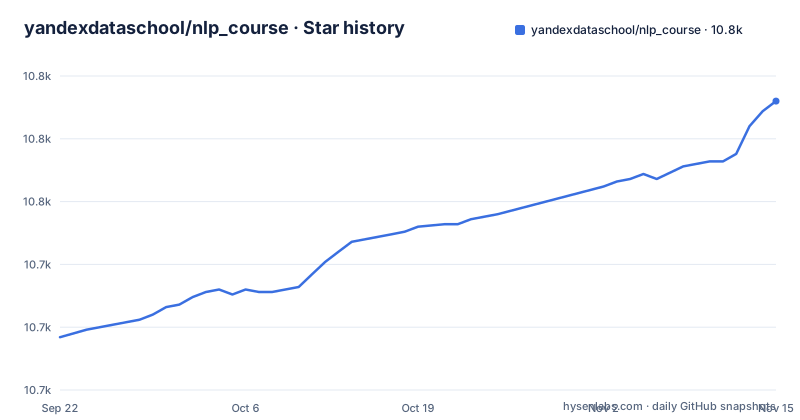
- yandexdataschool/nlp_course10,790 ★ · +94
| Repository | 2026-09-22 | 2026-11-15 |
|---|---|---|
| yandexdataschool/nlp_course | 10.7k | 10.8k |
94 Stars in the last 54 days, measured from the daily GitHub snapshot. Compare with other projects
Editorial analysis
Eight week folders accompany a fourteen-week syllabus
The repository root currently contains .gitignore, LICENSE, README.md, a resources/ directory, and eight week folders: week01_embeddings/, week02_lm/, week03_attention/, week04_transfer/, week05_llm/, week06_icl/, week07_efficiency/, and week08_finetuning/.
The syllabus above that listing describes fourteen topics, starting at Word Embeddings and running through AI Agents in Production. So the folder names you can see today cover the first eight weeks. The syllabus also names weeks 09 to 14: retrieval, agents, interpretability, multimodal models, LLM systems, and agents in production.
The gap is explained by the opening line: this is the 2025 iteration of the course and materials are added as they are prepared. Consequence for the reader: the current default branch contains eight week folders, not the full fourteen-week term. If you build a self-study schedule across fourteen topics you will hit folders that do not exist yet, and the syllabus at least tells you in advance which part of the term is published.
No GitHub releases means no immutable snapshot to teach from
The repository has no GitHub releases. The last push was on 2026-10-29, so the project is being worked on, but there is no version number, no dated archive, and no tag to point a cohort at.
Combined with the statement that materials are added as they are prepared, this creates a specific hazard: the contents of a week folder can change between terms while the folder name stays the same. Nothing in the repository freezes the state of the notebooks you used.
Consequence for anyone building on top of it, whether that is a study plan, a lecture that references a notebook, or a reproduction of a homework: a commit hash is the only durable handle available, and nobody is publishing it for you. Record it yourself when you start, because a link to the default branch will silently move under you. The default branch is also named 2026, so the branch itself is a cohort label rather than a release label, and it gives you no version guarantee either.
Dependency setup is a support thread, not a declared environment
There is no install command in the README, and there is no dependency file at the root next to LICENSE and README.md. What the README offers instead is routing: installing libraries and troubleshooting have their own thread, issue 1, and technical issues, ideas, and bugs in the course material are supposed to become repository issues.
That is the entire setup story, and for a notebook-based course it is a thin one. Nothing at the root pins library versions, so what a notebook expects is reconstructed from a discussion thread rather than declared in the repository. The primary language of the repository is Jupyter Notebook, which means a run depends on a kernel and a package set matching the environment the material was prepared in, and that environment is not written down where a tool could read it.
Consequence for the reader: budget real time for dependency resolution before the first homework, and treat issue 1 as the authority on how to install rather than as a convenience link. Anything you have to infer yourself is where results start to differ between two people running the same assignment.
Weeks are not shaped alike: seminar, homework, practice, or nothing
Reading the syllabus week by week shows several different shapes, which matters if you are planning your own term.
Weeks 01 to 03 each carry a lecture, a seminar, and a named homework: an embedding-based machine translation system, neural language models with smoothing in count-based models, and machine translation with attention. Week 04 has a lecture and a homework about fine-tuning a pre-trained BERT model, but no seminar line. Week 05 replaces the homework with a practice session on open-source LLMs. Week 06 brings back a homework, on manual prompt engineering and chain-of-thought reasoning. Week 07 is titled Efficiency, with a lecture on model acceleration and inference optimization plus a seminar and homework. Week 08 covers fine-tuning, including parameter-efficient methods and reinforcement learning from human feedback, with a seminar and homework, and weeks 12, 13, and 14 appear as titles with no lecture, seminar, or homework line at all.
Consequence: you cannot assume a uniform weekly rhythm. A self-learner gets explicit deliverables for some weeks, a seminar and homework for week 08, and nothing stated at all for the last three topics in the list.
Interactive lecture material sits on a separate site and stops linking after week 4
The lecture line for each of the first four weeks ends with a pointer to interactive lecture materials and more, hosted on the course homepage at lena-voita.github.io/nlp_course.html. Each pointer lands on its own anchor for that week: the embeddings page, the language modeling page, the seq2seq and attention page, and the transfer learning page. Weeks 05 through 14 have no such link.
So the interactive component of the course is not in the repository. What the repository holds is the written material and the assignments, while the live, interactive version lives on a separate site maintained alongside it.
Consequence for the reader: cloning the repository and expecting the interactive notebooks inside it will disappoint you, and the hosted version is not uniformly reachable from the syllabus either. For the second half of the listed topics you get no pointer at all, which leaves those weeks to be worked from the repository files on their own. Anyone comparing the repository to the site should also expect the two to differ, because they are maintained as separate artifacts with no release tying them together.
The branch says 2026 and the README describes the 2025 edition
The default branch is named 2026. The README describes the contents as the 2025 iteration of the course, and the credits name a specific person as responsible for the 2025 edition and as lecturer. The last push on that branch is 2026-10-29.
Three labels therefore describe one body of material: a branch named for 2026, an edition described as 2025, and a commit date in late October of 2026. Nothing in the repository reconciles them, and the README's own wording, that materials are added as they are prepared, means the branch accumulates work across terms rather than representing a frozen edition.
Consequence for citation and for planning: if you refer to this course by year, by branch, or by edition, you can end up describing the same notebooks three different ways. The stable citation is the repository, a commit hash, and a date. For a learner it also means a branch switch is not a version change, so do not treat switching branches as upgrading or pinning anything.
Grading is built for an enrolled cohort, not for a self-learner
The credits section describes a course with institutional structure behind it. A course admin handles on-campus students, and a host of teaching assistants grade hundreds of homework submissions from those students each year. More than thirty volunteers contributed and refined the notebooks and the course material. The original course author is Elena Voita, the person responsible for the 2025 edition and a lecturer is Michael Diskin, most of the seminars and some lectures were run by Just Heuristic, and lectures were also given by Ignat Romanov, George Yakushev, and Andrei Panferov, with further help on materials and classes from Boris Kovarsky, David Talbot, Sergey Gubanov, and Ruslan Svirschevski.
Consequence for the reader: every element built around assessment assumes people who are registered. A self-learner has no grader, no feedback loop, and no substitute for the seminar sessions, and the repository publishes the problems without publishing the path for having them checked. That is the part of the course design you cannot borrow.
Editorial conclusion
This repository fits a self-learner who wants the written material and the problems, week by week, and accepts that the content arrives partially and changes under you. It does not fit anyone looking for a fixed edition, a reproducible environment, or feedback on their solutions: there are no releases to pin, no dependency manifest at the root, and the grading half of the design belongs to an on-campus cohort. Before you plan a term around it, check how many week folders exist at the moment you clone, read the install thread rather than guessing versions, and record the commit you are working from.
Frequently asked questions
What is the YSDA NLP course about?
It is the YSDA Natural Language Processing course. Its syllabus runs fourteen topics, from word embeddings and language modeling through sequence-to-sequence with attention, transfer learning, large language models, prompting and in-context learning, efficiency, retrieval-augmented generation, agents, interpretability, multimodal LLMs, building LLM systems, and agents in production.
Can the YSDA NLP course materials be worked through online?
The lecture, seminar, and homework material sits in the public repository in per-week folders, and the interactive lecture material is hosted on the course homepage at lena-voita.github.io/nlp_course.html. The repository has no GitHub releases, so online readers follow the default branch rather than a tagged edition.
Why does the YSDA NLP course repository show only seven week folders?
The root currently holds week01_embeddings, week02_lm, week03_attention, week04_transfer, week05_llm, week06_icl, and week07_efficiency, while the README describes the 2025 iteration and states that materials are added as they are prepared. The syllabus itself lists fourteen weeks.
How do you install libraries for the YSDA NLP course notebooks?
The README contains no install command and the root has no requirements or environment file. It sends library installation and troubleshooting to a dedicated thread, issue 1, and asks that technical issues with the material be filed as repository issues.
Does the YSDA NLP course hand back graded homework?
A course admin for on-campus students and a host of teaching assistants grade hundreds of homework submissions from on-campus students each year, and more than thirty volunteers refined the notebooks. No submission or grading route is described for people studying outside the campus program.
Official sources
Add this badge to your README
If you maintain this project, the badge below links readers to this analysis and shows its maintenance status from the daily GitHub snapshot. Paste the markdown into your README; add ?metric=license or ?metric=stars to the image URL for a different field.

[](https://hysenlabs.com/projects/yandexdataschool-nlp-course)Star history chart for your README
[](https://hysenlabs.com/projects/yandexdataschool-nlp-course)Was this useful?