Offer Toolkit Skill routes a job hunt through six self-contained folders
Full job-hunt Claude skill bundle — Job Description decoder + Resume builder (11 templates) + Behavioral Interview / story bank. Three self-contained sub-skills with a top-level router.
At a glance
- What is it?
- An MIT licensed agent skill pack that splits a job search into six numbered stages, from building a deduplicated job list to comparing four-year compensation and writing negotiation scripts. Each sub-folder works on its own, and a top-level router picks between them. Nothing is ever submitted on your behalf.
- Who is it for?
- Offer Toolkit Skill fits a job hunt where the work between applications is the bottleneck: it front-loads JD decoding, story mining and offer math instead of leaving them to the hour before an interview. It is a poor fit if you want an agent to submit applications or write to recruiters, because every sub-skill refuses that step.
- Can I use it commercially?
- Yes. MIT is a permissive licence: you can use, modify and sell software built on it, as long as you keep its copyright and licence notices.
- Is it still maintained?
- Yes. The repository last received commits 19 days ago.
- What is it written in?
- Mainly HTML, according to GitHub's language statistics.
Answers come from the project's GitHub data, last synced on November 15, 2026, and from our analysis. They are not legal advice.
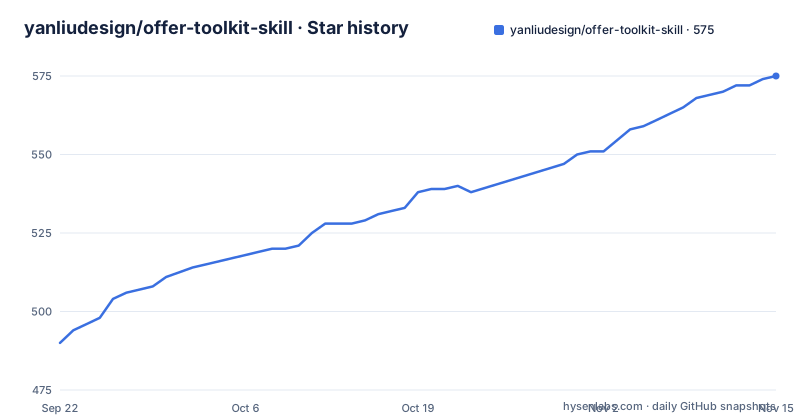
Star history
- yanliudesign/offer-toolkit-skill575 ★ · +85
| Repository | 2026-09-22 | 2026-11-15 |
|---|---|---|
| yanliudesign/offer-toolkit-skill | 490 | 575 |
85 Stars in the last 54 days, measured from the daily GitHub snapshot. Compare with other projects
Editorial analysis
Six numbered stages, six folders, one router at the top
The pack is laid out as a sequence rather than a single tool. Stage 0 is discovery through job-hunt-skill, which produces a searchable HTML job list. Stage 1 is job-description-skill, which decodes a posting into an Offer Strategy report. Stage 2 is resume-skill for tailoring and layout. Stage 3 is bq-skill for behavioural interview preparation. Stage 4 is offer-compare-skill, and stage 5 is salary-negotiation-skill.
Every one of those sub-folders is self-contained, so copying a single directory gives you a working tool with no router. A top-level SKILL.md handles the routing when you install everything.
The repository layout does not perfectly match the six-item table. Alongside the six named folders there is also a job-search-skill directory, plus docs, an example directory split into cn and en sub-folders, and paired English and Chinese READMEs. Treat that seventh folder as unexplained by the table rather than assuming it is a seventh stage.
Discovery stops at a list and refuses to submit anything
job-hunt-skill is the only stage that goes looking for work rather than working on a given one. Input can be a resume, a target direction, a seed job description, or a set of existing job links.
From there it searches public sources, deduplicates the candidates it turns up, and keeps verified facts separate from inference, so a report can show which claims came from a posting and which are the model's reading. The result is a searchable HTML list rather than a spreadsheet or a set of tabs.
The boundary is explicit: the skill discovers and analyzes, and it never applies for you. That line is restated in the shared rules and it is the reason discovery can be automated at all while form submission stays a human action.
The JD report answers six questions on one page
job-description-skill takes a job description together with your resume and returns an HTML report. The report is organised around six judgements: whether the role is worth applying to, how well you match it, where the gaps sit, what you can expect to be asked in interviews, whether the stated salary is reasonable, and what to do over the next six weeks.
Read as a pipeline, those six answers decide whether stages 2 and 3 are worth running at all. A gap list feeds the resume tailoring, and an interview prediction feeds the story bank, so the same posting text does work three times instead of once.
The output is a single HTML file on disk, which is why the next stage can consume it without any live connection back to the agent.
Twelve resume templates, and two files out of every render
resume-skill has three entry points. It can polish a resume you already have, pull one in from LinkedIn, or build one from scratch by talking to you about your history.
Layout is handled by twelve print-ready templates named Classic-ATS, Ledger, Modern Sidebar, Pillar, Elegant Serif, Atelier, Timeline, Swiss, Executive, Editorial Banner, Photo Corporate and Photo Minimal. The repository description refers to eleven templates while the template list names twelve, and the list is the one to plan against.
Each render produces two files rather than one: a version that prints straight to PDF, and a version you open in a browser to edit. The paired output exists because PDF is treated as the end state and the browser file as the working copy, so a typo gets fixed in the editable file rather than by regenerating a PDF.
Story banking instead of canned answers
bq-skill deliberately avoids handing you ready-made replies. It works by interviewing you about your real past and organising what you say into a bank you can reuse, asking about your experience step by step rather than firing a questionnaire.
Each story is shaped with STAR or CAR, tagged with a capability label such as took ownership or handled ambiguity, and stored in both English and Chinese. Keeping one story under several tags is the point: when a different behavioural question comes up later, a story you already own can be retold to fit it.
The skill also reads a job description and predicts the twenty questions that employer is likely to ask, then walks through preparation for each. That stage produces a top twenty list with STAR templates attached and model answers you can edit.
Offers are compared over four years, and leverage is itemised
offer-compare-skill takes two or more offers and scores them across four-year total compensation, growth, AI exposure, company and team risk, promotion, lifestyle, resume value and future mobility. The four-year window is what separates it from a salary calculator: it forces the question of what the package becomes after the first raise cycle rather than what the offer letter says today. The output is an HTML Offer Decision Report carrying an explicit recommendation.
salary-negotiation-skill works on a single live offer instead. It diagnoses where your negotiating position actually sits by breaking the package into Base, RSU, Sign-on and Bonus, because those four move independently and can be traded. From that it builds a strategy, writes phone and email scripts, simulates recruiter pushback, and fixes the decision boundaries in advance as sign, walk and stop-lines inside an HTML Negotiation Playbook. Defining the walk-away point before the call is the part the stage is built around.
Four rules the sub-skills refuse to break
Four constraints are shared by all six. Never fabricate: every experience, number and title has to come from what you actually said, with weak content sharpened rather than invented and numbers verified. Ask only what changes the answer, following each child skill's own intake cadence, one question at a time or batched, instead of turning a session into a sprawling questionnaire. Structure first, render second, which means the content reaches a standard shape and is confirmed before any file is generated. And never apply on the user's behalf, since search can be automated while submitting forms and sending messages remain user actions.
Installation is a file copy. Drop the whole offer-toolkit-skill folder into a skills directory such as ~/.claude/skills/ or the prompts folder in VS Code, and all six sub-skills are picked up, or copy one sub-folder if you only want that tool. Reports, resumes and story banks are written to your own machine, while prompts and attachments follow the data policy of whichever agent and model provider you use.
Once installed, the router responds to plain requests such as:
Should I apply to this? I'll paste the JD link or full text next.Prep me for behavioral interviews.Compare these two offers and tell me which one to take.The repository is MIT licensed, its last push to main is dated 2026-09-29, and it publishes no GitHub releases.
Editorial conclusion
Offer Toolkit Skill fits a job hunt where the work between applications is the bottleneck: it front-loads JD decoding, story mining and offer math instead of leaving them to the hour before an interview. It is a poor fit if you want an agent to submit applications or write to recruiters, because every sub-skill refuses that step. Before trusting an output, check the numbers against your own records, since the pack is built around not inventing figures, and confirm the install path you chose, since the whole folder and a single sub-folder behave differently.
Frequently asked questions
Do I have to install all six Offer Toolkit sub-skills?
No. Installing the whole offer-toolkit-skill folder enables automatic routing across the whole search, while copying a single sub-folder gives you a self-contained tool on its own.
Will Offer Toolkit Skill apply to jobs or contact recruiters for me?
No. Discovery and analysis are automated, but submitting forms and sending messages stay user actions, and this boundary is one of the four rules shared by every sub-skill.
Where do the files produced by Offer Toolkit Skill end up?
Reports, resumes and story banks are written to your own machine as HTML files. Prompts and attachments are processed according to the data policy of the agent and model provider you use.
What does the behavioural interview sub-skill produce?
A story bank built from your real past, shaped with STAR or CAR, tagged with capability labels and stored in English and Chinese. It also predicts the twenty questions that employer is expected to ask from a job description and prepares each one.
How does Offer Toolkit Skill compare two job offers?
It scores each offer over four-year total compensation along with growth, AI exposure, company and team risk, promotion, lifestyle, resume value and future mobility, then produces an HTML Offer Decision Report with an explicit recommendation.
How current is the Offer Toolkit Skill repository?
The last push to the main branch is dated 2026-09-29, and the repository publishes no GitHub releases, so version tracking depends on the commit history rather than a release feed.
Official sources
Add this badge to your README
If you maintain this project, the badge below links readers to this analysis and shows its maintenance status from the daily GitHub snapshot. Paste the markdown into your README; add ?metric=license or ?metric=stars to the image URL for a different field.

[](https://hysenlabs.com/projects/yanliudesign-offer-toolkit-skill)Star history chart for your README
[](https://hysenlabs.com/projects/yanliudesign-offer-toolkit-skill)Was this useful?