llm-master: a Chinese documentation corpus with no code in it
A full-stack learning path and Chinese tutorial for large language models, covering prompt engineering, RAG, AI agents, MCP, fine-tuning, model deployment, Transformers, AI coding, and big-tech interviews, from beginner to production practice.
At a glance
- What is it?
- llm-master is a Chinese-language roadmap and tutorial collection for LLM application engineering, stored as Markdown under docs/ with no package, no build and no releases. Its own scope note rules out pretraining research, and the first row of its topic map points out of the repository.
- Who is it for?
- llm-master fits a developer who already writes software and wants one ordered path through LLM application work rather than a pile of articles, and whose Chinese reading is good enough that a Chinese corpus is not a barrier. It does not fit someone looking for model research, foundation model training or proofs, which the project itself rules out, and it does not fit an English-only reader, because the documentation here is Chinese.
- Can I use it commercially?
- Yes. MIT is a permissive licence: you can use, modify and sell software built on it, as long as you keep its copyright and licence notices.
- Is it still maintained?
- Yes. The repository last received commits 3 days ago.
- What is it written in?
- GitHub does not report a main language for this repository.
Answers come from the project's GitHub data, last synced on November 14, 2026, and from our analysis. They are not legal advice.
Star history
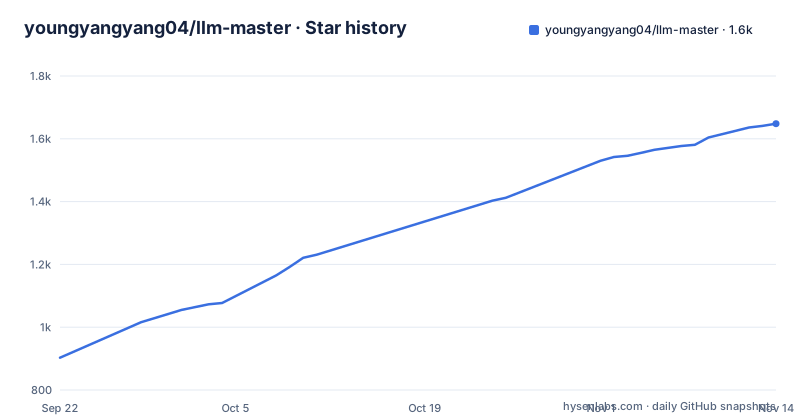
- youngyangyang04/llm-master1,648 ★ · +745
| Repository | 2026-09-22 | 2026-11-14 |
|---|---|---|
| youngyangyang04/llm-master | 903 | 1.6k |
745 Stars in the last 53 days, measured from the daily GitHub snapshot. Compare with other projects
Editorial analysis
The root holds three entries and none of them is code
The top level of the repository contains `LICENSE`, `README.md` and `docs/`. There is no package manifest, no build script, no test suite, no `src/` directory and no lockfile. The repository's own recorded language is listed as unknown, which is what you would expect from a corpus of Markdown rather than a codebase.
Everything substantive therefore lives under `docs/`, reachable through four links in the header: a start page at `docs/roadmap/README.md`, a full index at `docs/README.md`, a topic index at `docs/topics/README.md` and an interview bank at `docs/interview/llm/README.md`.
One thing to settle before reading: the documentation is written in Chinese. The index page, the six-stage roadmap, every topic page and the interview question bank are all Chinese-language documents, and no English version is listed alongside them at the root.
The index page is described as covering more than 150 tutorials and interview write-ups. That count is the project's own claim, and it is the only sense in which this repository has a version: with no GitHub releases, a curriculum that changes does so under the same URL.
The first row of the topic map points out of the repository
The knowledge map is a table of eleven directions, each with a core-content column and a learning-entry column. Ten of those entries resolve to files inside `docs/`. The first one does not.
That row is the AI usage direction, covering ChatGPT, GPT-6 Astra, Claude Opus 5 and Fable 5.1, and its two learning-entry links go to separate repositories by the same author: one for membership top-ups and one for ChatGPT and Claude API access. Neither lives here.
So the row a beginner clicks first is the one row this repository does not serve. Everything from the second row onward, the developer entry route, the application development route, the RAG topic, the agent route, multi-agent, fine-tuning, deployment, Transformer, AI coding and the interview route, is local Markdown.
It is a small structural quirk and it is easy to miss, because the table looks uniform. Nothing in the row marks it as external.
Six stages, and only two of them state a completion criterion
The roadmap is a linear chain, and the diagram states it in one line per stage:
flowchart LR
    A[0 · 全局认知] --> B[1 · 模型调用]
    B --> C[2 · RAG]
    C --> D[3 · Agent]
    D --> E[4 · 生产工程]
    E --> F[5 · 原理与面试]
Stage 0 establishes the whole picture, stage 1 covers model calls, stage 2 is RAG, stage 3 moves from workflow to agent, stage 4 is production engineering, and stage 5 is principles plus interview preparation.
The two ends of the chain are the ones that define done. Stage 0 asks you to be able to draw the full path of one model request and explain the boundaries between roles. Stage 5 asks you to hand-write a minimal Transformer and explain a project in terms of metrics, failures and trade-offs.
The four middle stages are framed by projects rather than criteria. Each names a deliverable: a streaming AI application with JSON Schema, error handling and cost statistics; a knowledge base with hybrid retrieval, answer citations, an offline evaluation set and error analysis; an interruptible and recoverable tool-based agent; and a load-test, capacity, reliability and cost report for a RAG or agent service.
Four projects, each with a delivery standard rather than a demo
A separate table proposes four projects to put on a resume, and the third column is the part that matters. It is called a minimum delivery standard rather than a feature list.
The AI business assistant is not finished when it streams. It needs exception handling, token statistics and automated tests. The enterprise knowledge base needs a fixed evaluation set, bad-case classification and a metric baseline. The tool-based agent needs traces, failure recovery, a budget cap and completion-rate evaluation. The production AI service needs P99, TTFT, TPOT, Goodput and a capacity report.
Read together, those four standards are a checklist for what an interviewer will ask about, and they line up with what the interview section tells you to say: business problem, then technical choice, then system design, then evaluation metrics, then failures and optimisations, then the final result.
The project text also says explicitly that running a demo is not the end. Being able to answer why this design was chosen, how the effect is measured, how failure is recovered from and how cost is controlled is what counts as done.
MIT covers the repository, and the words inside it carry a separate instruction
The licence section states MIT and links a LICENSE file at the root. It then adds a sentence with no equivalent in a standard MIT grant: articles, images and similar content should keep their source attribution when republished, and the copyright notice belonging to each piece should be respected.
That is a reasonable thing for a documentation repository to say and a strange thing for an MIT licence to imply, because MIT does not distinguish between the code you wrote and the material you collected. Here the distinction is real. The repository contains a licence of its own, and it contains text and images that arrived from somewhere else.
So if you copy a page out of this corpus into your own notes, a team wiki or a slide deck, the MIT grant covers the repository as a project and does not settle the rights in the individual article or image.
The same applies to the interview write-ups in particular, since those describe specific people and specific interview rounds, and they are the part of the corpus people tend to quote.
The project rules out pretraining research in its own words
Most learning corpora for this subject hedge. This one does not. A section on who it suits and who it does not states that the repository is not aimed at pure algorithm research or large-scale pretraining, and that if your goal is researching new model architectures, training foundation models or going deep into mathematical proofs, you should treat it as a supplement to application engineering rather than your only source.
The topic list is consistent with that. Fine-tuning covers SFT, RLHF, DPO, LoRA, QLoRA, distillation and, notably, when not to fine-tune at all. Deployment covers vLLM, SGLang, KV Cache, PagedAttention, quantization and load testing. Transformer coverage runs from Q/K/V and Attention through positional encoding, FFN and LayerNorm to a full implementation. The emphasis throughout is operating a system rather than inventing one.
The multi-agent material is the same shape, covering Planner, Worker and Reviewer roles, DAGs, task packages, communication and context governance.
For a reader deciding whether to spend a week here, that boundary is the most useful sentence in the repository.
The content originates in a notes column and a WeChat account
The first line of the README attributes the material. It states that the repository's content comes from the Kama Coder LLM column hosted at notes.kamacoder.com, which is also the repository's declared homepage.
A later section adds that the field changes quickly, that the repository keeps adding engineering practice, project experience and interview questions, and that new content appears first on a WeChat public account named 卡码大模型.
Put together, those two statements describe a publication pipeline rather than a software project. The notes site and the WeChat account are where material is written and released; this repository is the index over it, with the roadmap, the topic pages and the interview bank as the durable artefacts.
That has an effect on how you should treat it. There is no version, no changelog entry per document and no release to diff against, so if a page changes you cannot tell what moved unless you kept a copy. The commit history is the only record, and the last push to main was on 2026-09-19.
Editorial conclusion
llm-master fits a developer who already writes software and wants one ordered path through LLM application work rather than a pile of articles, and whose Chinese reading is good enough that a Chinese corpus is not a barrier. It does not fit someone looking for model research, foundation model training or proofs, which the project itself rules out, and it does not fit an English-only reader, because the documentation here is Chinese. Before you commit, check three things. Read the scope note, since the project asks to be used as a supplement rather than as your only source. Notice that the first row of the topic map resolves to two other repositories by the same author rather than to anything in this one. And accept that there is no version to pin: the repository publishes no releases, so a curriculum changes under the same URL. The last push to main was on 2026-09-19.
Frequently asked questions
Is llm-master a law degree?
No. It is a Chinese-language learning roadmap and tutorial collection for LLM application engineering, not a university programme. It states that it is aimed at programmers who already have a development background and want to move into LLM application development, agent engineering or AI backend work.
What language is llm-master written in?
The documentation is in Chinese, and what this repository ships is that Chinese version: the index page, the six-stage roadmap, the topic pages and the interview question bank. The repository root holds only `LICENSE`, `README.md` and `docs/`, with no English version listed and no code.
Does llm-master cover model research and pretraining?
No, and the project says so itself. It states that it is not aimed at pure algorithm research or large-scale pretraining, and suggests treating it as a supplement to application engineering rather than your only source if your goal is new model architectures, foundation model training or mathematical proofs.
Where does the content in llm-master come from?
The README states that the material comes from the Kama Coder LLM column at notes.kamacoder.com, which is also the declared homepage, and that new content is published first on a WeChat public account. The repository is the index over that material rather than the place it is written.
What projects does llm-master ask you to build?
Four, each with a minimum delivery standard rather than a feature list: an AI business assistant needing exception handling, token statistics and automated tests; an enterprise knowledge base needing a fixed evaluation set, bad-case classification and a metric baseline; a tool-based agent needing traces, failure recovery, a budget cap and completion-rate evaluation; and a production AI service needing P99, TTFT, TPOT, Goodput and a capacity report.
Official sources
Add this badge to your README
If you maintain this project, the badge below links readers to this analysis and shows its maintenance status from the daily GitHub snapshot. Paste the markdown into your README; add ?metric=license or ?metric=stars to the image URL for a different field.

[](https://hysenlabs.com/projects/youngyangyang04-llm-master)Star history chart for your README
[](https://hysenlabs.com/projects/youngyangyang04-llm-master)Was this useful?