kube-score: the checksum step prints a digest and compares nothing
Kubernetes object analysis with recommendations for improved reliability and security. kube-score actively prevents downtime and bugs in your Kubernetes YAML and Charts. Static code analysis for Kubernetes.
At a glance
- What is it?
- kube-score analyses Kubernetes object definitions and prints recommendations, from four installation routes and with per-object annotations that can silence individual checks. Its build file is where the care ends: it downloads Helm and Kustomize into the image, prints a checksum for each without comparing either, and the documentation and the module file disagree about which Go version builds the thing.
- Who is it for?
- kube-score suits a team that deploys from static manifests or from Helm and Kustomize output and wants a cheap gate that runs before a merge, because the checks it lists, resource limits, network policies, disruption budgets, anti-affinity, distinct probes and a non-root security context, are the ones most hand-written manifests get wrong.
- Can I use it commercially?
- Yes. MIT is a permissive licence: you can use, modify and sell software built on it, as long as you keep its copyright and licence notices.
- Is it still maintained?
- Activity is slowing. The repository last received commits 6 months ago.
- What is it written in?
- Mainly Go, according to GitHub's language statistics.
Answers come from the project's GitHub data, last synced on November 22, 2026, and from our analysis. They are not legal advice.
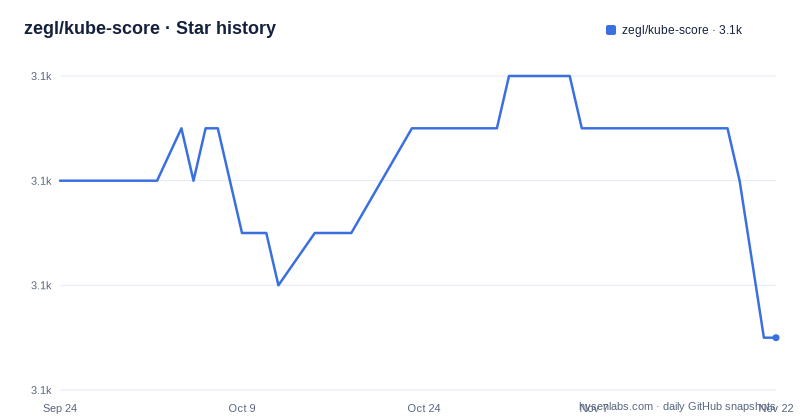
Star history
- zegl/kube-score3,101 ★ · -3
| Repository | 2026-09-24 | 2026-11-22 |
|---|---|---|
| zegl/kube-score | 3.1k | 3.1k |
-3 Stars in the last 59 days, measured from the daily GitHub snapshot. Compare with other projects
Editorial analysis
The readme says Go 1.21, the module says 1.26, the container agrees with the module
Three files in this repository give three answers about which Go version is needed, and the documentation is the outlier. The Building from Source section says the project requires Go 1.21 or later to build. The module file declares its minimum as a later minor series entirely. The container file builds against a 1.26 toolchain. So the two files that a build actually reads agree with each other and disagree with the page, which means someone following the readme and installing the version it names will be told by the toolchain that the module requires something newer. The dependencies table near the bottom of the readme repeats the older number, so the wrong version appears twice. The readme does get the build invocation right in every other respect, naming the command with the same package path the tree uses for its command directory.
The checksum step prints a digest and compares nothing
The container build downloads two third-party archives and appears to check both. The download step writes the archive to a file, then pipes the expected checksum and the filename into a checksum utility, then extracts the archive. What the utility is given is the expected digest and the name. It computes the digest of what it just downloaded and prints it. There is no flag telling it to compare, so the line runs, prints a hash, and the build continues to the next command regardless of whether the two digests match. The same shape is used for both downloads. The two expected digests are per architecture and they differ between the AMD and ARM stages, so the values are real and specific, and they are simply not being enforced. That is the difference between a build that verifies what it fetched and a build that looks like it does. The line in question is short:
echo "${HELM_SHA256SUM} helm.tar.gz" | sha256sumPiping an expected digest and a filename into that utility prints the digest of the file it just read. Adding a comparison flag is what would turn it into a gate.
The dependencies table lists the toolchain and nothing else
The readme closes with a section headed Dependencies and a table with a single row naming the toolchain and a version constraint. The module file lists fourteen direct requirements. Among them are the two Kubernetes API libraries at a recent version, a YAML library, the flag library the CLI is built on, a test library, a colour library, a terminal detection library, a word wrapping library pinned to a commit from the middle of the last decade, a library that converts terminal output to HTML, and a JUnit report writer. So the table describes the build environment and calls it the dependency list, while the actual dependency surface, which includes two Kubernetes client libraries and a handful of small third-party modules of varying vintage, is invisible to anyone reading the page. The one row it does contain also repeats the Go version the module file contradicts.
A manifest can silence its own findings and two flags turn that off
The suppression mechanism is worth understanding because it inverts the usual relationship between a linter and its input. Two per-object annotations exist, one to ignore named tests and one to enable optional ones, and each takes a comma-separated list of test identifiers. So a manifest can carry an annotation saying which of its own findings to drop. Two further flags disable the effect of those annotations for a whole run. The defaults are therefore suppression on and suppression overridable, which is a reasonable choice for a tool that runs against manifests other people own and a questionable one for a gate, since the cheapest way to make a pipeline green is to annotate the pipeline green. The optional-check side of the same mechanism is what the shipped example demonstrates, and it enables a seccomp profile check that is off unless you ask for it.
The krew install gives you a binary named score
The installation table lists four routes and three of them install a binary called kube-score: the release archives, the container image, and Homebrew. The fourth, the Kubernetes plugin manager, is documented as installing a plugin called score. Every usage example in the readme then invokes kube-score with a subcommand, in the form kube-score score and then a path or a hyphen for standard input. A plugin installed under a different name than the examples use will not behave the way the page describes, and the page does not reconcile the two. The container route is the one place where the shorter name appears correctly, because there the invocation is the image, the subcommand and the files, with the binary itself supplied by the image's entry point. The reason for the shorter plugin name is visible in the container build rather than in the documentation: the version, commit and date are injected at link time in the three-part shape the plugin manager expects.
Two machine-readable output formats ship and neither is documented
The readme says the output is a list of recommendations, and the configuration block says the score action gives a score and recommendations. Neither a score nor a scale is defined anywhere: no formula, no range, no threshold, and no explanation of what a number means. Two directories in the tree suggest the answer is more than a list. One is named for the interchange format that static analysis tools emit so a code-hosting interface can render findings inline, and the module requires a library that writes JUnit XML, which is how continuous integration systems ingest test results. Neither format appears in a single usage example, neither is mentioned in the readme's prose, and there is no flag in the visible portion of the usage block to emit either. For a tool whose job is to be a gate, the format a machine consumes is at least as important as the format a person reads, and it is the part with no documentation at all.
The example output section is a heading with nothing under it
The readme has a section headed Example output with nothing in it. That is the one place a reader most wants a sample, since the value of the tool is the shape of what it prints and how it grades severity, and neither is shown. What the page does provide, in place of that sample, is a check list of seven bullets, which the page itself says is not the full list and points to a separate document for that. Two further documents are linked for the probe and security context checks, so the seven bullets are a summary of documents that are not in the repository's own top level naming convention the page links them by, and the page does not say how many checks exist in total. The configuration block then prints a CSV of them on request through a separate action, which is the only way the readme suggests of discovering the full set.
Thirty-two bit ARM was dropped and left commented out
The container build is organised around three per-architecture stages carrying their own expected checksums for the two downloads. Two of them are live, one for AMD and one for 64-bit ARM. The third, for 32-bit ARM, is present in the file with its own pair of checksums and its own download logic, commented out rather than deleted. That is a readable record of a decision: 32-bit ARM was supported and is not any more, and the values needed to restore it were kept in place. The stage selection then looks the requested architecture up by name in that list, so an architecture that is neither of the two live names fails the build on a missing stage rather than on a download. The installation table, meanwhile, advertises binaries for macOS, Linux and Windows without mentioning which processor architectures are covered for each.
Editorial conclusion
kube-score suits a team that deploys from static manifests or from Helm and Kustomize output and wants a cheap gate that runs before a merge, because the checks it lists, resource limits, network policies, disruption budgets, anti-affinity, distinct probes and a non-root security context, are the ones most hand-written manifests get wrong. It is a poor fit if you need to know why a finding fired, because the seven documented checks are a summary of a separate document and the per-object suppression annotations let a manifest silence itself. Before you wire it into a pipeline, run it once over a whole namespace rather than one file, since that is what the page asks for, and check which findings you actually gate on, because the default gate is critical only and one of the security checks is off unless you switch it on.
Frequently asked questions
what is kube score
It is a Go tool that performs static code analysis of Kubernetes object definitions and outputs a list of recommendations for making an application more secure and resilient. It has four actions: score the input files, list the available checks as CSV, print the version and print help. It installs from release archives, a container image, Homebrew, or a Kubernetes plugin manager.
How do I run kube-score in a pipeline?
It exits with code 1 when a critical finding is present, and a flag lowers the trigger level to warnings instead. The readme also says the input should be all applications deployed to the same namespace for the best result, and one of its examples feeds it every namespaced resource type across every namespace in a cluster.
How do I ignore a kube-score check?
For a whole run with a flag, or per object with an annotation naming a comma-separated list of test identifiers, with a second annotation that enables optional tests. Two further flags disable the effect of those annotations entirely, so by default a manifest can suppress findings about itself.
Which Go version do I need to build kube-score?
Three answers appear. The readme says 1.21 or later, the module file declares a later minor series, and the container builds with a 1.26 toolchain. Building from source on the version the readme names will not work.
Does kube-score produce output a tool can read?
The readme documents only a human readable list, and a CSV of check names from the list action. The repository contains a directory named for the static analysis interchange format and the module requires a JUnit report writer directly, but the readme mentions neither format and the visible flags do not emit them.
What does '100m cpu' mean in Kubernetes, and what are the four Cs of Kubernetes security?
This page does not address either question. It documents one static analysis tool for Kubernetes object definitions, lists seven of its checks, and explains how to suppress or enable individual ones.
Official sources
Add this badge to your README
If you maintain this project, the badge below links readers to this analysis and shows its maintenance status from the daily GitHub snapshot. Paste the markdown into your README; add ?metric=license or ?metric=stars to the image URL for a different field.

[](https://hysenlabs.com/projects/zegl-kube-score)Star history chart for your README
[](https://hysenlabs.com/projects/zegl-kube-score)Was this useful?