OnlineToolsBook: a README driven Hugo build wrapped around forty numbered tool writeups
Online tool cheats — a quality manual for online tools, to make online tools benefit humanity.
At a glance
- What is it?
- zhaoolee's OnlineToolsBook is a Hugo site rather than an app. The root README.md is copied into the home page by a shell script before Hugo runs, and the body of the project is a Chinese catalogue of browser tools numbered T007 to T044, with dated entries that stop in November 2020 and a licence field that disagrees with the repository metadata.
- Who is it for?
- Treat OnlineToolsBook as a snapshot of the 2020 web, not a current index. The entry run it prints stops in November 2020, two numbers are missing from the sequence, and the promise to sync to a WeChat account was written for 2022 and never dated again, while the last push arrived on 2026-06-08 with no release to show for it.
- Can I use it commercially?
- Yes. Apache-2.0 is a permissive licence: you can use, modify and sell software built on it, as long as you keep its copyright and licence notices.
- Is it still maintained?
- Yes. The repository last received commits 160 days ago.
- What is it written in?
- Mainly CSS, according to GitHub's language statistics.
Answers come from the project's GitHub data, last synced on November 15, 2026, and from our analysis. They are not legal advice.
Star history
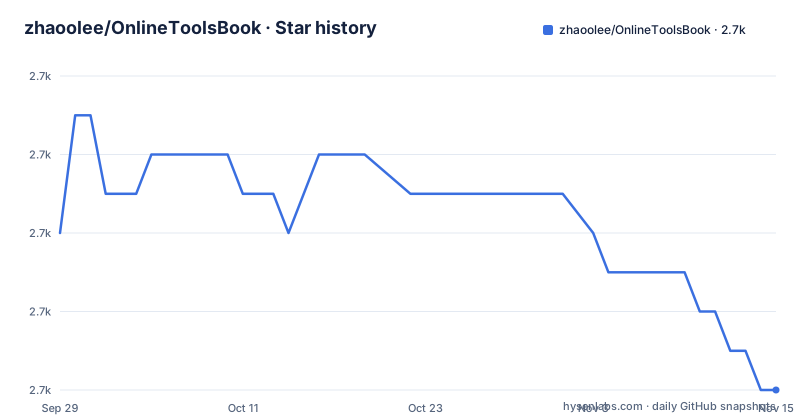
- zhaoolee/OnlineToolsBook2,666 ★ · -4
| Repository | 2026-09-29 | 2026-11-15 |
|---|---|---|
| zhaoolee/OnlineToolsBook | 2.7k | 2.7k |
-4 Stars in the last 47 days, measured from the daily GitHub snapshot. Compare with other projects
Editorial analysis
The home page is a shell script copy of README.md
Everything the site publishes about itself starts in one file. The root README.md holds the project pitch, two permanent links and the whole entry list, and package.json turns that into the front page before Hugo runs: the `sync:home` script is `bash scripts/sync-home-from-readme.sh`, and both `dev` and `build` call it first.
{
  "name": "onlinetoolsbook",
  "version": "1.0.0",
  "description": "在线工具秘籍 Hugo site",
  "scripts": {
    "sync:home": "bash scripts/sync-home-from-readme.sh",
    "dev": "bash scripts/sync-home-from-readme.sh && hugo server --renderToMemory --noBuildLock --disableFastRender",
    "build": "bash scripts/sync-home-from-readme.sh && hugo --gc --minify",
    "index": "npx --yes pagefind --site public --output-subdir pagefind"
  },
  "keywords": [],
  "author": "",
  "license": "ISC"
}
So an edit to README.md is an edit to the published home page, and a build that skips the script, by running `hugo` on its own, would publish whatever the last sync happened to leave in place. The version field reads 1.0.0, and there are no GitHub releases to compare that number against.
T041 and T042 are missing from the entry run
Entries are numbered by hand and the visible run skips slots. The list opens at T044 《Squat》, then T043 《Compres Jpg》, and the next heading is T040 《KinhDownload》: no T042, no T041. From there it steps down one at a time until T007, where the file ends inside a link, the address stopping at https://zhaoolee.com/OnlineToo. Thirty eight headings sit inside a range that would hold forty four, and the two gaps are explained nowhere.
Coverage is uneven below that too. T040, T039, T038, T016 and T015 are a heading and a link with nothing written under them, while T044 gets three sentences about reading the device accelerometer to count squats and T043 gets one line naming Google's squoosh algorithm as the basis. The unevenness matters if you plan to use the list as an index: a title with no body gives you no way to tell whether a tool was used or merely bookmarked.
Dated entry slugs stop in November 2020
Five entry URLs carry a date and every one of them sits in 2020: T035 mdnice on 2020-09-27, T036 photo editor on 2020-09-29, T037 on 2020-10-09, T038 on 2020-10-12, T039 world time on 2020-11-06. The body text agrees with the slugs. T012 dates itself to 2020-02-29 and explains that the sticker existed because the Dow fell a thousand points in a single day, a market reaction a reader now has to look up alone.
Set against that, the repository took a push on 2026-06-08 and has never cut a release, so nothing on the page says which entries were revisited after 2020 and which were left as written. The README also promises that the author's WeChat account would carry the same content during 2022. That sentence stayed in place through later pushes without a date update, which is a fair signal about how much of the prose outside the entries gets touched.
Apache-2.0 in the metadata, ISC in package.json
Two licence statements sit in this repository and they point in different directions. The licence the repository reports for itself is Apache-2.0, and the tree carries a LICENSE file at the root next to README.md. The package.json that drives the build declares `"license": "ISC"`, sitting beside empty `author` and `keywords` fields. No NOTICE file appears in the tree and no second licence text is there to weigh against either. If you want to reuse the layouts or the archetypes, that choice is yours to make, and the two files do not help you make it.
The rest of the tree is the ordinary shape of a Hugo project: archetypes/, assets/, content/, layouts/, scripts/ and static/, with hugo.toml at the root and a README/ directory beside README.md. Nothing in that list explains the licence split or says which file wins.
The pagefind index is a step that build never runs
Search on the published site is handled by pagefind, and the wiring is easy to miss. The `index` script is `npx --yes pagefind --site public --output-subdir pagefind`: it reads the `public` directory and writes the index back into it under a pagefind subdirectory. The `build` script never calls it. `build` syncs the home page, runs `hugo --gc --minify`, produces public/ and stops. A fresh clone built once therefore has no search index until someone runs the fourth script by hand, and the direction matters, because pagefind is pointed at build output rather than at the source.
`dev` has the same shape with server flags `--renderToMemory --noBuildLock --disableFastRender`, and it also syncs first. Rendering to memory means a preview never writes public/, which is exactly why `index` cannot run against a dev server and has to wait for a real build.
Entries that argue with the tool instead of listing it
The strongest entries are the ones where the author takes a position. T023 《Savefrom》 argues that Google pulled every YouTube download extension from the Chrome Web Store to protect YouTube while leaving Bilibili downloaders alone, then closes on a claim about the internet sliding toward centralisation. T019 《船长解析》 admits in a line that the service does not produce the highest picture quality and is only worth using on a small screen. T021 《Base64》 calls base64 moral encryption: it stops people who do not know the encoding and does nothing against a programmer. T033 《最优图像优化》 argues from where the work happens, in the local browser, so nothing is uploaded.
One entry carries a number of its own. T020 《I Love Img》 reports a jpg going from 184KB to 68KB with no loss visible to the eye. That is the author's claim about someone else's site rather than a figure produced here, and no other entry in the file carries figures at all.
Hooks and an AGENTS.md the catalogue never mentions
The tree holds .githooks/, .github/ and AGENTS.md. None of the three appears in the project description, and no visible part of README.md says what the hooks run or what the agent instructions require, so the tooling around the writing is undocumented from the outside. scripts/ is the same: package.json names exactly one file in it, scripts/sync-home-from-readme.sh, and any other script sitting there is referenced by no command the project states.
The README even carries a section, under the heading the author calls double pleasure, admitting that resource sites met while hunting for tools were folded into the list too. No selection rule, exclusion policy or review standard is offered anywhere, so the only quality bar the file supplies is its opening definition: the ideal tool needs no installation and works once a browser is open.
Paid membership entries that print no address
T040 《KinhDownload》 is a Baidu netdisk download that skips membership, T019 《船长解析》 parses member video from five services, and T017 《MyFreeMP3》 is described as a player that fetches songs with no login and no VIP. These are the entries where a reader is most likely to read an endorsement into a workaround, and they are also the entries that give the least to copy. None of the three prints a tool address in the file, while T044, T043, T034 and T024 each print one.
That split is the useful part. What ships here is commentary about other people's services, hosted as a Hugo site, and the reader receives an opinion plus a link to the writeup. Whether the opinion still holds depends on those tools rather than on this repository, and no entry says what a paid account using them does to its own terms.
Editorial conclusion
Treat OnlineToolsBook as a snapshot of the 2020 web, not a current index. The entry run it prints stops in November 2020, two numbers are missing from the sequence, and the promise to sync to a WeChat account was written for 2022 and never dated again, while the last push arrived on 2026-06-08 with no release to show for it. What is still solid is the build: README.md becomes the home page through scripts/sync-home-from-readme.sh, and anyone running npm run build should know the search index needs npm run index afterwards, pointed at public. Before reusing any of it, settle the licence question the two files leave open, Apache-2.0 in the metadata against ISC in package.json, and read the paid membership entries as one person's commentary rather than as permission.
Frequently asked questions
What kind of project is OnlineToolsBook, a tool or a site?
A Hugo site. The tree holds hugo.toml, layouts/, archetypes/, assets/, content/, scripts/ and static/, and package.json describes it as a Hugo site at version 1.0.0. Its content is Chinese writeups about other people's browser tools, numbered from T007 to T044 in the entry list.
How do you build OnlineToolsBook locally?
npm run build runs bash scripts/sync-home-from-readme.sh first and then hugo --gc --minify, so the home page is regenerated from README.md on every build. The search index is a separate command, npm run index, which runs npx pagefind against the public directory that build produces.
Which licence applies to OnlineToolsBook?
The repository metadata says Apache-2.0 and a LICENSE file sits at the root, while package.json declares ISC with empty author and keywords fields. The two files disagree and nothing in the tree says which one governs reuse of the layouts or archetypes.
Does the OnlineToolsBook entry list cover tools that need an account or an app?
Its stated ideal is a tool that installs nothing and runs once a browser is open, and several entries note the exception. T022 does OCR by storing a screenshot to Google Drive and opening it in Google Docs, and T030 is an image host whose storage is provided by UCloud with a CDN.
Official sources
Add this badge to your README
If you maintain this project, the badge below links readers to this analysis and shows its maintenance status from the daily GitHub snapshot. Paste the markdown into your README; add ?metric=license or ?metric=stars to the image URL for a different field.

[](https://hysenlabs.com/projects/zhaoolee-onlinetoolsbook)Star history chart for your README
[](https://hysenlabs.com/projects/zhaoolee-onlinetoolsbook)Was this useful?