zli12321/Vision-Language-Models-Overview: a four-era VLM survey where the dated reports sit in a directory named with a space and the license file is missing
A most Frontend Collection and survey of vision-language model papers, and models GitHub repository. Continuous updates.
At a glance
- What is it?
- A survey repository that tracks vision-language model architectures from frozen dual towers through early-fused unified trunks to world-action models, plus ten dated mini-surveys kept outside the main tables. The reading material is well organised and the freshest material lives on a separate site. What the repository does not have is a license, a release, or a way to pin a version of itself.
- Who is it for?
- Read this repository as a map, not as a dependency. It gives you the right vocabulary for why a multimodal model is shaped the way it is, and the report index tells you when each part of the map was last redrawn, which matters more than the model names baked into the prose.
- Can I use it commercially?
- Not without permission. GitHub finds no licence file in the repository, and without a licence all rights are reserved by default: you may read the code but not reuse it. Check the README, or ask the authors, before using it.
- Is it still maintained?
- Yes. The repository last received commits 32 days ago.
- What is it written in?
- Mainly HTML, according to GitHub's language statistics.
Answers come from the project's GitHub data, last synced on November 14, 2026, and from our analysis. They are not legal advice.
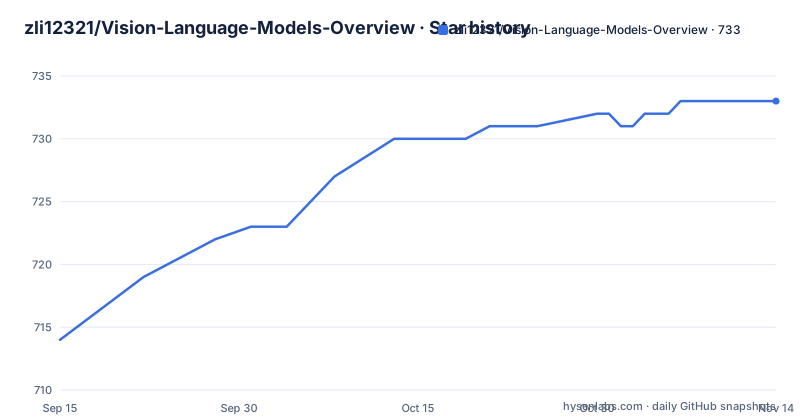
Star history
- zli12321/Vision-Language-Models-Overview733 ★ · +19
| Repository | 2026-09-15 | 2026-11-14 |
|---|---|---|
| zli12321/Vision-Language-Models-Overview | 714 | 733 |
19 Stars in the last 60 days, measured from the daily GitHub snapshot. Compare with other projects
Editorial analysis
Ten dated reports live in a directory with a space in its name
The repository holds two kinds of writing. The README carries the standing survey: four eras of architecture, a domains table, a set of links. The second kind sits in a top-level folder literally named progressive reports, with a space between the words. That single space is visible throughout the document, because every link into that folder is percent-encoded in the Markdown source: progressive%20reports/2026-09-13.md rather than a plain relative path. The folder holds ten dated mini-surveys, and the newest is dated 2026-09-13, one day before the branch's last push on 2026-09-14. These reports exist because new work arrives faster than the main tables can absorb. The project says as much, describing them as tracks for new models, benchmarks and post-training methods that have not yet been folded in. The scale of the backlog is stated in the fold label rather than hidden: expanding the list reports fifty new entries added since August 10. The report before it, dated 2026-08-10, is headlined as evaluation stopping to ask whether a model sees, and opens with HumanCLAW, which asks whether a vision-language model can act through a body, and GST-Bench, which tests global spatial awareness from video. So the README is a snapshot with a known expiry and the reports are the changelog that says what changed.
A compiled Python cache sits in a repository whose main language is HTML
The complete top-level file list is short enough to read in one go: README.md, README_zh.md, assets/, build_site.py, index.html, progressive reports/, and __pycache__/. Two things stand out. The repository's declared primary language is HTML, which fits a static site built from index.html and an assets directory, but a single Python script, build_site.py, is doing the building, and a __pycache__ directory is committed alongside it. That directory is compiled bytecode, the sort of local artifact a developer produces by running a script and then forgets to exclude. The repository has no .gitignore at the root to prevent it, since no .gitignore appears in the file list. For a project whose subject matter is careful architectural taxonomy, the packaging tells a different story: this is one maintainer's working directory that happens to be public. It also means build_site.py is the only piece of tooling here, so regenerating the site depends entirely on that one file. There is no package manifest, no CI configuration and no ignore file anywhere in that list, so the site is regenerated by hand on one machine, and the result of that hand is what the repository publishes.
No license at the root and no release to cite
The repository metadata names no license, and the file list contains no LICENSE. Nothing at the root grants permission to copy the tables, the taxonomy, or the report text, and a survey whose entire content is an index of other people's papers, model names and leaderboard positions is exactly the kind of project where that gap is worth noticing rather than assuming away. Versioning has a parallel gap. There are no GitHub releases and no tags in the record, so none of the ten dated reports is attached to a version identifier. The only two fixed points a reader can cite are the date inside each report filename and the last push, which the repository records as 2026-09-14. That is enough to say roughly when the survey was accurate and not enough to diff it. Someone tracking this survey across months has no way to tell whether a changed row means the world changed or the table was rewritten. The project's own description promises continuous updates, and a repository with no tags and no release makes that promise impossible to pin.
The part that updates daily lives on a different site
The project draws a line between what it holds and what it watches. The README records what exists. A companion called VLM Trends, published at zli12321.github.io/VLM_Survey/, tracks what changed today, and the description is specific about the pipeline: new model releases, papers, benchmarks and datasets pulled daily from arXiv, Hugging Face, GitHub and Semantic Scholar, scored on a published rubric, then grouped by topic and model family. It also charts how each research direction moves over time and makes the survey browsable. So the repository is the durable artefact and the site is the live one. The badge row at the top of the README links to both, next to an arXiv entry at 2501.02189. Two artefacts, two update cadences, and the one you would bookmark for freshness is not the one in this repository. That split also explains the dated reports: anything that needs to move fast goes to the companion, anything that needs to stay readable goes to the README. The companion carries two jobs this repository does not, charting each research direction over time and indexing models by topic and family, which is the only place in the project where models are grouped by anything other than architectural era.
Four eras in six years, with Era 3 split after the fact
The organising claim is that vision-language design has passed through four distinct eras in about six years. Era 1 keeps vision and language towers frozen and either aligns them contrastively, as CLIP does without any generative decoder, or bridges them with a learnable connector into a frozen language model, as BLIP-2 and Flamingo do. Era 2, dated 2023 to 2025, makes a pretrained LLM the trunk and treats vision as a bolt-on adapter, with an MLP or resampler projecting visual tokens into the LLM's vocabulary; LLaVA, Qwen2.5-VL and GPT-4V sit there. Era 3, 2025 to 2026, drops the bridge and early-fuses every modality into a single transformer that forks along the output axis. Era 4, dated 2026 onward, turns the trunk into a world model that predicts, remembers and acts. One caveat the document raises itself: eras 3a, 3b and 4 coexist rather than replacing one another, so this is a classification of the present, not a timeline. Era 3 was also split into two branches after the fact, which is worth keeping in mind when reading any earlier version of the numbering. A diagram caption walks the same progression from left to right, from the two-tower design through the LLM-centred arrangement to the fused trunk with decoder heads, and closes on the era 4 loop from observation to action to the next observation.
Era 3b is shedding the VAE while Era 4 merges generator and policy
The 3a and 3b branches differ in what leaves the model. Era 3a takes image, video and sometimes audio in and returns autoregressive text, and the models placed there are the general-purpose flagships: Qwen3.5 and Qwen3.6, Gemma 4, Gemini 3, GPT-5.4, Phi-4-Reasoning-Vision, Claude Opus 4.6, Nemotron 3 Nano Omni. Era 3b keeps the fused trunk and adds dedicated image and video decoder heads, either VAE, DiT or flow-matching, plus audio codec heads, so the model can generate as well as read. Generation-only specialists reuse that decoder stack: Sora 2, Veo 3 and Kling now produce video with synchronized audio, and they become substrate for the next era, with DreamX-World built on Wan, OmniDreams on Cosmos, and SolarWM on Wan2.2, LTX-2.5 and MiniMax-H3. Generation inside era 3b is not only autoregressive either: the survey points to discrete diffusion, and what it calls AR-Diffusion, for that path, citing LLaDA2.0-Uni and Mamoda2.5. Two 2026 moves sit on top of all this. The newest 3b models are dropping the VAE as well, running understanding, reasoning and generation through one encoder-free and VAE-free mixture-of-transformers trunk, with SenseNova-U1.5 cited at 8B parameters and native 4K. And Era 4 collapses the roles entirely, making generator, perceiver and policy one network.
Six world-action systems in five weeks
The most concentrated passage in the README is the Era 4 wave. The founding releases are named as Cosmos 3, Kairos, DreamX-World 1.0 and OmniDreams. Then the August to September 2026 wave arrives with six systems in five weeks: DreamX-Phi 1.0, recorded as the WorldArena 2.0 winner; SimWAM at 91.5 PDMS on NAVSIM; ZimaBlue with 120k hours of video pretraining; G0.5 running reasoning and action through a single autoregressive stream; Puffin-World with native 3D world states; and SolarWM, open at 5B to 33B parameters, doing real-time rollouts from minute to hour. The report dated 2026-09-13 makes the same claim as a headline, that Era 4 has become a paradigm. The same report adds two firsts: Qwen-Drive-1.0 from Alibaba, described as the first vision-language foundation model for driving, and AuK from Tencent Hunyuan, credited with unifying speech through a 4-step route at 4.5x. Every entry in that list is a name, a parameter count or a leaderboard position, with no method description attached. For a taxonomy whose selling point is mechanism, that is the trade the survey makes: it tells you the field moved and it tells you to whom, and it leaves the mechanism to the papers.
Every capability claim is a number attached to a name
The numbers are everywhere and they are the easiest part to quote. SimWAM sits at 91.5 PDMS on NAVSIM. On EgoMonth the README puts Gemini at 71.8 percent against 94.2 percent for a human. VideoGAIA is described as putting GPT-5.5 and Kimi K3 below 60 percent. AuK is credited with a 4.5x gain through a 4-step process. Miles v0.1 is the first open post-training stack above 700B for multimodal reinforcement learning, running GLM-5.2 744B-A40B on 64 GB300 systems at 263 seconds per step. StateSight is listed as probing latent state, and WorldReward and PAWBench as adding reward and probabilistic-alignment axes for world models. Hardware is quoted the same way: ZimaBlue is recorded as reaching 30 Hz on an RTX 4090. What accompanies each figure is a link to the work, not a protocol. That is a defensible choice for a survey, and it has a consequence for readers: a score copied out of a table arrives without the settings that produced it, so treat the number as a pointer to the paper rather than as a result you can rely on.
Editorial conclusion
Read this repository as a map, not as a dependency. It gives you the right vocabulary for why a multimodal model is shaped the way it is, and the report index tells you when each part of the map was last redrawn, which matters more than the model names baked into the prose. Three things to settle before you rely on it. There is no LICENSE file at the root and the repository metadata names no license, so nothing here carries a stated grant of reuse, which is worth thinking about for a survey built entirely out of other authors' papers. There are no releases and no tags, so the 2026-09-13 report has no version attached to it and the last push on 2026-09-14 is the only fixed point. And the daily updating work happens on a separate companion site, so if you need to know what changed this week, this repository is the wrong bookmark. If you intend to reuse the tables or the prose, ask the author which licence applies before you copy anything.
Frequently asked questions
What does the Vision-Language-Models-Overview repository actually contain?
A survey README organised around four eras of vision-language model architecture, plus a top-level folder of ten dated mini-surveys for work too new for the main tables. The complete file list is README.md, README_zh.md, assets/, build_site.py, index.html, progressive reports/ and __pycache__/, so the repository is a static site with one Python build script.
How many architectural eras of vision-language models does the survey name?
Four, with Era 3 split into two parallel branches. Era 3a is native multimodal input with text output, Era 3b adds image, video and audio decoder heads so the model can generate as well as read, and Era 4 adds action as a first-class modality so the model becomes generator, perceiver and policy in one network. The survey notes that 3a, 3b and 4 coexist rather than succeeding one another.
What is VLM Trends and how does it differ from Vision-Language-Models-Overview?
VLM Trends is the live companion site published at zli12321.github.io/VLM_Survey/. The repository records what exists, while the companion tracks what changed today, pulling new model releases, papers, benchmarks and datasets daily from arXiv, Hugging Face, GitHub and Semantic Scholar and scoring them on a published rubric. The companion is what to watch for freshness.
Can you reuse the tables and prose from Vision-Language-Models-Overview?
Nothing in the repository states a permission. The metadata names no license and there is no LICENSE file among the top-level entries, and there are no releases or tags either, so no version of the survey can be cited. The repository's last push is recorded as 2026-09-14, and the newest dated report inside it is 2026-09-13.
Official sources
Add this badge to your README
If you maintain this project, the badge below links readers to this analysis and shows its maintenance status from the daily GitHub snapshot. Paste the markdown into your README; add ?metric=license or ?metric=stars to the image URL for a different field.

[](https://hysenlabs.com/projects/zli12321-vision-language-models-overview)Star history chart for your README
[](https://hysenlabs.com/projects/zli12321-vision-language-models-overview)Was this useful?