blog_demos: one directory per article, 600 posts of Java, Docker and Kubernetes source
GitHub of CSDN blog expert programmer Xinchen, with detailed categorization and summaries of 600+ original articles and their source code, covering Java, Docker, Kubernetes, DevOps and more.
At a glance
- What is it?
- The GitHub mirror of a Chinese developer's CSDN blog, where the code that accompanies each post sits in a directory named after its topic. Nothing here is a library you depend on; the value is that a Quarkus, Flink or JVM article and its runnable source sit side by side, and the repository has not been pushed to since March 2026.
- Who is it for?
- Fit if you read Chinese and want the runnable source behind a specific post, especially for Quarkus, Flink or the JDK source experiments. Skip it if you need a maintained library, a build you can run without picking a project first, or recent updates, since the last push was 2026-03-09.
- Can I use it commercially?
- Yes. Apache-2.0 is a permissive licence: you can use, modify and sell software built on it, as long as you keep its copyright and licence notices.
- Is it still maintained?
- Activity is slowing. The repository last received commits 8 months ago.
- What is it written in?
- Mainly Java, according to GitHub's language statistics.
Answers come from the project's GitHub data, last synced on November 15, 2026, and from our analysis. They are not legal advice.
Star history
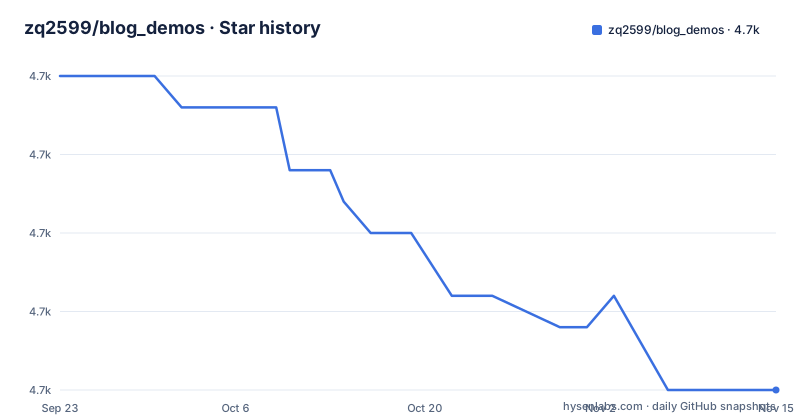
- zq2599/blog_demos4,730 ★ · -10
| Repository | 2026-09-23 | 2026-11-15 |
|---|---|---|
| zq2599/blog_demos | 4.7k | 4.7k |
-10 Stars in the last 53 days, measured from the daily GitHub snapshot. Compare with other projects
Editorial analysis
One directory per article, named after the topic
The repository is not an application. It is the source code and files that accompany the articles on a CSDN blog, laid out as a flat list of small projects so that each post has somewhere to point. The names are literal rather than tidy, and they tell you the domain immediately: `flink-tutorials`, `flinksql`, `flinkdatasourcedemo`, `flinkkafkademo`, `flinksinkdemo`, `disruptor-tutorials`, `grpc-tutorials`, `jetcd-tutorials`, `javacv-tutorials`, `client-go-tutorials`, `hiveudf`, `hbasedemo`, `cassandrahelloworld`, `dubbo_service_consumer`, `dubbo_service_provider`, `hellojib` and `jib-error-demo` among them. There is also a run of Spring customization demos that share a prefix: `customizeapplicationcontext`, `customizeimportselector`, `customizestarter`, `customizebeanpostprocessor`, `customizelifecycle` and more. Nothing here builds as one project, and nothing is meant to be added as a dependency.
Nine categories, from Java to Raspberry Pi and NAS boxes
The README groups everything into nine categories, and the spread explains why the repository is not just a Java archive. They are Java, backend middleware, Docker, Kubernetes, big data, general interests, DevOps, common tools and tips, and troubleshooting notes. The general interests category is the one that surprises people, since it covers LeetCode practice, Raspberry Pi and Synology systems alongside the professional topics, which tells you the same person writes both. Middleware and big data carry their own weight in the tree through the Kafka, Elasticsearch, ELK, Hive and HBase directories, while DevOps appears as Ansible playbooks for CDH6, Cloudera Manager with Flink 1.7.2, and a single-node Kylin 2.6.4 setup. If you arrive looking for one specific subject, the category list tells you in one line whether this repository is the right place to look at all.
Quarkus fills three series plus a virtual thread set
Java cloud-native work is the largest thread in the repository, and it is organised as numbered series rather than as scattered files. The Quarkus practical series runs to eight parts, moving from preparation work through creating, building and deploying an application, then development mode, remote hot deployment, the Maven plugin in detail, configuration, using configuration, and profiles. Dependency injection gets its own thirteen parts, covering bean creation, bean scopes, selecting a bean with annotations and by more advanced means, interceptors, publishing and consuming events, lifecycle callbacks, decorators, bean read and write locks, changing lazy loading rules, advanced interceptor properties, disabling class-level interceptors, and a final catch-all part on other important points. The database series runs to four parts: basic operations described as simpler than the official demo, running insert, update, delete and query with no database at all in dev mode, one application talking to several databases, and local caching. A separate five-part set covers virtual threads in JDK 19 as seen through Quarkus, ending with ThreadLocal.
The JVM articles compile and patch the JDK inside Docker
A recurring approach is to stop installing a JDK and to build one in a container instead. The series claims two Docker commands are enough to download and compile OpenJDK 11, then walks through making an image that downloads the OpenJDK 11 source, making another that compiles it, and editing that source on Ubuntu. The tag notes for the official openjdk image are documented alongside, and so is the question of why there is no version 8 image for ARM64, followed by a workaround article for the same gap on ARM Docker hosts. Older entries compile openjdk 8 inside Docker, modify and GDB debug the source there, and use `_JAVA_LAUNCHER_DEBUG` to get more information out of the JVM launcher. Two more threads go the other way: reading the bytecode instructions for method invocation, and a wait/notify trilogy that analyses the JVM source, then modifies it to watch parameters, then modifies it again to control the order in which threads contend for a lock.
Maven shows up as deployment and image-building exercises
The build tool appears twice in different roles. One set covers deploying and trying Nexus 3 on Ubuntu, and building a Maven project with Docker on a machine that has neither a JDK nor Maven installed, which is the point of the exercise. The other set is the Maven build Docker image trilogy, which starts with preparing the environment and then covers writing the code and building the image. Alongside these sit practical pieces that read like small experiments rather than tutorials: a rate limiter using Guava's RateLimiter, `java.util.Optional` notes, Spring's StopWatch as a small timing utility, a MongoDB replica set driven from Java, and a Redis serialization performance test comparing Kryo with plain strings. The advanced set also includes a Java file upload service built in Docker across three parts, ending with a packet capture analysis using Wireshark.
Remote development servers are treated as a topic
Several posts are about where the code runs rather than what it does. There is an experience piece on IntelliJ IDEA's remote development, and another that waited twenty days for an application to be approved before installing and trying the new UI preview of that IDE. Three more are built on cloud development environments: coding in the browser on a free four-core, 8 GB Microsoft server through Codespaces, a configuration guide for the background server behind Codespaces, and desktop VS Code pointed at a free four-core, 8 GB Microsoft server so that compiling and running happen in the cloud while Docker services can be created freely. It is an unusual cluster of articles for a Java blog, and it is the clearest signal that the author treats tooling as a subject in its own right rather than as an aside.
No releases, a March 2026 push, and the real index lives on the blog
Two facts decide how you should treat this repository. First, the README states that the WeChat public account, the Toutiao account and the CSDN account are all under the same name, that the author is a former Tencent and Alibaba employee who worked on Java backend systems, and that every article is original. Second, the code here is a companion to those posts rather than the product: the README gives the blog address and says this repository holds the source and files involved in the articles, and the links inside it point at two different article hosts. On maintenance, there are no GitHub releases, the default branch is master, and the last push landed on 2026-03-09. Treat the repository as a snapshot attached to articles rather than as something that tracks them.
Editorial conclusion
Fit if you read Chinese and want the runnable source behind a specific post, especially for Quarkus, Flink or the JDK source experiments. Skip it if you need a maintained library, a build you can run without picking a project first, or recent updates, since the last push was 2026-03-09. Before you rely on anything here, find the article that matches your problem, confirm its directory exists, and check whether the post you remember is newer than the last commit.
Frequently asked questions
What is in the zq2599 blog_demos repository?
It holds the source code and files used in the articles published on the author's CSDN blog, laid out as one small directory per topic. The README states the repository is where the blog's source and files live and groups the articles into nine categories covering Java, middleware, Docker, Kubernetes, big data, DevOps, tools, troubleshooting notes and general interests.
How much Quarkus coverage does blog_demos have?
Three numbered series: eight parts on practical Quarkus work from preparation through development mode and configuration, thirteen parts on dependency injection, and four parts on database access. A separate five-part set covers virtual threads in JDK 19 as handled by Quarkus.
Does blog_demos build as one project?
No. The repository is a flat collection of small demos with names such as `flink-tutorials`, `grpc-tutorials`, `jetcd-tutorials` and `dubbo_service_provider`, each corresponding to an article. There is no single build across the top level, and the code is meant to be read and run per directory rather than depended on as a library.
How current is the blog_demos repository?
There are no GitHub releases, the default branch is master, and the last push landed on 2026-03-09. Articles on the blog may therefore be newer than the code committed here, so check the commit date against the post you are following.
What license does blog_demos use?
The repository is published under the Apache-2.0 license, with the license text in the LICENSE file at the root. The README also states that all of the articles are the author's original work.
Official sources
Add this badge to your README
If you maintain this project, the badge below links readers to this analysis and shows its maintenance status from the daily GitHub snapshot. Paste the markdown into your README; add ?metric=license or ?metric=stars to the image URL for a different field.

[](https://hysenlabs.com/projects/zq2599-blog-demos)Star history chart for your README
[](https://hysenlabs.com/projects/zq2599-blog-demos)Was this useful?