SmartAdmin: a Java and Vue admin platform that ships four backend and frontend variants side by side
SmartAdmin: said to be China's first "high-quality code" rapid dev platform, built on SpringBoot 2/3 + Sa-Token + MyBatis-Plus and Vue3 + Vite5 + Ant Design Vue 4.x (JS and TS versions). Meets China's MLPS Level 3 requirements with login limits, domestic API encryption, and SQL-injection protection.
At a glance
- What is it?
- 1024-lab/smart-admin is an MIT-licensed rapid development platform for admin systems, with SpringBoot 2 and 3 backends, JavaScript and TypeScript Vue 3 frontends, a uni-app client, and a security feature set pitched at China's Level 3 MLPS requirements.
- Who is it for?
- Pick SmartAdmin if you build Chinese enterprise back offices on Java and Vue 3 and want one opinionated codebase with login limits, encrypted interfaces and a code generator already wired in. Skip it if you need a deployment guide in English or a verified compliance record, and before adopting it check the exact database you run, the encryption algorithm you need, and which of the four backend and frontend directories matches your stack.
- Can I use it commercially?
- Yes. MIT is a permissive licence: you can use, modify and sell software built on it, as long as you keep its copyright and licence notices.
- Is it still maintained?
- Yes. The repository last received commits 137 days ago.
- What is it written in?
- Mainly Java, according to GitHub's language statistics.
Answers come from the project's GitHub data, last synced on November 15, 2026, and from our analysis. They are not legal advice.
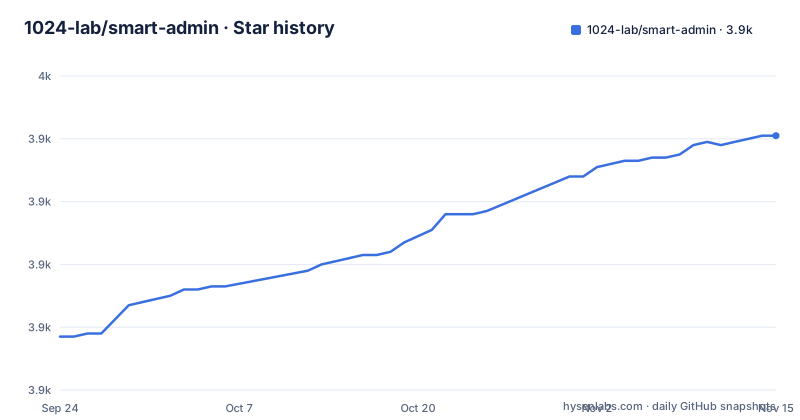
Star history
- 1024-lab/smart-admin3,941 ★ · +64
| Repository | 2026-09-24 | 2026-11-15 |
|---|---|---|
| 1024-lab/smart-admin | 3.9k | 3.9k |
64 Stars in the last 52 days, measured from the daily GitHub snapshot. Compare with other projects
Editorial analysis
Four top-level source directories force a stack decision before any code runs
The repository root holds smart-admin-api-java17-springboot3, smart-admin-api-java8-springboot2, smart-admin-web-javascript, smart-admin-web-typescript, smart-app and a folder of database SQL scripts. There is no single application at the root. The backend comes as Java 8 with SpringBoot 2.X or Java 17 with SpringBoot 3.X, and the frontend comes as JavaScript or TypeScript, both on Vue 3, Vite 5, Pinia and Ant Design Vue 4.X.
The consequence is that two of the four choices are permanent for a project. If your company is still on Java 8, the SpringBoot 3 tree is not an option, and if you later move to Java 17 you migrate by switching trees, not by flipping a flag. The same applies to the JavaScript and TypeScript frontends: they are separate directories, so bug fixes and new features have to exist in both for the two to stay equal. Read the directory you picked, not the repository as a whole.
The Level 3 security claim lists features, not a certification you inherit
SmartAdmin describes itself as the first domestic platform to meet the Cybersecurity Level 3 (MLPS) and data security requirements. The features behind that sentence are concrete: two-factor login, password encryption, a password complexity requirement, lockout after repeated login errors, logout on login timeout, and data masking.
A list of features is not an assessment result for your system. These features remove some implementation work from the admin framework, but whether your deployed system meets Level 3 is a separate question, and the first-in-China wording is the project's own statement. If a compliance audit is the reason you are looking at this project, treat the feature list as a checklist to verify against the code, and plan time for your own evaluation.
Interface encryption covers requests and responses, but the algorithm list is not spelled out
The project supports encrypting and decrypting both request parameters and returned content, and says it supports domestic encryption algorithms as well as foreign ones. The summary of the project mentions domestic API encryption and SQL injection protection alongside login limits.
Which algorithms are included, how keys are configured and whether encryption is switched on per endpoint or globally are questions for the Java source or the documentation site at smartadmin.vip. If a regulator or a partner requires a specific national algorithm, open the code and confirm that exact algorithm exists before you commit. A line saying domestic algorithms are supported is a reason to look, not a reason to skip looking.
Nine domestic database vendors are named, with no per-vendor support status
The database list is long: Dameng, Kingbase, Nandatongyong (GBase), Haliang Data, Shentong, OceanBase, GaussDB, Alibaba PolarDB and GoldenDB, plus the mainstream MySQL, PostgreSQL, SQL Server and Oracle. The repository ships a folder of database SQL scripts that the setup depends on.
A list of names is not a support matrix. Whether a script exists for every database, whether the code generator emits dialect-specific SQL and whether each one is tested against each release are things to check yourself. The practical result is that your own database is the first thing to try, with the SQL folder open next to the schema you need. If your target is one of the less common vendors on the list, run the scripts and a login flow before you plan a delivery date around it.
The code generator works from per-table configuration, so hand edits to generated files are at risk
Code generation is based on the configuration of each table. You can preview the generated code online and download it. That fits the usual pattern for this kind of platform: define a table, configure fields, get a controller-to-dao skeleton that follows the project's four layers.
After you hand-edit a generated file and then change the table, a second generation may overwrite your edits, so keep generated output under version control and check the result before you regenerate. The same caution applies to table custom columns: the project can persist a user's chosen columns to the database, which is useful, but it means the table and the frontend component now share state you have to migrate when either changes.
smart-reload and the four-layer split are conventions you adopt as a whole
The backend separates code into controller, service, manager and dao, and the project asks why the manager layer exists. It also ships smart-reload, a system hook that loads code dynamically so some code can run without restarting the program. Return codes are maintained in one place, shared configuration files are kept in a common location, and Maven handles development, test, pre-release and production environments. The frontend mirrors this with five env files for local, development, test, pre-release and production, and vue-enum constants to avoid magic numbers.
These are layout rules, not switches. If your team already uses a three-layer service structure, adopting SmartAdmin means either learning the manager layer or fighting it. Because smart-reload runs code without a restart, decide who is allowed to use it before it reaches production.
Most of the project text is philosophy, and the working documentation lives on another site
A large share of the project's text is about code quality, collaboration, not working overtime and the three coding standards it publishes: the high quality code ideas, a Vue 3 standard and a Java standard. Run instructions are not in that text. For setup, the project points to the documentation at smartadmin.vip, an online desktop preview at preview.smartadmin.vip and a mobile preview at app.smartadmin.vip. The documentation and previews are in Chinese, and a team that cannot read Chinese will need translation for the standards documents, which are a main selling point. The newest releases listed are v3.30.0 on 2026-03-02, v3.29.0 on 2026-01-22 and v3.28.0 on 2025-08-24, and the last push was on 2026-07-01. The mobile client in smart-app uses uni-app with uni-ui and targets apps, mini programs and H5, so confirm which of those your users need before counting it as covered.
Editorial conclusion
Pick SmartAdmin if you build Chinese enterprise back offices on Java and Vue 3 and want one opinionated codebase with login limits, encrypted interfaces and a code generator already wired in. Skip it if you need a deployment guide in English or a verified compliance record, and before adopting it check the exact database you run, the encryption algorithm you need, and which of the four backend and frontend directories matches your stack.
Frequently asked questions
What is SmartAdmin?
SmartAdmin is a rapid development platform from 1024 Lab in Luoyang, China. It combines SpringBoot 2 or 3, Sa-Token and MyBatis-Plus on the backend with Vue 3 and Ant Design Vue on the frontend, plus a uni-app mobile client.
Is SmartAdmin a framework or a template?
It is a full platform rather than a single template. The repository has backend projects, JavaScript and TypeScript frontends, a mobile client and database scripts, and it includes system features such as roles, menus, files and a code generator.
How do I use SmartAdmin?
Choose a backend directory (Java 8 with SpringBoot 2 or Java 17 with SpringBoot 3) and a frontend directory (JavaScript or TypeScript), then follow the documentation at smartadmin.vip. The database SQL scripts folder holds the schema scripts.
Official sources
Add this badge to your README
If you maintain this project, the badge below links readers to this analysis and shows its maintenance status from the daily GitHub snapshot. Paste the markdown into your README; add ?metric=license or ?metric=stars to the image URL for a different field.

[](https://hysenlabs.com/projects/1024-lab-smart-admin)Star history chart for your README
[](https://hysenlabs.com/projects/1024-lab-smart-admin)Was this useful?