What abanoub-asaad/Java-Backend actually is: a reading order, not a framework
These are resources, roadmaps, links to learn Java Backend :)
At a glance
- What is it?
- The Java-Backend repository holds two files, a LICENSE and a README, and the README is an eight stage reading order for backend development with Java and Spring. It contains no code, no build and no releases, so it is useful as a curriculum map and useless as a dependency.
- Who is it for?
- Use Java-Backend as a checklist when you already know Java and want an ordered list of what to study next, or as a gap audit for a junior you are mentoring. Do not expect a runnable artifact from it: the repository has only a README and a LICENSE, so nothing to build, nothing to depend on and nothing that ships.
- Can I use it commercially?
- Yes. Apache-2.0 is a permissive licence: you can use, modify and sell software built on it, as long as you keep its copyright and licence notices.
- Is it still maintained?
- Activity is slowing. The repository last received commits 6 months ago.
- What is it written in?
- GitHub does not report a main language for this repository.
Answers come from the project's GitHub data, last synced on November 7, 2026, and from our analysis. They are not legal advice.
Star history
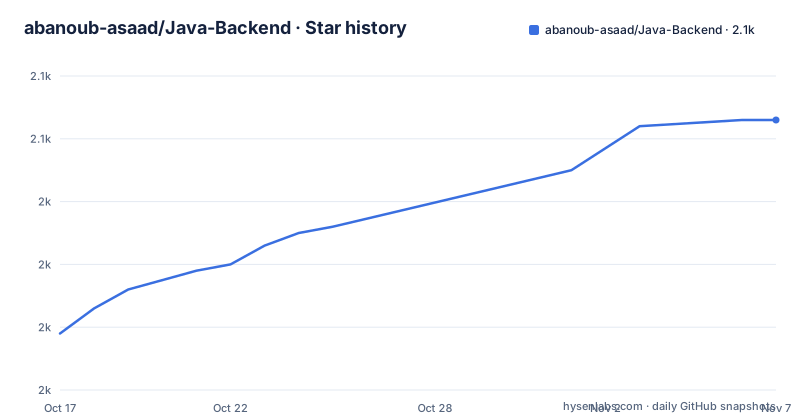
- abanoub-asaad/Java-Backend2,053 ★ · +34
| Repository | 2026-10-17 | 2026-11-07 |
|---|---|---|
| abanoub-asaad/Java-Backend | 2k | 2.1k |
34 Stars in the last 21 days, measured from the daily GitHub snapshot. Compare with other projects
Editorial analysis
Two files, one artifact
The repository listing is LICENSE and README.md. That is the whole project. There is no src directory, no build file, no CI configuration and no GitHub releases, and the README itself describes the contents as resources, roadmaps and links.
That shapes how the project can be used. There is nothing to install and no command to run. If you were looking for a Spring Boot starter, a reference implementation of the aggregator or saga patterns listed later in the roadmap, or a sample REST service, none of that exists here. What exists is an ordering of subjects and a set of pointers to external material.
The repository is licensed under Apache-2.0. Check the terms of any linked content separately before republishing it.
The roadmap puts the JVM before Spring, which is the part that matters
Eight numbered stages run in a deliberate order. Stage one is Java itself, split into basics (classes, variables, loops), OOP, collections and generics, then advanced: design patterns, JVM, threads, Servlets and JSPs, concurrency and garbage collection. Build tools follow, naming Maven, Gradle and Ant, then servers, naming Tomcat, Weblogic, JBOSS, WebSphere and Jetty. Testing comes next with unit and integration testing, JUnit and Mockito, and logging with Log4j, Log4j2 and Logback.
Stage two is Spring Framework, broken into Core (bean life cycle, dependency injection, inversion of control, bean factory and application context), Web (annotations, MVC structure, configurations, integrating libraries and frameworks, profiles) and AOP (how it works, then pointcut, join point, aspect). Stage three is Spring Boot, framed as a short list: why it exists, auto configuration, adding configuration, properties or YAML, and integrations with other libraries.
The sequence matters more than the item list. Dependency injection and the application context appear in stage two, before auto configuration in stage three, which is the only way the Boot material makes sense. JVM and garbage collection land before any framework talk. For a reader who starts at Spring Boot because it is what job ads ask for, this ordering is the main thing the repository offers that a search engine does not.
REST, databases and security as three separate stages
Stage four is REST API, listing the HTTP methods POST, GET, PUT, DELETE, OPTIONS and TRACE, then the status code families 1.X.X through 5.X.X grouped by first digit. That is the entire entry. No content negotiation, no versioning, no caching headers appear at this level.
Stage five is databases, split three ways. SQL covers My SQL, Postgress SQL and Oracle as spelled in the README. No SQL covers Mongo Db and Cassandra. A third bucket, Spring Data, covers Spring Data JPA, Spring Data MongoDB and Spring Data JDBC, which is where the framework-specific access patterns sit.
Stage six is Spring Security, five items: authentication, authorization, OAuth2, form authentications and JWT. The order implies form-based authentication first and token flows after, and OAuth2 sits above JWT rather than beneath it, which some would argue is backwards since a signed token is what the OAuth2 flows emit. Worth knowing if you follow the list literally and build a resource server before you understand the authorization server side.
Microservices stage carries the DevOps bill
Stage seven is the heaviest. Spring Cloud first, with Spring Cloud Gateway, Spring Cloud Config, Spring Cloud Circuit Breaker, Spring Cloud OpenFeign and Spring Cloud Sleuth, plus other Spring Cloud projects chosen per requirement. Sleuth is notable: it is the tracing project that has since been superseded, so a reader starting today should know the entry points at the ecosystem rather than treating that name as the current default.
Devops follows inside the same stage: Docker, Kubernetes, and cloud on AWS, GCP and Azure. Then patterns (Aggregator, CQRS, SAGA, Event Sourcing) and queues (SQS, Kafka, RabbitMQ).
Stage eight is titled Software Engineering for Backend and covers the things that are not Java at all: Clean Code, SOLID Principles, API Versioning, Idempotency and Rate Limiting, then system design basics with scalability, availability, reliability, load balancing, circuit breaker and CDN, database scaling with replication, partitioning and sharding, Redis for caching, distributed locks, pub/sub and rate limiting, messaging systems with Kafka, RabbitMQ and dead letter queue, and observability with logging and tracing. The list is cut off mid entry at Prometheus, so the observability section in the README as given is incomplete.
Redis and rate limiting appear twice, which is a sign the list was assembled rather than planned
Rate Limiting shows up in stage eight twice: once as a standalone backend concept and again as one of the Redis use cases. Kafka and RabbitMQ also appear twice, once under microservices queues and again under messaging systems, the second time adding dead letter queue. Clean Code and SOLID sit in the same stage as observability, at a very different altitude.
This duplication is not a fatal flaw. In practice most readers come back to the list per stage rather than reading it once, and the same topic surfacing under two headings gives a second chance to notice it. But it is a signal about the artifact: the sections were appended over time by topic demand rather than derived from a single curriculum model, so the ordering carries less weight in stage eight than in stages two and three.
The README also carries a References of the roadmap section and a Want to contribute to this repository section, so additions are invited rather than gated.
How this compares with the alternatives
The alternative approaches are a structured online course platform with hands-on projects, and a vendor learning path such as the official Spring guides, both of which pair the topic list with exercises and runnable code.
The difference is the delivery model. A course charges for a project you build, so the learning happens in your own repository and survives the subscription. A vendor path gives you version-matched documentation but covers one vendor's answer to each row. Java-Backend gives neither project: it is a neutral map across three SQL databases, two NoSQL stores, three clouds and three queues, which is exactly the breadth a course usually omits, and exactly the depth a course would fix.
So the two are complements rather than rivals. The list decides what to study and in what order; the course or the vendor guides supply the code for the row you are on.
A link list with no link checker
The repository has a Resources section above the roadmap, split into Docs & Articles, YouTube Channels, Books, Projects, Helpful Links and Interview Questions, and an Interview Questions section listed separately in the table of contents. Nothing in the repository verifies that those URLs still resolve, and the README is not generated from a checked manifest.
Practical consequence: two of the named technologies have moved on since the list was written, which is a small sample of what a six month old link list can contain. Budget an hour of link checking before you commit study time to it.
The last push was on 2026-04-15. The repository is not archived, but a six month gap on a resource list is a long time when the ecosystem underneath it moves every quarter.
Editorial conclusion
Use Java-Backend as a checklist when you already know Java and want an ordered list of what to study next, or as a gap audit for a junior you are mentoring. Do not expect a runnable artifact from it: the repository has only a README and a LICENSE, so nothing to build, nothing to depend on and nothing that ships. The first thing to verify is the links themselves, because the repository stores a fixed set of URLs with no build step and no link checker, so a dead video channel or a moved article is only visible when you click it. The last push was on 2026-04-15, so check that the Spring Cloud and observability entries still match the versions you deploy before you plan study time around them.
Frequently asked questions
Does the Java-Backend repository contain example code I can run?
No. The repository contains only a LICENSE and a README, and the README describes itself as resources, roadmaps and links. There is no build file and nothing to install.
What order should I follow the Java-Backend roadmap in?
It runs eight stages in order: Java, Spring Framework, Spring Boot, REST API, Database, Spring Security, Microservices, and Software Engineering for Backend. Spring Framework comes before Spring Boot, and JVM, threads and concurrency come before any framework material.
Which databases does the Java-Backend roadmap cover?
SQL is covered through My SQL, Postgress SQL and Oracle. No SQL is covered through Mongo Db and Cassandra. A separate Spring Data bucket covers Spring Data JPA, Spring Data MongoDB and Spring Data JDBC.
Can I contribute links to the Java-Backend repository?
The README has a Want to contribute to this repository section and a References of the roadmap section, so the list is presented as open to additions. It is published under Apache-2.0, which covers the README text but not the external material the links point at.
Official sources
Add this badge to your README
If you maintain this project, the badge below links readers to this analysis and shows its maintenance status from the daily GitHub snapshot. Paste the markdown into your README; add ?metric=license or ?metric=stars to the image URL for a different field.

[](https://hysenlabs.com/projects/abanoub-asaad-java-backend)Star history chart for your README
[](https://hysenlabs.com/projects/abanoub-asaad-java-backend)Was this useful?