Hunter Community Edition: a self-hosted financial AI agent stack with a three-way data supply
Hunter Community Edition: your private financial AI team combining AI agents and AI quant trading, open-source and self-hosted, powered by opencode, Claude Code, MCP and multi-agent orchestration, with a 15-minute Docker start.
At a glance
- What is it?
- Hunter Community Edition is an Apache-2.0 Python project that runs a conversational stock research agent on your own machine through docker compose. The interesting design decision is that its data layer is optional: free sources, your own MCP servers, or the vendor's paid pipeline.
- Who is it for?
- Adopt it if you are a technically comfortable individual investor who wants conversational research, position notes and an investment thesis record sitting in a local Postgres on your own disk, and who is willing to supply an LLM key and accept that the free data path degrades on coverage. Do not adopt it if you need a hosted service with no Docker footprint, if you cannot run a 7.5 GB container image, or if you expect a production trading system rather than a research tool.
- Can I use it commercially?
- Yes. Apache-2.0 is a permissive licence: you can use, modify and sell software built on it, as long as you keep its copyright and licence notices.
- Is it still maintained?
- Yes. The repository received new commits within the last day.
- What is it written in?
- Mainly Python, according to GitHub's language statistics.
Answers come from the project's GitHub data, last synced on November 15, 2026, and from our analysis. They are not legal advice.
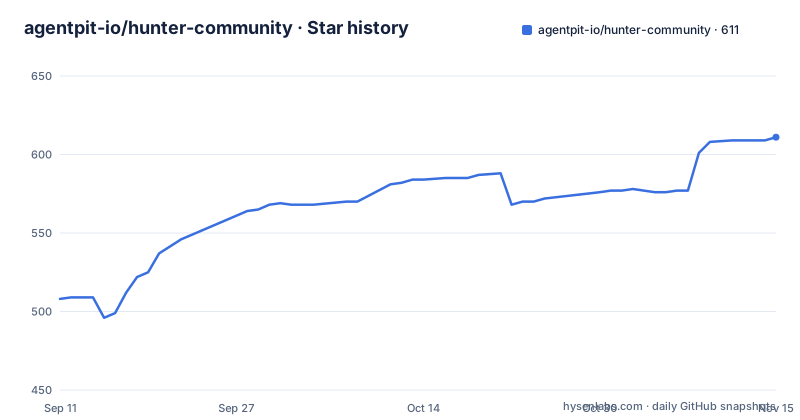
Star history
- agentpit-io/hunter-community611 ★ · +103
| Repository | 2026-09-11 | 2026-11-15 |
|---|---|---|
| agentpit-io/hunter-community | 508 | 611 |
103 Stars in the last 65 days, measured from the daily GitHub snapshot. Compare with other projects
Editorial analysis
The problem is not analysis, it is where the analysis lives
Most retail investors who want AI help with equities end up pasting numbers into a general chat window. The model answers, the answer scrolls away, and nothing accumulates. Hunter Community Edition targets that specific gap. The README frames it as a private financial AI team: an agent that can pull quotes, news, candlesticks and shareholder data, run a deep multi-dimension report, and keep a written record of why you bought something. The intended user is an individual investor, not a fund. The README's comparison table puts it against OpenBB and FinGPT (which it says require assembling providers and tools yourself, quoted as two to three days of setup), against TradingView (strong charts but subscription-only and not self-hostable), and against general coding agents like Cursor and Cline (general purpose, so financial method has to be taught). Whether those characterisations are fair is a separate question, but they make the positioning clear: the bet is on packaged financial method plus local data ownership, not on having the best charting or the largest model.
Three data paths, and only one of them is free forever
The README calls the data supply the only concept you need to understand, and that is honest, because it is also the main commercial boundary. Path one needs no vendor key at all: akshare covers A-shares, yfinance covers US and Hong Kong listings, and there are bundled offline samples. The README states plainly that coverage is incomplete and that the system gives an explicit degradation notice rather than failing silently. Path two is bring-your-own: you attach your own broker, data vendor or MCP server through a plus button in the sidebar toolbox, and the README mentions the Cline and Cursor MCP ecosystem as a source of servers. Path three is the vendor's pipeline, gated behind a hunt_tools_xxx key that the README says is free to request and takes about thirty seconds. That key reportedly opens 32 of 33 data sources, 23 curated skills, Kronos trend forecasting and TrueSource alternative intelligence through four gateways (tools, data, kronos, truesource). The recommended progression is explicit: start on free sources, hit coverage gaps, then upgrade either to the vendor pipeline or to your own feeds. Read that as the product's real funnel. The self-hosting is genuine, but the deepest data is not in the repository.
What actually runs when you type a ticker
The architecture is a set of six services orchestrated by docker compose, described as reaching healthy state automatically. The conversational engine is pulled from ghcr.io rather than built locally, and the README puts that image at roughly 7.5 GB, which is why it asks for 20 GB of disk and 4 GB of RAM. The agent loop is MCP-based with function calling: the model decides which tool to invoke, the tool returns structured data, and the frontend renders it as a rich card rather than raw text. The README's example is asking for the price of 601899 and getting a card with the live price, a 52-week percentile and a short AI comment. Streaming is SSE, so tokens appear as they are generated. Deep analysis is a separate, longer path: the README quotes 60 to 300 seconds for a 22-dimension report. Kronos, described as a Tsinghua time-series model, produces a ten-day candlestick forecast in 30 to 70 seconds and is listed as GPU inference, which means the CPU-only Docker host will not get the same experience. Skills are written in Markdown, which is the extension surface: a skill file is a methodology document the agent follows, and the README says skills can be installed from GitHub with one click.
Getting it up: the commands and the keys that matter
The README gives a three-step start. Clone the repository, copy .env.example to .env, then generate a secret with openssl rand -base64 48 appended as JWT_SECRET (a PowerShell equivalent is in docs/01-getting-started.md). Then you edit three things by hand. LLM_BASE_URL, shown as https://api.deepseek.com/v1. LLM_DEFAULT_MODEL, shown as deepseek-v4-pro. LLM_API_KEY, your own key. There is a fourth setting the README flags as mandatory for DeepSeek specifically: LLM_SCHEMA_SANITIZE=1. A fifth, HUNTER_API_KEY, takes a hunt_tools_xxxxx value and is optional, covering data path three. Then docker compose up -d and open http://localhost:3100. The README is candid about timing: about ten minutes on first run to pull images, about thirty seconds afterwards, and it advertises five minutes once images are present. The model key is not optional and is not supplied by the project. The README points at DeepSeek's free tier and says any OpenAI-compatible endpoint works, naming OpenAI, OpenRouter, OneAPI and AIHubMix. There is no account requirement when you self-host; the live demo site at hunter-community.agentpit.io does require registration because it is multi-user.
The investment thesis memory is the part worth evaluating closely
Hunter's differentiator, per its own README, is what it calls the investment thesis memory. When you record a position you also record the reasoning: the core argument, five key assumptions, and your cost basis. The system then re-checks those assumptions against new data. The README lists four monitoring behaviours: earnings falsification, where reported revenue and profit are compared against your original assumptions and deviations are flagged quantitatively; order-flow monitoring, which watches sentiment around key customers, suppliers and channels; pillar-collapse alerts, which fire when any of the five assumptions breaks; and assumption drift tracking, which records how far and how fast a metric has moved from baseline. Storage is a local Postgres, described as staying on your disk, with the vendor stating it sees request counts for the pipeline key but not your data or conversations. The mechanism runs through a skill named uzi_thesis. The README also notes a planned v1.0 optional paid cloud sync for the memory, while saying the local single-machine version stays free. That is the honest shape of the thing: a genuinely useful concept, implemented as a skill plus a local database, with a future paid tier attached to the one feature that creates lock-in.
Model choice is a real risk, and the project knows it
The README states a methodology it calls testing tool calls rather than testing chat, and says seven golden cases were used to measure tool_call reliability per model. The visible part of that table shows DeepSeek v4 pro as the default, with a claimed cost under $0.001 per call and 12 to 70 second latency, plus a column for known pitfalls. What can be said is that the design makes the LLM a hard dependency with a specific failure mode: if your model calls tools poorly, the agent produces plausible text without the underlying data, and the rich cards simply do not appear. LLM_SCHEMA_SANITIZE=1 existing as a DeepSeek-specific requirement is a signal that provider quirks leak into the agent loop. Anyone swapping in a cheaper or local model should expect to re-run that golden-case evaluation themselves, because the README does not publish the harness.
Where it is the wrong tool
Three constraints stand out. First, the Docker footprint: a 7.5 GB image and a 20 GB disk request is not a lightweight install, and Kronos forecasting is described as GPU inference, so the CPU-only laptop gets a degraded feature set. Second, the free data path is explicitly incomplete. If your universe is small-caps, non-Chinese exchanges, or instruments akshare and yfinance do not cover, the first-run experience will be a series of degradation notices, and the fix is either the vendor's key or building your own MCP server, which is real work. Third, this is a research tool and the README says so in its own disclaimer: all output is AI-generated, for research reference only, and not investment advice. Anyone reading the ai-quant and quantitative-trading topics as a signal that this places trades is reading it wrong. The honest comparison here is OpenBB: it is a data and analytics library with a broad provider ecosystem that you compose yourself, whereas Hunter is an opinionated agent application with a fixed set of skills and a conversational front end. If you want to build your own pipeline, OpenBB's approach fits better. If you want a working agent today and are willing to accept its opinions, Hunter is the shorter path.
Licence, maintenance and what a fork actually costs
The licence is Apache-2.0, and the README states the practical condition in its own words: fork freely, but rename. That is a trademark restriction rather than a copyright one, and it is the clause to read before you ship a derivative. Apache-2.0 also means commercial closed-source use and redistribution are permitted, which is unusual for a project with a paid data pipeline attached, and it is worth understanding that the moat is the data and the hosted tier, not the code. On maintenance: the release history shows v0.1.3 and v0.2.0 both on 2026-08-10, then v1.0.0-rc1 on 2026-08-31, with the last push to main on 2026-09-10. That is a compressed release cadence on a young project, and v1.0.0-rc1 is a release candidate, not a stable tag. Upgrading means pulling new images from ghcr.io and re-running docker compose, and because the conversational engine is a pulled image rather than source you build, you are trusting the vendor's build pipeline for that component. The .env file is the upgrade surface you control: model endpoint, model name, API keys and the sanitize flag. Pin your image tags if you care about reproducibility, because the README does not describe a rollback procedure.
Editorial conclusion
Adopt it if you are a technically comfortable individual investor who wants conversational research, position notes and an investment thesis record sitting in a local Postgres on your own disk, and who is willing to supply an LLM key and accept that the free data path degrades on coverage. Do not adopt it if you need a hosted service with no Docker footprint, if you cannot run a 7.5 GB container image, or if you expect a production trading system rather than a research tool. Before committing, verify three things: that the free akshare and yfinance path actually covers the instruments you follow, that your chosen model passes the tool-calling golden cases the README describes, and that you have read the Apache-2.0 trademark condition about renaming on fork.
Frequently asked questions
What is HunterCode and what does it do?
A self-hosted financial research assistant for A-share, Hong Kong and US equities that runs on your own machine or server. You give it a model key and it looks up quotes, pulls news, does single-stock deep analysis, forecasts trends, and manages a watchlist and holdings, storing conversations, holdings and investment theses in a local database.
Does HunterCode trade stocks or give investment advice?
No. It does not connect to brokerage trading, does not make decisions for you, and does not guarantee prediction accuracy. The page carries a disclaimer that all output is AI-generated, is for research reference only, and does not constitute investment advice.
What services does the HunterCode compose file run?
Six: postgres 16 on alpine, redis 7 on alpine, and four project services named api, opencode, llm-shim and web. All project images are prebuilt and published for both amd64 and arm64, so Apple Silicon and ARM cloud hosts run natively without emulation.
Why does HunterCode not collect market data on a fresh install?
Because HUNTER_MINIMAL_BOOT defaults to 1, which skips the collector, signal monitor, alerts, backtest and stocks catalogue seed since they need external credentials. Schema changes still run and authentication, watchlist and settings work; set the variable to 0 once a model key and data source are configured.
What are the HunterCode built-in model quota limits?
Ten million tokens per key per day counting input and thinking output, resetting at midnight Beijing time, with separate per-minute request and concurrency limits. The same key unlocks the platform data pipeline. Exhausting it is not an outage: the conversation explains when it resets and how to switch to your own key.
Has the HunterCode desktop launcher been tested on Windows?
No. It was compiled and packaged in continuous integration but has not been run on any real Windows machine. macOS was verified end to end on real hardware on 2026-09-23, and Linux was verified on a test machine including offline import. Every release is marked prerelease because the packages are unsigned.
Official sources
Add this badge to your README
If you maintain this project, the badge below links readers to this analysis and shows its maintenance status from the daily GitHub snapshot. Paste the markdown into your README; add ?metric=license or ?metric=stars to the image URL for a different field.

[](https://hysenlabs.com/projects/agentpit-io-hunter-community)Star history chart for your README
[](https://hysenlabs.com/projects/agentpit-io-hunter-community)Was this useful?