Airframes Public Data: A Curated Aeronautical Dataset with a Three-Tier License
Centralization of source data for Airframes/Acars projects
At a glance
- What is it?
- Airframes Public Data centralizes ACARS, VDL, HFDL, and SATCOM reference data for aviation projects, but its licensing model demands attention before adoption.
- Who is it for?
- Adopt Airframes Public Data if you are building a non-commercial ACARS, VDL, HFDL, or SATCOM tool and can accept attribution or a paid contributor status. Avoid it for commercial products unless you budget for an annual license, and verify the current data formats and update frequency by inspecting the repository before integration.
- Can I use it commercially?
- Not without permission. GitHub finds no licence file in the repository, and without a licence all rights are reserved by default: you may read the code but not reuse it. Check the README, or ask the authors, before using it.
- Is it still maintained?
- Yes. The repository received new commits within the last day.
- What is it written in?
- Mainly Ruby, according to GitHub's language statistics.
Answers come from the project's GitHub data, last synced on October 22, 2026, and from our analysis. They are not legal advice.
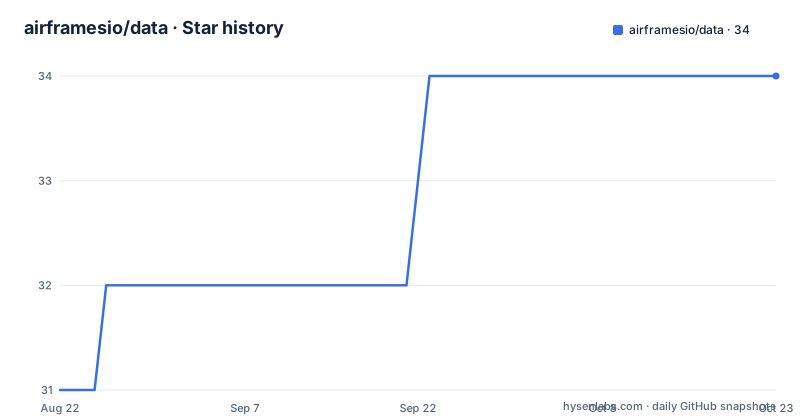
Star history
- airframesio/data34 ★ · +3
| Repository | 2026-08-22 | 2026-10-22 |
|---|---|---|
| airframesio/data | 31 | 34 |
3 Stars in the last 61 days, measured from the daily GitHub snapshot. Compare with other projects
Editorial analysis
What This Repository Actually Provides
The repository is a central store of aeronautical reference data for the Airframes project and related ACARS, VDL, HFDL, and SATCOM tracking applications. The README describes the data as collected, crafted, curated, processed, pruned, and otherwise prepared for public consumption. This is not a live feed or a historical message database. It is a static dataset, likely containing aircraft registrations, ground station locations, and other reference tables. The intended users are developers building their own tracking or visualization tools, such as ACARS Hub or Airplanes.Live, which are listed as consuming projects. If you need real-time message streams, this repository is not that; the README mentions a separate historical database planned for API access, but that is not available here.
The Data Structure and Format
The README does not list specific files or schemas, but it states the data is provided in standard formats. The repository is Ruby-primary, which suggests the data processing scripts are written in Ruby, likely for parsing and generating CSV, JSON, or similar plain-text files. The actual data directories are not described in the provided material, so you would need to clone the repository to inspect the layout. The emphasis on standard formats is a practical choice: it lowers the barrier for integration into different programming environments. However, the lack of documented schema in the README means you must rely on the file contents themselves, which could be a hurdle for quick adoption.
Getting Started: Commands and Workflow
The README does not include installation commands or a quick-start guide. Based on the repository being a data repository, the typical workflow is to clone it. You would run `git clone https://github.com/airframesio/data.git` and then explore the directories. The primary language is Ruby, so any processing scripts would be executed with `ruby script.rb`, but no specific scripts are named. The README encourages contributions via Pull Requests, which implies a standard GitHub workflow: fork, branch, commit, and open a PR. For data consumers, the simplest path is to download the repository as a ZIP archive or clone it, then copy the relevant data files into your project. There is no package manager setup or dependency installation mentioned, which suggests the data is self-contained.
The Licensing Model: Three Tiers, Clear Boundaries
The repository uses a custom licensing scheme with three options. Non-commercial projects can use the data for free, with attribution encouraged but optional. Non-commercial significant contributors, defined as those who submit meaningful data files or contribute at least $250 annually, can use the data without attribution. Commercial projects must purchase an annual license. This is a deliberate departure from standard open-source licenses like MIT or GPL. The README explicitly prohibits republishing the data as your own, even for non-commercial use. This model creates a clear boundary: if you are building a paid product, you must pay. If you are a hobbyist, you are welcome. The lack of a standard license identifier in the repository metadata means you should rely on the README and any LICENSE file in the repo, which is not shown here.
Who Should Use It and Who Should Not
This data is ideal for hobbyist or research projects that track aircraft communications. If you are building a personal ACARS decoder or a visualization tool for a local feed, the non-commercial license is permissive and free. The listed projects, ACARS Hub and Airplanes.Live, show real-world usage. However, if you are developing a commercial aviation analytics product, the license requires payment, and the cost is not disclosed. That is a potential deal-breaker for startups or small companies without a budget for data licensing. Also, if you need real-time or historical message data, this repository is the wrong tool because it is static reference data. The README mentions a future API for the historical database, but that is not available now.
Alternatives and How They Differ
A direct alternative is the OpenSky Network, which provides open access to ADS-B and Mode S data via API. OpenSky offers real-time and historical data under a Creative Commons license, with a free tier for non-commercial use and paid plans for commercial access. The key difference is that OpenSky focuses on ADS-B, not ACARS or VDL, and it provides dynamic flight data rather than static reference tables. Another alternative is to compile your own data from public sources like FAA registrations or ICAO documents, but that requires significant effort and is exactly the work this repository aims to save. The trade-off is that OpenSky gives you live data but requires an API key and has rate limits, while Airframes data is a static download with no rate limits but no real-time component.
Maintenance and Upgrade Costs
The README indicates ongoing curation, with contributors listed for ground station data and general improvements. The repository is not archived and has a default branch of master, but the last push date is unknown, so the update frequency is uncertain. Data files may become stale if aircraft registrations or ground station locations change. The README encourages users to submit corrections via pull requests, which means the community is expected to maintain the data. For a consumer, the upgrade cost is low: you can re-clone or pull the repository periodically. However, the license requires you to notify the project via email for non-commercial use, and significant changes to data structure are communicated through that channel. There is no versioning or release system mentioned, so you cannot rely on semantic versioning for backward compatibility.
Editorial conclusion
Adopt Airframes Public Data if you are building a non-commercial ACARS, VDL, HFDL, or SATCOM tool and can accept attribution or a paid contributor status. Avoid it for commercial products unless you budget for an annual license, and verify the current data formats and update frequency by inspecting the repository before integration. The licensing terms are explicit and enforced, so check the license file and contact [email protected] for any use case not clearly covered.
Frequently asked questions
Where does Flightradar24 get its data from, according to this repository?
The repository says nothing about Flightradar24. What it describes is its own role: centralising common aeronautical elements in standard formats for projects such as Airframes, which uses ACARS, VDL, HFDL and SATCOM, and Airplanes.Live, which uses ADS-B.
Can I see ACARS messages using this repository?
Not from here. The repository holds common aeronautical elements and is separate from the feed messages historical database, which the project plans to expose through an API, free for feeders and significant contributors. ACARS Hub is listed as a separate project for visualising local ACARS and VDL feeds.
Are flight data recorders mandatory, and does this data say?
The repository does not address regulation or the legal requirement for recorders. It covers aeronautical reference data in csv/, json/ and images/ directories, maintained by scripts, and says nothing about flight data recorder mandates.
What is the difference between ACARS and ATN?
The README does not explain the protocols. It refers to the radio systems its consumer projects use, namely ACARS, VDL, HFDL, SATCOM and ADS-B, and to the aeronautical elements that describe them. Nothing in it defines ATN or compares it with ACARS.
Official sources
Add this badge to your README
If you maintain this project, the badge below links readers to this analysis and shows its maintenance status from the daily GitHub snapshot. Paste the markdown into your README; add ?metric=license or ?metric=stars to the image URL for a different field.

[](https://hysenlabs.com/projects/airframesio-data)Star history chart for your README
[](https://hysenlabs.com/projects/airframesio-data)