hermes-agent-orange-book: A Free Book About Hermes Agent, and What Its Own Errata Reveals
Hermes Agent from beginner to expert: Orange Book series, a practical guide to the Nous Research open-source AI agent framework.
At a glance
- What is it?
- The Orange Book series guide to Nous Research's Hermes Agent is a free PDF; the English edition covers v0.16.0 across 21 sections and the Chinese third edition is updated for v0.22.2. Its most instructive page is the errata, where the author retracts a claim about data collection.
- Who is it for?
- Read this book if you want a structured, free walkthrough of Hermes Agent v0.16.0 before committing time to the official docs, and read the errata section before section 03. Skip it if you need reference material that tracks the current release: the repository has published no releases, and the author states the English edition has not been regenerated with the corrected body text.
- Can I use it commercially?
- Check first. The repository uses a licence we do not classify automatically, so read its LICENSE file before any commercial use.
- Is it still maintained?
- Yes. The repository last received commits 25 days ago.
- What is it written in?
- Mainly Python, according to GitHub's language statistics.
Answers come from the project's GitHub data, last synced on November 13, 2026, and from our analysis. They are not legal advice.
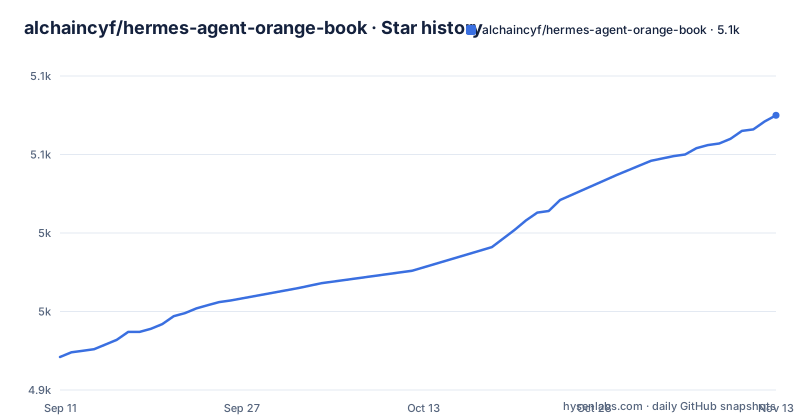
Star history
- alchaincyf/hermes-agent-orange-book5,075 ★ · +154
| Repository | 2026-09-11 | 2026-11-13 |
|---|---|---|
| alchaincyf/hermes-agent-orange-book | 4.9k | 5.1k |
154 Stars in the last 63 days, measured from the daily GitHub snapshot. Compare with other projects
Editorial analysis
A Book Repository, Not a Framework Repository
The name invites a wrong assumption. This repository contains no Python package to install and no agent runtime. It is the source of a book: two PDFs, one in Chinese and one in English, plus screenshots and a hero animation asset. The Python listing in the repository metadata comes from the tooling around the writing rather than from anything a reader would import. If you arrived expecting a library, you are in the wrong place, and the README makes the actual subject clear in its first line by linking out to NousResearch/hermes-agent. The problem this repository solves is narrower than it looks: Hermes Agent is a fast-moving project, and the book exists to give a reader a single ordered path through it rather than a scattered set of documentation pages. The stated audience is developers who already use Claude Code, OpenClaw or Cursor and want to place Hermes in that context, plus AI users who do not work in a terminal and now have a desktop app to try. A third group is named explicitly: people who want to see Harness Engineering concepts turned into a shipping product. That framing matters, because the book is written as a companion to a concept series rather than as an API reference.
What Version 2.0 Actually Changed
The README is unusually direct about the rewrite. The first edition, v260408, was built on Hermes Agent v0.7.0. The second edition, v260607, was rebuilt around v0.16.0, which the book calls The Surface Release. The author describes the gap as two months and nine releases, and says the product grew a native desktop app, a full browser dashboard and 23 messaging platforms in that window. The structural change is concrete: 17 chapters across 5 parts became 21 sections across 6 parts. Three areas are named as new material, the self-improvement loop called Curator, the multi-agent Kanban platform, and the security model.
The Six-Part Structure and What Each Part Assumes
The table of contents is the most useful thing in the README for deciding whether the book fits your situation. Part 1, What It Is, spans sections 01 to 03 and covers the product, its multiple surfaces, and Nous Research's motives. Part 2, titled The Reins Grow Themselves, covers sections 04 to 06: the self-improvement engines, Curator, and a section on what not to learn. Part 3, How It Remembers You, runs sections 07 to 10 across three-layer memory, session search, Skills, and orchestrating agents. Part 4, Connecting Everything, covers sections 11 to 14: 64 tools, MCP, 23 platforms, three surfaces. Part 5 handles multi-agent work from delegate_task up to the Kanban platform across sections 15 to 17. Part 6 closes with deployment, the OS boundary, Promptware defense, and a section on how far the system can go, sections 18 to 21.
The Errata Is the Most Valuable Section in the Repository
The README devotes a long passage to correcting its own book, and this is the part worth reading before anything else. Section 03, Why Nous Built It, argued that Hermes Agent doubles as a data harvester feeding user trajectories back into Nous Research's own models. The author now states that chain breaks at its first link. Two sources are cited. The official FAQ is quoted as saying API calls go only to the LLM provider you configure, that Hermes Agent does not collect telemetry, usage data or analytics, and that conversations, memory and skills are stored locally in ~/.hermes/. The official AGENTS.md is cited as listing outbound telemetry or usage attribution without opt-in gating among contributions that get rejected even when well built. The author's own explanation of the error is specific: artifacts like batch_runner.py, trajectory_compressor.py and a Research-ready section are real, but they are research infrastructure for generating trajectories in a researcher's own environment, not a pipeline pulling data from users. He also concedes that flagging the claim as inference did not save it, since an inference contradicted by official documentation is still wrong. The knock-on effect is stated plainly: the data flywheel argument at the end of section 03 does not hold, and of the motives attributed to Nous, monetizing through Portal and competing for OpenClaw's users stand while users feeding it training data should be struck.
The PDFs Are Build Artifacts and Have Not Been Regenerated
Here is the limitation that should shape how you use this. The author writes that the English edition v260607 has not been regenerated yet and the erratum stands for it, while the Chinese edition v261020 corrects the §03 body text. That means the downloaded English PDF still contains the incorrect section 03 argument, and its correction lives only in the repository's README. A reader who grabs the PDF and skips the repository page will absorb a claim the author has already retracted. There is no release tag to pin, since the repository has no published GitHub releases, so the only version markers are the filenames themselves: Hermes-Agent-The-Complete-Guide-v260607.pdf and its Chinese counterpart. The repository also has no homepage field set. The deeper issue is that a book about a product shipping nine releases in two months has a short shelf life by design, and the author acknowledges this directly by pointing readers to the official documentation for the latest information. Treat the book as an orientation layer, not a reference you keep open beside your editor.
How You Actually Get the Material
There is nothing to build. The README's Download table gives two direct links: the Chinese PDF at the raw path Hermes-Agent橙皮书2.0-v261020.pdf and the English PDF at Hermes-Agent-The-Complete-Guide-v260607.pdf, both under the main branch of the repository. Cloning the repository gets you the same files plus the assets and screenshots directories referenced in the README. If you only want to read, the download links are sufficient and no Python environment is required. If you intend to quote or redistribute the text, note that the repository metadata reports NOASSERTION, which means GitHub could not map the repository's licence file to a recognised identifier. Read the LICENSE file in the repository directly before relying on any terms.
Where a Book Loses to the Official Docs
The honest alternative to this repository is not a competing book. It is hermes-agent.nousresearch.com/docs, which the README itself names as the authority for product facts. The difference in approach is structural rather than qualitative. Official documentation is maintained by the project and updated as the product changes; this book is a snapshot of v0.16.0 that its author has already had to correct once in public. Documentation gives you per-feature reference entries you can jump into, while the book gives you a sequence and a rationale for the sequence. If your question is how do I configure a specific MCP server, the docs win outright. If your question is which part of this system should I learn first, the book's six-part ordering is the thing the docs do not provide. There is a second alternative worth naming for readers coming from other tools: the same author's Harness Engineering 橙皮书, which the README describes as covering five components (instructions, constraints, feedback, memory, orchestration) that Hermes productizes. Reading that first would make the Hermes book's Part 2 and Part 3 land differently.
Maintenance Cost and the Case Against Adopting It
Adopt this if you want a free, ordered introduction to Hermes Agent and you are willing to cross-check anything version-sensitive. Do not adopt it as your only source if you are building against the current release, because the PDF trails the product and the author says so. Do not adopt it if you need material you can redistribute commercially without reading a licence file first, given the NOASSERTION metadata. And do not quote section 03's data-collection argument in any form, since the author has retracted it in writing. The maintenance picture is simple: the repository has no releases and no homepage, so updates arrive as new PDF filenames and README edits rather than as tagged versions you can diff. The concrete next step is to open the English PDF alongside the errata section, read section 03 knowing which paragraph is wrong, and confirm the licence by opening the LICENSE file in the repository before you reuse a single sentence.
Editorial conclusion
Read this book if you want a structured, free walkthrough of Hermes Agent v0.16.0 before committing time to the official docs, and read the errata section before section 03. Skip it if you need reference material that tracks the current release: the repository has published no releases, and the author states the English edition has not been regenerated with the corrected body text. Verify the licence file first, since GitHub reports NOASSERTION, then confirm any product fact against hermes-agent.nousresearch.com/docs.
Frequently asked questions
What is hermes-agent-orange-book?
It is a repository holding two PDF editions of a free guide to Hermes Agent, the open source AI agent framework from Nous Research. The second edition is version v260607, rewritten around Hermes Agent v0.16.0 called the Surface Release, with 21 sections across 6 parts. Both PDFs sit at the repository root alongside a tools directory.
Does hermes-agent-orange-book collect user data?
The book's errata withdraws its own claim that Hermes Agent harvests user data for training Nous models. The errata cites the project FAQ, which says API calls go only to the configured LLM provider, that no telemetry or usage data is collected, and that conversations, memory and skills are stored locally in `~/.hermes/`. The book states that the data flywheel argument in section 03 does not hold either.
What license is the hermes-agent-orange-book released under?
GitHub shows no recognised license value (NOASSERTION) for the repository even though a LICENSE file exists at the root, so read that file for the actual terms.
Is there a dashboard for the Hermes agent?
The book describes Hermes Agent v0.16.0 as adding a full browser dashboard and a native desktop app, and part four of the book covers three surfaces. That release also brought support for 23 messaging platforms. The repository itself contains no code for a dashboard, since it holds the book PDFs rather than the framework.
Official sources
Add this badge to your README
If you maintain this project, the badge below links readers to this analysis and shows its maintenance status from the daily GitHub snapshot. Paste the markdown into your README; add ?metric=license or ?metric=stars to the image URL for a different field.

[](https://hysenlabs.com/projects/alchaincyf-hermes-agent-orange-book)Star history chart for your README
[](https://hysenlabs.com/projects/alchaincyf-hermes-agent-orange-book)Was this useful?