The Alexa Skills Kit SDK for Node.js: A 2020 Snapshot of a Mature but Quiet Repository
GitHub describes it as The Alexa Skills Kit SDK for Node.js helps you get a skill up and running quickly, letting you focus on skill logic instead of boilerplate code.. The repository metadata lists TypeScript as its primary language. The metadata lists the Apache-2.0 license. This article stays within the project description and details documented in the GitHub repository README.
At a glance
- What is it?
- The ASK SDK v2 for Node.js abstracts Alexa request and response JSON into model classes and handlers, but its last push was in October 2020, so engineers must weigh its stability against its stagnation.
- Who is it for?
- Adopt this SDK if you are building a new Alexa skill in Node.js and want a structured handler model with built-in persistence adapters and SMAPI access. Do not adopt it if you need active maintenance, recent security patches, or support for the latest Alexa features beyond the 2020 preview list.
- Can I use it commercially?
- Yes. Apache-2.0 is a permissive licence: you can use, modify and sell software built on it, as long as you keep its copyright and licence notices.
- Is it still maintained?
- Probably not. The repository last received commits 41 months ago, on May 16, 2023.
- What is it written in?
- Mainly TypeScript, according to GitHub's language statistics.
Answers come from the project's GitHub data, last synced on October 22, 2026, and from our analysis. They are not legal advice.
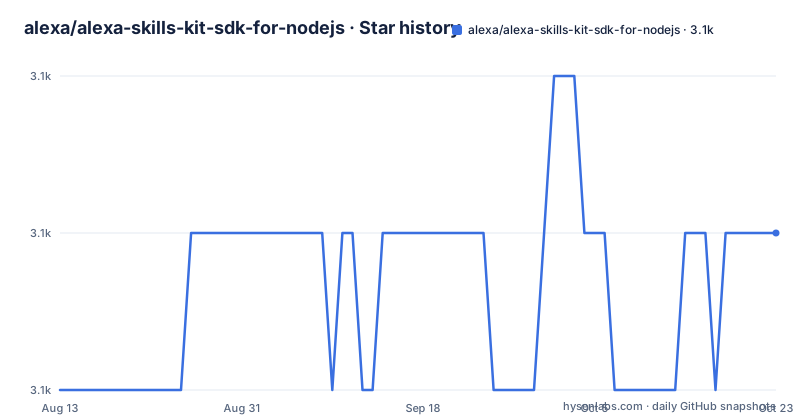
Star history
- alexa/alexa-skills-kit-sdk-for-nodejs3,136 ★ · +1
| Repository | 2026-08-13 | 2026-10-22 |
|---|---|---|
| alexa/alexa-skills-kit-sdk-for-nodejs | 3.1k | 3.1k |
1 Stars in the last 70 days, measured from the daily GitHub snapshot. Compare with other projects
Editorial analysis
The Problem It Solves: Boilerplate Reduction for Alexa Skills
The SDK is not a single package. It is a monorepo with multiple npm packages: ask-sdk, ask-sdk-core, ask-sdk-runtime, persistence adapters for DynamoDB and S3, an Express adapter, a v1 adapter, and the SMAPI SDK. This modular design lets you install only what you need. For example, a Lambda-hosted skill might only need ask-sdk and ask-sdk-dynamodb-persistence-adapter. The README lists these packages in a table, which suggests the project is organized for selective adoption rather than a monolithic install.
The Architecture: Handlers, Model Classes, and Persistence Adapters
Persistence is a separate concern. The SDK ships adapters for DynamoDB and S3, so you can store session and user attributes without writing your own storage code. The DynamoDB adapter is the default for Lambda-hosted skills, but the S3 adapter is available for skills that run elsewhere. The Express adapter lets you host a skill on a standard Node.js HTTP server, which is useful for local testing or non-AWS deployment. The v1adapter exists to help migrate skills built with the older ASK SDK v1, but the README does not describe how complete that migration path is. That is a gap you should verify before relying on it.
Getting It Running: Commands and Config Keys
The SDK is written in TypeScript, and the primary language is listed as TypeScript. That means type definitions are likely included in the npm packages, which is useful for editors and for catching errors at compile time. The README does not show a config file for the SDK itself. Configuration is done in code, through the skill builder and handler registration. For example, you would create an instance of the skill with a Lambda handler and add request handlers and error handlers. The exact method names are not in the README, so you would need to consult the technical docs or the samples to get the precise API.
Limitations: Frozen in Time and Preview Features
Another limitation is the lack of a homepage and minimal documentation in the repo itself. The README points to external docs and samples, but the core API is not documented in the repository. This means you must rely on the developer portal, which may not be versioned with the SDK. The v1adapter is a migration tool, but without clear documentation on its coverage, you might find that some v1 features are not supported. The SDK also assumes you are building for the Alexa platform, so it is the wrong tool if you are building a voice assistant for a different ecosystem or if you need to handle non-Alexa voice input.
Alternatives: The Controls Framework and Raw JSON Handling
Another alternative is to skip the SDK entirely and handle the raw JSON requests yourself. That approach gives you full control over the request parsing and response generation, and it avoids the dependency on a frozen SDK. The downside is that you must implement routing, session management, and persistence manually. For a very simple skill, raw JSON might be simpler than learning the SDK's handler model. For a complex skill, the SDK's structure is likely worth the dependency. The v1adapter is another alternative for existing v1 skills, but it is a migration path rather than a separate approach. The choice depends on whether you value structure over control and whether you accept a frozen dependency.
Maintenance and Upgrade Cost
The maintenance cost of this SDK is effectively zero because there is no active maintenance. The repository has not received a push since October 2020, so you will not be forced to upgrade for new features. However, that also means you will not get fixes for issues that emerge as Node.js versions change or as the Alexa service evolves. The SDK is written in TypeScript, so you might need to update your own TypeScript version to match the SDK's type definitions. The last release is v2.10.0, and the default branch is 2.0.x, which indicates a stable major version. The license is Apache-2.0, which permits commercial use and modification, but you must include the license notice in your distribution. The README does not mention any contribution guidelines or a code of conduct, so the maintenance process is opaque. Before adopting, check the npm page for each package to see if there are any known vulnerabilities or deprecated versions.
What the README Does Not Tell You
The README is a high-level overview, not a technical reference. It does not show a single line of code, and it does not explain how to handle errors, how to use the persistence adapters, or how to test a skill locally. The technical documentation is external, and the samples are separate repositories. This means the repository itself is not self-contained for a newcomer. You will need to visit the Alexa developer portal and read the sample code to get started. The README also does not mention any performance characteristics or benchmarks. There is no claim about cold start times or memory usage. The SDK's overhead is likely small, but you cannot confirm that from the material. The SMAPI SDK is mentioned as a separate package, but the README does not describe its API or its relationship to the core SDK. You would need to explore that package separately.
Editorial conclusion
Adopt this SDK if you are building a new Alexa skill in Node.js and want a structured handler model with built-in persistence adapters and SMAPI access. Do not adopt it if you need active maintenance, recent security patches, or support for the latest Alexa features beyond the 2020 preview list. Before committing, verify the current state of the ask-sdk packages on npm, check whether the 2.0.x branch still accepts issues, and test the v1adapter if you are migrating from an existing v1 skill. The repository has not changed since October 2020, so treat it as a frozen dependency, not a living project.
Frequently asked questions
What is the Alexa Skills Kit SDK for Node.js used for?
It is the ASK SDK v2 for Node.js, a set of packages intended to let you spend time on skill features rather than on boilerplate. Instead of native Alexa JSON requests and responses it exposes model classes generated from the Request and Response JSON schemas, with the generated model source kept in the separate alexa-apis-for-nodejs repository.
Which packages does alexa-skills-kit-sdk-for-nodejs publish?
Nine appear in the package table with npm links: ask-sdk, ask-sdk-core, ask-sdk-runtime, ask-sdk-express-adapter, ask-sdk-v1adapter, ask-sdk-dynamodb-persistence-adapter, ask-sdk-s3-persistence-adapter, ask-smapi-sdk, and ask-sdk-local-debug. A tenth directory named ask-sdk-controls exists in the repository but has no row in that table.
Is the Alexa API free?
Nothing in this repository addresses that. It is a builder SDK, and its README covers packages, supported Alexa features, preview features, how models are generated, and a short list of samples. Pricing and service terms for Alexa itself are not discussed anywhere in it.
What is the Alexa connect kit?
No feature by that name appears in the README. The closest entries are Video in the list of supported features and Connections in the preview list, where the note says preview interfaces might change in future releases. The README otherwise contains no mention of a connect kit.
What is the latest release of alexa-skills-kit-sdk-for-nodejs?
v2.10.0, tagged 2020-10-30, preceded by v2.9.0 on 2020-07-22 and by ask-sdk-controls at 0.2.1 on the same day as v2.9.0. The most recent commit is dated 2023-05-16, and the default branch is named 2.0.x rather than main.
Official sources
Add this badge to your README
If you maintain this project, the badge below links readers to this analysis and shows its maintenance status from the daily GitHub snapshot. Paste the markdown into your README; add ?metric=license or ?metric=stars to the image URL for a different field.

[](https://hysenlabs.com/projects/alexa-alexa-skills-kit-sdk-for-nodejs)Star history chart for your README
[](https://hysenlabs.com/projects/alexa-alexa-skills-kit-sdk-for-nodejs)