ChatUI's README and its package.json disagree about which version you get
The UI design language and React library for Conversational UI
At a glance
- What is it?
- ChatUI ships one React package for chatbot interfaces with three build outputs, a stylesheet you import yourself and a message model built around appendMsg. Inside the same repository, the CDN badge row and the npm manifest name two different builds of it.
- Who is it for?
- ChatUI earns a slot in any React app that must render a bot transcript and cannot spare the effort to build bubbles, composer and typing states by hand. Pass on it when your own design system already owns that surface, or when you need server rendering guarantees the repository never states.
- Can I use it commercially?
- Yes. MIT is a permissive licence: you can use, modify and sell software built on it, as long as you keep its copyright and licence notices.
- Is it still maintained?
- Yes. The repository last received commits 33 days ago.
- What is it written in?
- Mainly TypeScript, according to GitHub's language statistics.
Answers come from the project's GitHub data, last synced on November 12, 2026, and from our analysis. They are not legal advice.
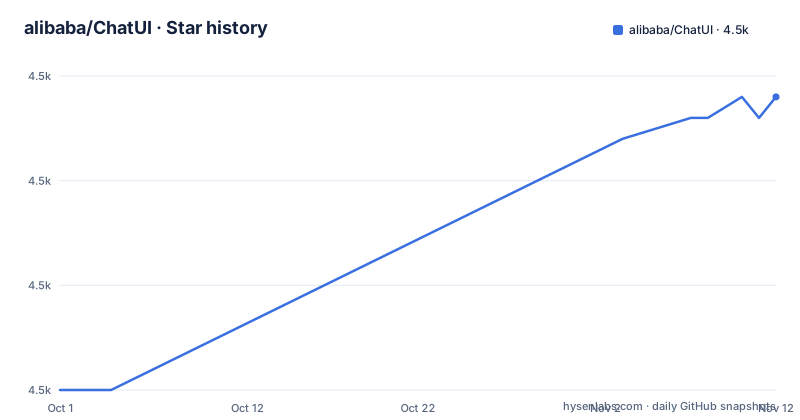
Star history
- alibaba/ChatUI4,464 ★ · +14
| Repository | 2026-10-01 | 2026-11-12 |
|---|---|---|
| alibaba/ChatUI | 4.5k | 4.5k |
14 Stars in the last 42 days, measured from the daily GitHub snapshot. Compare with other projects
Editorial analysis
The unpkg badge serves 0.1.0 while the manifest declares 3.7.0
The badge row at the top of the repository carries two identical npm links, an unpkg link to `@chatui/[email protected]/dist/index.js`, and a jsDelivr link. That unpkg entry belongs to the very first build of the package, while the manifest sitting in the same tree declares 3.9.0. The only release the project tags on record is 0.1.0 from 2020-09-17, and the install line printed underneath carries no version flag at all.
npm install @chatui/core --saveDrop that unpkg URL into a script tag on a page and you load a bundle from 2020 rather than the artifact the install line produces, and the README does not flag the difference. The two npm badges repeat the same package name, so nothing in that row points a reader at the current build either. Everything below the badge, including the browser support table and the usage sample, describes the library as of the manifest, not as of the bundle those links fetch.
One source tree ships as CommonJS, ESM and UMD
Four entry fields route different consumers to different directories. `main` is `lib/index.js` for CommonJS, `module` is `es/index.js` for ES modules, `browser` is `dist/index.js` for a plain script tag, and `typings` is `lib/index.d.ts`, with `style` pointing at `dist/index.css`.
Only three directories appear in the `files` array, dist, es and lib, so nothing under the source folder reaches the published tarball. The less sources are a partial exception, because `copy:less` runs copyfiles over `src/**/*.less` into the es directory, which means styling stays inspectable after an install while component code does not. Fifteen scripts drive the pipeline, from `clean` and `prebuild` through `js:cjs`, `js:esm`, `build:types`, `build:css` and `build:umd`. `prepublishOnly` fires `build` and then `build:umd`, so nothing reaches the registry without all three outputs regenerated.
React is not among the six runtime dependencies
Six packages are named in the dependency block and none of them is React. They are `@babel/runtime` at ^7.22.6, `@babel/runtime-corejs3` at ^7.22.5, `clsx` at ^1.1.1, `core-js` at ^3.31.0, `dompurify` at ^2.3.8 and `intersection-observer` at ^0.12.2. Two of the six are Babel runtime shims and one is a class name joiner, which leaves three doing real browser work.
A package whose own example imports `Chat`, `Bubble` and `useMessages` from `@chatui/core` still needs a React instance from somewhere, and the dependencies block does not list it.
DOMPurify and IntersectionObserver are pinned, then unexplained
Two of the runtime dependencies, dompurify and intersection-observer, are third-party libraries the README never mentions. `dompurify` is pinned at ^2.3.8 and `intersection-observer` at ^0.12.2, while `clsx` at ^1.1.1 keeps class names consistent without a CSS-in-JS layer.
Nothing in the README explains how the sanitiser is configured, whether raw HTML arriving in a message passes through it by default, or what the observer watches for and what it triggers. For a library whose whole job is displaying output written by a remote model, those two defaults matter more than anything on the feature list. Theming, by contrast, gets a heading of its own with an outbound link and no example underneath.
Chrome 49 and IE11 share one support table
The environment table gives Edge 16+, Firefox 31+, Chrome 49+, Safari 9.1+, iOS Safari 9.3+ and Android WebView 6+, and the line above it conditions the whole library on CSS Variables support. Internet Explorer 11 is named separately and works only with polyfills plus a CSS Variables shim, with two named candidates linked.
That variable dependency shows up in the build. `build:css` compiles `src/styles/index.less` into `dist/index.css`, then `prefix` runs postcss over the same file with `NODE_ENV=production` set. Two of the three Babel environments, cjs and esm, are plain directory builds limited to `.ts,.tsx` extensions, so the UMD bundle is the only artifact that passes through rollup.
The usage sample stops inside renderMessageContent
The single usage sample in the repository wires up a message list and a send handler, then cuts off. It imports the stylesheet on its own line, because the package hands you `dist/index.css` and expects your build to load it.
import Chat, { Bubble, useMessages } from '@chatui/core';
import '@chatui/core/dist/index.css';
`useMessages([])` returns `messages`, `appendMsg` and `setTyping`, and the handler fires only when the incoming type is `text` and the trimmed value is non-empty. Outgoing text carries `position: 'right'`, while the reply appended a second later through a `setTimeout` carries no position field at all and takes the default. After that the block stops inside the first line of `renderMessageContent`, so the README does not show what a custom renderer must return.
Theming and translation are two links and no examples
Both headings point outward and stop there. Theme goes to the customize-theme page, internationalization goes to the i18n page, and both live under chatui.io. The README gives no theme object, locale file or worked example of overriding either one.
The feature list above makes considerably larger claims: internationalization for dozens of languages, theme customisation down to every detail, and an accessibility certification credited to an association that carries no link. That same list attributes the interaction patterns to experience with a product called Alime Chatbot, which is the only statement in the file about where the design decisions came from. Two entries in a six-item list are therefore documented somewhere other than here, and the remaining four are adjectives rather than behaviour.
Husky, commitlint, jest and rollup share one repository
The top level is a full contributor setup rather than a demo-only tree. `.eslintrc.js`, `.eslintignore` and `.prettierrc` govern style, `commitlint.config.js` with `@commitlint/cli` 17.6.6 governs commit messages, and `prepare` runs `husky install` against the `.husky/` directory.
Testing runs through `jest.config.js` and `jest.setup.ts` with three entry points: `jest`, `jest --watch` and `jest --coverage`. The last push on the default branch is dated 2026-03-30. Beneath all of that, `demo/` carries its own `package.json`, `index.html`, `vite.config.ts` and three tsconfig files, and the documented development path runs inside that folder rather than at the repository root.
cd demo
npm i
npm run dev
Editorial conclusion
ChatUI earns a slot in any React app that must render a bot transcript and cannot spare the effort to build bubbles, composer and typing states by hand. Pass on it when your own design system already owns that surface, or when you need server rendering guarantees the repository never states. Before you commit, verify two things yourself: React is absent from the six runtime dependencies, and the unpkg link in the badge row serves 0.1.0 while the manifest declares 3.9.0. Read the theming page on chatui.io before planning a theme, because the repository holds no theme object of its own.
Frequently asked questions
What is a chat UI library like ChatUI?
ChatUI is the UI design language and React library for Conversational UI that Alibaba publishes as @chatui/core, written in TypeScript and served from chatui.io. The package ships CommonJS, ES module and UMD builds plus a stylesheet you import yourself.
What does installing @chatui/core put in a project?
It adds the @chatui/core package, whose default entry is lib/index.js, ES module entry es/index.js, browser bundle dist/index.js and typings lib/index.d.ts. Only the dist, es and lib directories are published, so the TypeScript sources are not part of the install.
Does ChatUI work in Internet Explorer 11?
It is listed as supported only with polyfills and a CSS Variables shim, with two named options linked in the README. Modern browsers are listed from Chrome 49+, Firefox 31+, Safari 9.1+, Edge 16+ and Android WebView 6+.
How do you run the ChatUI demo?
Three commands run inside the demo folder: cd demo, npm i, then npm run dev. That folder has its own package.json and a vite.config.ts, separate from the library build, and it is not part of the published tarball.
Where does ChatUI document theming and translation?
Both live outside the repository, under chatui.io. Theming goes to the customize-theme page and internationalization to the i18n page, and the README gives no example for either.
Official sources
Add this badge to your README
If you maintain this project, the badge below links readers to this analysis and shows its maintenance status from the daily GitHub snapshot. Paste the markdown into your README; add ?metric=license or ?metric=stars to the image URL for a different field.

[](https://hysenlabs.com/projects/alibaba-chatui)Star history chart for your README
[](https://hysenlabs.com/projects/alibaba-chatui)Was this useful?