parakeet-rs: NVIDIA Parakeet speech-to-text, diarization and streaming from Rust
very fast speech-to-text, diarization, streaming (even in CPU) with NVIDIA Parakeet in Rust
At a glance
- What is it?
- parakeet-rs wraps NVIDIA Parakeet, Nemotron and Cohere ASR models behind ONNX Runtime in a Rust crate, including streaming end-of-utterance decoding and four-speaker diarization. The trade-off is that you supply the ONNX weights yourself.
- Who is it for?
- Adopt parakeet-rs if you want Parakeet or Nemotron inference inside a Rust binary and are willing to fetch the ONNX weights and tokenizer files yourself from the HuggingFace links in the README. Skip it if you need a single model that covers every language, or if you expect a CLI that reads a file path and prints a transcript; the repository ships library examples, not an application.
- Can I use it commercially?
- Yes. MIT is a permissive licence: you can use, modify and sell software built on it, as long as you keep its copyright and licence notices.
- Is it still maintained?
- Yes. The repository last received commits 10 days ago.
- What is it written in?
- Mainly Rust, according to GitHub's language statistics.
Answers come from the project's GitHub data, last synced on November 25, 2026, and from our analysis. They are not legal advice.
Star history
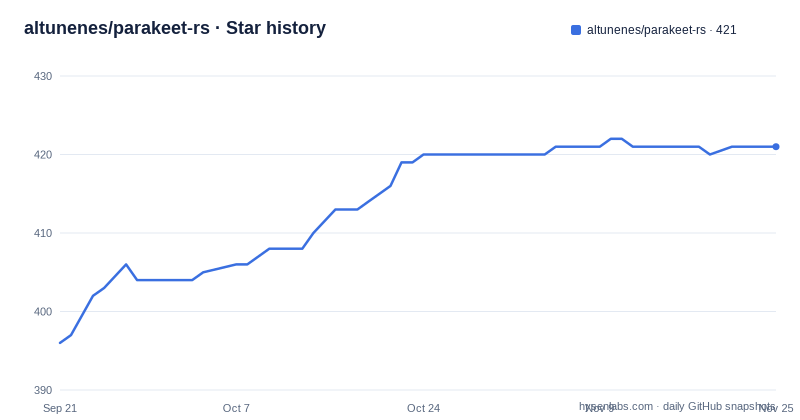
- altunenes/parakeet-rs421 ★ · +25
| Repository | 2026-09-21 | 2026-11-25 |
|---|---|---|
| altunenes/parakeet-rs | 396 | 421 |
25 Stars in the last 65 days, measured from the daily GitHub snapshot. Compare with other projects
Editorial analysis
What parakeet-rs actually wraps
The crate is a Rust binding layer over NVIDIA's Parakeet family plus a few adjacent models, executed through ONNX Runtime. It is not a model release and it is not a service. The repository contains src/, examples/, scripts/ and tests/, and the Cargo.toml describes the package as "Fast ASR & Speaker Diarization with NVIDIA Parakeet via ONNX", licensed MIT OR Apache-2.0.
The audience is narrow and identifiable: Rust developers who want speech recognition inside their own process rather than behind an HTTP call to a Python service. If you are shipping a desktop app, a local transcription tool, or an agent that needs to hear, the crate gives you a library API instead of a subprocess. If you are a Python user, this is the wrong layer; the ONNX files it consumes are produced by Python export scripts that also live in the repository under scripts/, and you could run those models directly.
The interesting part is the breadth. Five distinct model families are exposed behind a shared Transcriber trait: CTC for English, TDT for 25 languages with auto-detection, EOU for streaming with end-of-utterance detection, Nemotron for cache-aware streaming in English and multilingual variants, and Cohere Transcribe for offline multilingual work. Sortformer v2 and v2.1 handle diarization, and a Multitalker type combines streaming recognition with speaker attribution. That is a lot of surface for a 0.3.x crate, and the feature flags in Cargo.toml reflect it.
How the ONNX pipeline and chunked decoding work
Every model type follows the same shape: a from_pretrained call takes a directory path and an optional second argument, then a transcribe method consumes audio. The audio contract is fixed at 16 kHz mono, normalized to f32. There is no resampling in the API surface shown in the README, so conversion happens before you call in.
The offline path is direct. Parakeet::from_pretrained loads the ONNX graph and tokenizer from a directory, and transcribe_samples takes the sample buffer, a sample rate, a channel count and a TimestampMode. Results carry both a text field and a tokens vector with start and end times in seconds, which is what you need for subtitle alignment or for highlighting a transcript as audio plays.
The streaming path is where the design decisions show. EOU expects 160 ms chunks, which the README spells out as 2560 samples at 16 kHz. Nemotron expects 560 ms chunks, or 8960 samples. Multitalker expects roughly 1.12 s chunks, 17920 samples. These numbers are not arbitrary; they are the encoder frame budgets the exported graphs were built around, and feeding a different chunk size is the most likely way to get degraded output rather than an error. Diarization has a matching split: diarize() processes a whole buffer, while diarize_chunk() preserves state across calls for real-time use. That statefulness is the actual mechanism that makes streaming diarization work, and it is also the reason you cannot parallelize chunks across threads without breaking the speaker tracking.
Nemotron adds a mode check. model.mode() returns NemotronMode::Multilingual or the English-only variant, and set_target_lang is a no-op when an English-only model is loaded. The README states that passing a specific language code is strictly more accurate than leaving it at "auto" when you know the language in advance.
Installing parakeet-rs and running a first transcription
There is no installer and no binary. You add the crate to a Rust project and download the ONNX weights separately. The README's Setup section lists the exact files each model needs, and they differ per family, so read that list before downloading.
For the English CTC model, the README points at onnx-community/parakeet-ctc-0.6b-ONNX and names three files: model.onnx, model.onnx_data and tokenizer.json. Put them in one directory and point the loader at it.
use parakeet_rs::{Parakeet, Transcriber, TimestampMode};

let mut parakeet = Parakeet::from_pretrained(".", None)?;
let result = parakeet.transcribe_samples(audio, 1600, 1, Some(TimestampMode::Words))?;
println!("{}", result.text);
Note the sample rate argument in that snippet: the README's own example passes 1600, while the TDT example passes 16000. Both appear verbatim in the README, and the discrepancy is worth checking against examples/raw.rs before you copy either one.
For multilingual work, the TDT model comes from istupakov/parakeet-tdt-0.6b-v3-onnx and needs four files: encoder-model.onnx, encoder-model.onnx.data, decoder_joint-model.onnx and vocab.txt. The call shape is the same, with TimestampMode::Sentences available if you want sentence-level rather than word-level timing.
Optional model families are gated behind Cargo features, so a default build does not pull them in:
parakeet-rs = { version = "0.3", features = ["sortformer"] }Diarization then loads a single ONNX file and a configuration profile. The README offers DiarizationConfig::callhome() and dihard3() as presets, plus a custom() constructor, which tells you the streaming parameters are tuned per corpus rather than universally.
use parakeet_rs::sortformer::{Sortformer, DiarizationConfig};

let mut sortformer = Sortformer::with_config(
    "diar_streaming_sortformer_4spk-v2.onnx",
    None,
    DiarizationConfig::callhome(),
)?;
let segments = sortformer.diarize(audio, 16000, 1)?;
Each returned segment carries a speaker_id and sample offsets, which the README converts to seconds by dividing by 16_000.0.
Execution providers, and why CoreML is called out as unstable
The Cargo.toml exposes an unusually long list of execution provider features: cuda, tensorrt, coreml, directml, migraphx, openvino, webgpu and nnapi, plus api-24 through api-28 for pinning the ONNX Runtime API level, and load-dynamic and preload-dylibs for deployment flexibility. The default feature set is cpu, ort-defaults and api-28.
That menu is wider than most projects offer, and it is also the main source of setup friction. The README states plainly that CoreML is unstable with this model and tells Apple users to use the WebGPU execution provider or CPU instead, noting that WebGPU is a native GPU standard rather than a browser-only technology. It also claims that CPU alone is significantly faster on the author's Mac M3 16GB than Whisper with Metal. That is a single-machine observation by the maintainer, not a benchmark you can generalise from, and the README does not publish the audio, model variant or measurement method behind it.
The practical consequence: on macOS, the recommended path is WebGPU or CPU, and CoreML is a feature you should treat as present but discouraged. On Linux with an NVIDIA GPU, cuda or tensorrt are the obvious choices. The api-24 through api-28 features exist because ONNX Runtime changes its C API between releases, so the crate lets you match the runtime you already have rather than forcing an upgrade.
Load-dynamic deserves a mention for packaging. It defers loading the ONNX Runtime shared library until runtime, which matters if you want to ship a binary without bundling the runtime, but it also moves a failure from build time to first call. The README does not document the error you get when the library is missing.
Where parakeet-rs is the wrong tool
The clearest limitation is that model acquisition is entirely on you. from_pretrained takes a path and does not download anything. The README's Setup section is a list of HuggingFace URLs and required filenames, and getting the file set wrong is a silent failure mode in the making: the CTC model wants model.onnx plus model.onnx_data, while TDT wants encoder-model.onnx plus encoder-model.onnx.data plus decoder_joint-model.onnx plus vocab.txt. These are different naming conventions from different uploaders, not a uniform scheme the library normalises.
Language coverage is fragmented rather than unified. CTC is English-only. TDT covers 25 languages with auto-detection. Cohere Transcribe covers 14 languages offline. Nemotron multilingual covers 40 language-locales, but the README cites NVIDIA's own tiering: 19 transcription-ready, 13 with broad coverage, and 8 that need fine-tuning to reach production quality. If your product needs one model for everything, no single type here does that, and you would be selecting per request.
The examples are library examples, not an application. There is no documented CLI that takes a WAV path and prints text. examples/raw.rs, examples/streaming.rs, examples/diarization.rs and the rest show API usage; you write the file loading, the resampling to 16 kHz mono, and the output handling. hound is a dependency, so WAV decoding is available, but the README does not describe a decoding pipeline for other formats.
Finally, the chunk sizes are load-bearing. If you feed Nemotron 160 ms chunks because that is what EOU wanted, you are outside the frame budget the exported graph expects, and the README does not describe what happens. Nothing in the repository's public documentation describes validation or a warning for wrong chunk sizes.
parakeet-rs against whisper-rs and the Python ONNX route
The natural comparison is whisper-rs, which binds whisper.cpp and therefore bundles model loading, quantization formats and a well-trodden CPU path in one ecosystem. The difference in approach is where the model comes from. whisper.cpp defines its own GGML model format and the project distributes converted weights; parakeet-rs consumes ONNX graphs exported elsewhere, several of them by third parties on HuggingFace rather than by the maintainer. That makes parakeet-rs more flexible about which model you run and less self-contained about getting it.
The second alternative is running the same ONNX files from Python with onnxruntime directly. That is genuinely viable, and the repository's scripts/ directory, including export_diar_sortformer.py and export_nemotron_streaming_multilingual.py, is Python tooling for producing those graphs. The reason to choose the Rust crate instead is deployment: a single static binary with no Python runtime, which matters for desktop apps and embedded targets. The reason to choose Python is that the surrounding audio ecosystem is richer and you avoid the execution provider build matrix.
A third point of comparison is what the crate does beyond transcription. Sortformer diarization and the Multitalker combination of streaming ASR with speaker attribution are not things whisper.cpp offers, and the README's own diarization example shows combining Sortformer with TDT transcription. If speaker labels are a requirement, that gap is decisive.
Maintenance, licence and upgrade cost
The repository is not archived, and the last push was on 2026-09-04. Releases are spaced roughly six to eight weeks apart across 2026: v0.3.5 on 2026-04-17, v0.3.6 on 2026-06-04, v0.3.7 on 2026-07-28. Version 0.3.7 is what Cargo.toml declares, and the README's Cohere and Multitalker snippets both pin version = "0.3", so the minor line is what the documentation targets.
Upgrade cost centres on ONNX Runtime rather than on the crate. The api-24 through api-28 features exist because the underlying ort dependency, pinned at 2.0.0-rc.13, tracks ONNX Runtime's C API. Moving to a newer runtime means selecting a different feature, and the crate has not yet reached 1.0, so the pre-1.0 convention applies: minor versions may change APIs. The feature-gated model families (sortformer, multitalker, cohere) reduce that exposure if you only use the default CPU path.
Licensing needs care because two licences are in play. Cargo.toml declares MIT OR Apache-2.0 for the crate, while the repository's LICENSE file and the GitHub metadata both show MIT; the SPDX expression in Cargo.toml is the broader of the two. The models are separate works under their own terms: NVIDIA's Parakeet and Nemotron weights, the ONNX conversions hosted on HuggingFace, and the int8 and int4 Nemotron quantizations that the README links to under a different account. Those model licences govern your use of the weights, not the crate's licence, and the README does not restate them. Check each model page before shipping.
Editorial conclusion
Adopt parakeet-rs if you want Parakeet or Nemotron inference inside a Rust binary and are willing to fetch the ONNX weights and tokenizer files yourself from the HuggingFace links in the README. Skip it if you need a single model that covers every language, or if you expect a CLI that reads a file path and prints a transcript; the repository ships library examples, not an application. Before committing, verify which execution provider builds on your target machine, since the README states CoreML is unstable with this model and points Apple users at WebGPU or CPU, and check that your chosen model directory contains exactly the files the loader expects, because from_pretrained takes a path and does not fetch anything.
Frequently asked questions
What language do parakeet-rs models speak?
It depends on which model you load. The README describes CTC as English-only, TDT as covering 25 languages with auto-detection, Cohere Transcribe as offline multilingual across 14 languages, and Nemotron multilingual as covering 40 language-locales, of which NVIDIA classifies 19 as transcription-ready and 8 as needing fine-tuning for production quality.
Can parakeet-rs mimic human speech?
No. The crate performs speech recognition, diarization and streaming transcription; it converts audio into text and speaker labels. Nothing in the README describes speech synthesis or voice cloning.
How are parakeet-rs models able to transcribe speech?
The models are NVIDIA Parakeet, Nemotron and Cohere ASR graphs executed through ONNX Runtime. Audio is passed as 16 kHz mono f32 samples, either as a whole buffer through transcribe_samples or in fixed chunks for the streaming types, and the result carries text plus token timestamps.
Official sources
Add this badge to your README
If you maintain this project, the badge below links readers to this analysis and shows its maintenance status from the daily GitHub snapshot. Paste the markdown into your README; add ?metric=license or ?metric=stars to the image URL for a different field.

[](https://hysenlabs.com/projects/altunenes-parakeet-rs)Star history chart for your README
[](https://hysenlabs.com/projects/altunenes-parakeet-rs)Was this useful?