Anoma: An Elixir Reference Implementation of a Protocol Still Under Construction
Reference implementation of Anoma
At a glance
- What is it?
- Anoma is a reference implementation of the Anoma protocol, written in Elixir. The README lists developer and user docs as coming soon, and the build process carries real friction.
- Who is it for?
- Adopt Anoma if you are a researcher or contributor who needs a reference implementation to study or extend the Anoma protocol, and you are comfortable with Elixir, Rust, and Protobuf tooling. Do not adopt it if you need a stable, user-facing node with documented APIs or a smooth build experience; the README itself lists multiple compilation failures and the developer docs are not yet published.
- Can I use it commercially?
- Yes. MIT is a permissive licence: you can use, modify and sell software built on it, as long as you keep its copyright and licence notices.
- Is it still maintained?
- Yes. The repository last received commits 161 days ago.
- What is it written in?
- Mainly Elixir, according to GitHub's language statistics.
Answers come from the project's GitHub data, last synced on November 23, 2026, and from our analysis. They are not legal advice.
Star history
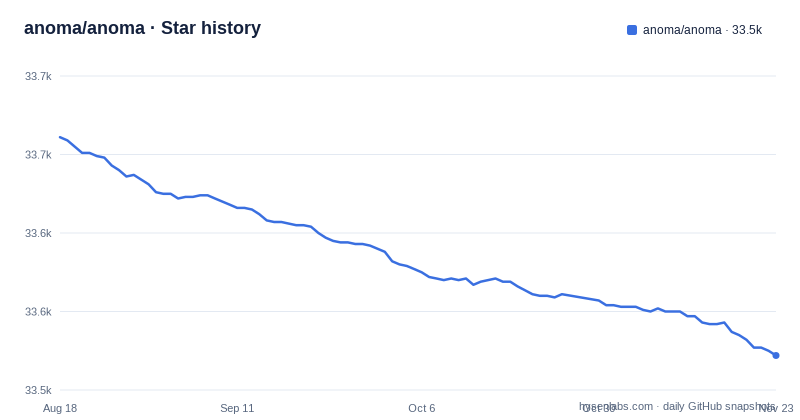
- anoma/anoma33,522 ★ · -139
| Repository | 2026-08-18 | 2026-11-23 |
|---|---|---|
| anoma/anoma | 33.7k | 33.5k |
-139 Stars in the last 97 days, measured from the daily GitHub snapshot. Compare with other projects
Editorial analysis
What Anoma Actually Is
The project is written primarily in Elixir. Elixir brings the BEAM VM, which offers strong concurrency and fault tolerance, but it also means the toolchain is less familiar to many protocol engineers. The README does not explain why Elixir was chosen, so that decision is left to the reader to infer from the architecture. The practical consequence is that you need Elixir, Rust, and Protobuf installed just to compile the thing.
The Build Is a Multi-Language Chain
The README also lists OS-specific dependencies. On macOS you need Apple Command Line Tools and ncurses. On Ubuntu you need cmake and libwxgtk3.2-dev. On Windows you need Visual Studio 2022 build tools and PowerShell. On Windows the README says OpenSSL is not required. For a reference implementation, this is a heavy setup burden. The Docker route is available as an alternative: docker build -t <IMAGE>. followed by docker run -it --network host <IMAGE> <SUBCOMMAND>. That avoids local toolchain issues, but the README does not describe what subcommands the binary accepts, so you are still on your own after the container starts.
Running the Node: Two Commands, Little Guidance
The README says work is merged into base on a bi-weekly schedule and that there are bi-weekly releases, but the latest tagged release is v0.35.1 from 2026-02-22, after v0.35.0 (2026-02-06) and v0.34.0 (2025-06-05). The README warns that a PR may be merged into next or main and only appear in the next scheduled release. For a user, that means the binary you download may lag the code. For a contributor, it means you should base your work on the base branch, and a maintainer will handle any merge conflicts. The README explicitly says "no attempt to keep it up to sync with main should be had," which is a clear warning about the merge model.
Known Issues: The Build Can Break in Two Specific Ways
The README does not mention any runtime failures, network issues, or protocol-level bugs. That is not evidence that none exist; it is just a gap in the documentation. The known issues section is purely about compilation. For a protocol implementation, runtime correctness is the more important question, and the README gives you no hints. You would need to read the specs or run the node yourself to discover any issues.
The Contribution Model Is Unusual
The research forums are the primary place for architecture discussions, and the README specifically recommends the architecture posts. That suggests the design is still evolving, and the codebase may not be a stable reference. If you adopt Anoma, you are adopting a moving target. The bi-weekly release cadence and the active research forum mean the protocol could change significantly between releases. That is fine for a research project, but it is a liability for anyone who wants to build on top of it.
Alternatives: What Else Is Out There
Another alternative is to skip the implementation entirely and read the specs at specs.anoma.net. The README links to the spec, and for a researcher, the spec is the primary artifact. The codebase is just one interpretation of the spec, and it may lag behind the latest research. The README's own architecture posts are a better guide to the intended design than the code, which is still evolving. So the alternative to using Anoma is to treat it as a secondary source and focus on the spec.
Maintenance and License: What You Are Signing Up For
The contributor docs are the only place to learn the codebase structure, and the README links them from both its Docs and Contributing sections. The README's "Contributing" section points to a .livemd file, which is a Livebook notebook, not a standard Markdown file. That format may be less convenient for browsing on GitHub. The overall impression is that this is a research codebase, not a product. The maintenance burden is on the user to keep up with the bi-weekly releases and the evolving spec.
Editorial conclusion
Adopt Anoma if you are a researcher or contributor who needs a reference implementation to study or extend the Anoma protocol, and you are comfortable with Elixir, Rust, and Protobuf tooling. Do not adopt it if you need a stable, user-facing node with documented APIs or a smooth build experience; the README itself lists multiple compilation failures and the developer docs are not yet published. Before committing, verify your exact OS and toolchain versions against the known issues, and check the specs at specs.anoma.net to confirm the protocol design matches your needs, because the codebase is only one part of a moving target.
Frequently asked questions
What is the Anoma reference implementation?
It is an Elixir implementation of the Anoma protocol, whose specifications are published separately at specs.anoma.net. Work is merged into a branch called base on a bi-weekly schedule, and the most recent release tag is v0.35.1 from 2026-02-22 while the last push to the repository was 2026-06-15. The tree carries a Makefile, a changelog, a usage file, a configuration directory, documentation written as notebooks, and a test directory.
How do I run Anoma from a pre-built release?
Download the Anoma release for your platform, extract it, and run `bin/anoma`. The release dependencies are the Apple command line developer tools installed with `xcode-select --install` plus MacPorts or an equivalent, ncurses on macOS only, and OpenSSL from a package manager on macOS and Linux, which is not required on Windows.
How do I compile Anoma from source?
Install Elixir, Rust, Protobuf, and the Elixir protobuf plugin with `mix escript.install hex protobuf 0.11.0`, which the README says must be that version, then put it on your path and confirm it reports 0.11.0. Platform dependencies are installed with brew on macOS, with apt on Ubuntu and Debian, or with the Visual Studio 2022 build tools and PowerShell on Windows. Then run `mix deps.get` and `mix compile`, and start a node with `iex -S mix` or `mix run --no-halt`.
Why does my Anoma build fail on enacl or cairo?
Both are known issues with dependencies rather than with the project. For enacl, on some versions of macOS and Linux, the workaround is to check out the mariari/no-libsodium branch, run mix clean, mix deps.get and mix compile again. For cairo, the cause is likely an incompatible Rust toolchain, and the fix is to add a specific toolchain version with rustup, with a target-specific variant on macOS.
Why is my merged Anoma pull request still open?
Because there are bi-weekly releases. The README explains that if a maintainer says your pull request is merged but it is still open, that just means it is merged into next or main and will be included in the next scheduled release. It also notes that new code should be based on base, and that you should not try to keep your branch in sync with main yourself.
Official sources
Add this badge to your README
If you maintain this project, the badge below links readers to this analysis and shows its maintenance status from the daily GitHub snapshot. Paste the markdown into your README; add ?metric=license or ?metric=stars to the image URL for a different field.

[](https://hysenlabs.com/projects/anoma-anoma)Star history chart for your README
[](https://hysenlabs.com/projects/anoma-anoma)Was this useful?