Apache Cassandra Python Driver: Installation and Use
Python Driver for Apache Cassandra®
At a glance
- What is it?
- Apache Cassandra Python Driver is a Python client for Cassandra 2.1 and later, with synchronous and asynchronous execution, prepared statements, node discovery, retries, and an integrated object mapper. It is designed for applications that communicate with Cassandra through CQL.
- Who is it for?
- Adopt this driver when a Python application needs direct CQL access to Apache Cassandra and can work with its client model. Do not choose it for SQL applications, non-Python runtimes, or unsupported platform environments.
- Can I use it commercially?
- Yes. Apache-2.0 is a permissive licence: you can use, modify and sell software built on it, as long as you keep its copyright and licence notices.
- Is it still maintained?
- Yes. The repository last received commits 94 days ago.
- What is it written in?
- Mainly Python, according to GitHub's language statistics.
Answers come from the project's GitHub data, last synced on October 23, 2026, and from our analysis. They are not legal advice.
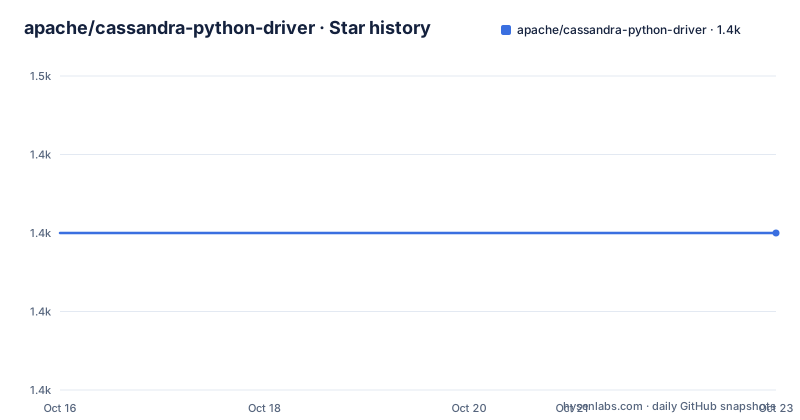
Star history
- apache/cassandra-python-driver1,430 ★ · +0
| Repository | 2026-10-16 | 2026-10-23 |
|---|---|---|
| apache/cassandra-python-driver | 1.4k | 1.4k |
0 Stars in the last 7 days, measured from the daily GitHub snapshot. Compare with other projects
Editorial analysis
Why cassandra-driver targets Python Cassandra applications
Apache Cassandra Python Driver solves the problem of connecting Python applications to Apache Cassandra. Cassandra stores distributed data and is queried with Cassandra Query Language, or CQL. The driver provides a Python client for that database instead of requiring applications to implement protocol handling themselves. The README identifies support for Apache Cassandra 2.1 and later and DataStax Enterprise 4.7 and later.
The intended users are Python developers building services, batch jobs, command-line tools, and other applications that need direct database access. Its API includes synchronous and asynchronous session execution, so it can fit applications with either blocking request handling or concurrent execution. The package also includes cqlengine, an object mapper maintained as part of the project. That gives teams a choice between explicit CQL statements and a model-oriented interface.
This is not a general-purpose SQL client. The driver communicates through Cassandra’s binary protocol and CQL v3. It does not present itself as a tool for relational transactions, joins, or SQL migrations. An application whose data model and query requirements are fundamentally relational may be better served by a database and driver designed for that model.
How cassandra-driver moves CQL through Cassandra connections
The driver communicates with Cassandra using the binary protocol and CQL v3. Its documented APIs include synchronous execution through `Session.execute` and asynchronous execution through `Session.execute_async`. It also lists request pipelining, parallel execution, connection pooling, automatic node discovery, and automatic reconnection.
The normal application flow is to configure a cluster, connect to Cassandra hosts, obtain a session, and execute statements. The driver’s policies control host selection and retry behavior. This removes some of the need for application code to maintain a permanent host list or implement reconnection after a host becomes unavailable. Prepared statements are also supported, which lets applications define statement structure separately from supplied parameter values.
The execution model still affects application design. A synchronous call waits for the operation to complete, while an asynchronous call requires the application to manage completion and results. The repository includes concurrent execution utilities, but the README does not prescribe a complete application concurrency pattern. Teams must decide whether blocking database calls fit their request lifecycle or whether asynchronous execution should be coordinated with the rest of their application.
Installing cassandra-driver and checking its runtime boundary
The README recommends installing the driver with pip. The distribution name is `cassandra-driver`, as shown in the installation command. The project metadata requires Python 3.10 or later, and the README documents support for Python 3.10 through 3.14.
Install the package into the environment used by the application:
pip install cassandra-driverThe README points to the online installation guide for more complete instructions. It does not document a separate command for deploying or starting Cassandra. A Cassandra deployment, reachable contact points, and appropriate database credentials must therefore already be available for an application to use the installed client.
The project metadata declares `geomet>=1.1` as a runtime dependency. It also defines optional extras named `graph`, `cle`, and `test`. The README does not document an installation command for those extras, so an application should not infer an extra installation command from this article. The setup configuration also marks the optional C extensions as unsupported on some platforms, and the README states that DataStax products do not support big-endian systems. These constraints should be checked before deploying the package.
Using direct CQL statements or the integrated cqlengine mapper
The driver supports simple, prepared, and batch statements. Direct statement use gives an application explicit control over CQL and execution parameters. This is useful when queries need to reflect a Cassandra schema closely, or when statement structure, execution timing, and query shape are application requirements.
The package also includes cqlengine, its object mapper. The README says cqlengine was originally developed by Blake Eggleston and Jon Haddad and is now maintained as an integral part of the package. It is intended for applications that prefer mapping application objects to Cassandra data instead of writing every operation as an explicit CQL statement. The repository includes `example_mapper.py` and separate mapper documentation, so teams can inspect a project-specific example before selecting the abstraction.
These options solve different problems within the same driver. Direct statements expose Cassandra operations more clearly, while cqlengine adds an object-oriented modeling layer. The object mapper should not be treated as a guarantee that Cassandra behaves like a relational database. Partition keys, query patterns, consistency behavior, and the application’s retry semantics still need to be designed for Cassandra.
Connection policies and retry behavior in cassandra-driver
The driver includes configurable load balancing and retry policies, along with automatic node discovery and automatic reconnection. These features address a common Cassandra client requirement. A cluster can contain multiple hosts, and a failed host may later become available again. The driver is designed to manage connection discovery and reconnection instead of requiring the application to remove and restore hosts by hand.
Retry behavior still needs application-level attention. The README confirms that retry policies are configurable, but it does not define a universal retry policy or state that every failed operation is safe to repeat. A request that increments a counter, sends an external notification, or advances a multi-step workflow may have side effects outside Cassandra. The application should verify how its chosen retry policy interacts with those effects.
Load balancing is also configurable rather than automatically optimal for every workload. The right policy depends on the Cassandra deployment and the application’s latency or capacity requirements. The README documents the policy mechanism, but it does not prescribe a production policy for all clusters.
Where cassandra-driver is the wrong choice
The driver is the wrong choice when the application does not use Cassandra or does not speak CQL. It is not an SQL compatibility layer, a schema migration framework, or a Cassandra deployment control plane. Projects built around PostgreSQL, MySQL, or another relational database should use the client and transaction model for that database.
The runtime boundary is also narrow. The project supports Python 3.10 through 3.14. The README says DataStax products do not support big-endian systems, and the setup configuration contains platform checks for optional C extensions. An environment outside those documented boundaries needs another client or a different deployment approach.
A Cassandra driver cannot remove the need for sound Cassandra data modeling. Prepared statements and cqlengine can simplify application code, but neither changes the consequences of an unsuitable partition key or query pattern. Automatic reconnection can restore a connection to an available host, but it does not determine whether a business operation succeeded after a timeout.
Maintenance, licensing, and upgrade boundaries
The repository is not archived. Its last push was on 2026-07-21, so the available maintenance record shows recent repository activity. The repository has no GitHub releases. The package metadata identifies version 3.30.1, while the README documents supported Python versions and Cassandra compatibility.
The project is licensed under Apache License 2.0. That license governs use and modification under its terms. An application should review the `LICENSE` file for its notice and redistribution obligations. This is a compliance consideration, not legal advice.
The package metadata declares `geomet>=1.1` as a runtime dependency and defines optional dependency groups. Upgrade planning should account for the Python range, Cassandra versions, dependency changes, and the difference between repository activity and a GitHub release. The README does not document a rollback procedure or a complete compatibility matrix for every minor release, so those details must be checked before an upgrade is scheduled.
Editorial conclusion
Adopt this driver when a Python application needs direct CQL access to Apache Cassandra and can work with its client model. Do not choose it for SQL applications, non-Python runtimes, or unsupported platform environments. Verify Python compatibility, Cassandra deployment, platform support, authentication, and whether direct statements or cqlengine fit the data model before adoption.
Frequently asked questions
How do I install Apache Cassandra Python Driver?
The README recommends installing it with `pip install cassandra-driver`. The project metadata requires Python 3.10 or later, and the README documents support for Python 3.10 through 3.14.
Does Apache Cassandra Python Driver support asynchronous execution?
Yes. The README documents asynchronous execution through `Session.execute_async`, alongside synchronous execution through `Session.execute`.
Can I use cqlengine with Apache Cassandra Python Driver?
Yes. The README says cqlengine is maintained as an integral part of the package. It provides an object mapper documented separately from the direct CQL APIs.
Official sources
Add this badge to your README
If you maintain this project, the badge below links readers to this analysis and shows its maintenance status from the daily GitHub snapshot. Paste the markdown into your README; add ?metric=license or ?metric=stars to the image URL for a different field.

[](https://hysenlabs.com/projects/apache-cassandra-python-driver)Star history chart for your README
[](https://hysenlabs.com/projects/apache-cassandra-python-driver)Was this useful?