SpikingBrain-7B: Hybrid Attention, MoE, and Spiking Inference
Spiking Brain-inspired Large Models, integrating hybrid efficient attention, MoE modules and spike encoding into its architecture
At a glance
- What is it?
- SpikingBrain-7B is a research-oriented 7B model distribution with HuggingFace, vLLM-HyMeta, and W8ASpike implementations. It targets efficient long-context inference and spiking-neural-network research, but its pseudo-spiking implementation does not execute true asynchronous events on neuromorphic hardware.
- Who is it for?
- SpikingBrain-7B fits researchers evaluating SpikingBrain architecture, long-context serving, or tensor-level pseudo-spiking, rather than production users needing a stable asynchronous neuromorphic runtime. Teams should first verify hardware compatibility, exact checkpoint requirements, memory needs, and whether W8ASpike's pseudo-spiking behavior meets their research goals.
- Can I use it commercially?
- Yes. MIT is a permissive licence: you can use, modify and sell software built on it, as long as you keep its copyright and licence notices.
- Is it still maintained?
- Yes. The repository last received commits 178 days ago.
- What is it written in?
- Mainly Python, according to GitHub's language statistics.
Answers come from the project's GitHub data, last synced on November 7, 2026, and from our analysis. They are not legal advice.
Star history
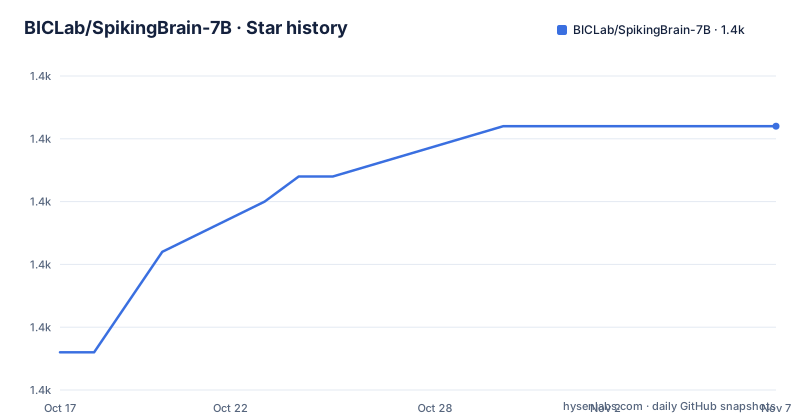
- BICLab/SpikingBrain-7B1,428 ★ · +9
| Repository | 2026-10-17 | 2026-11-07 |
|---|---|---|
| BICLab/SpikingBrain-7B | 1.4k | 1.4k |
9 Stars in the last 21 days, measured from the daily GitHub snapshot. Compare with other projects
Editorial analysis
What SpikingBrain-7B Changes in the 7B Model Stack
SpikingBrain-7B addresses a specific research problem: combining a 7B language model with mechanisms inspired by spiking neural networks while retaining pathways compatible with open-source model tooling. The intended audience is researchers studying efficient attention, sparse computation, low-precision inference, and the relationship between language-model execution and neuromorphic hardware. It is also relevant to engineers operating on MetaX clusters, although the repository's vLLM-HyMeta documentation also describes NVIDIA GPU deployment.
The architecture described in the README combines hybrid efficient attention, mixture-of-experts modules, and spike encoding. The repository also presents a universal conversion pipeline, but it does not provide enough documentation here to explain that conversion pipeline's supported source formats, command-line interface, or validation process. That omission matters for engineers hoping to convert arbitrary checkpoints without reading the implementation and technical report.
The README reports two research results. It says SpikingBrain can perform continual pre-training with less than 2% of the data used by mainstream open-source model comparisons while achieving comparable performance, and it reports over 100 times faster time to first token for 4M-token sequences. It also states that micro-level spiking produces over 69% sparsity before accounting for macro-level MoE sparsity. These are project-reported claims, not independent findings, and the repository excerpt does not provide enough evaluation settings to reproduce or compare them.
Repository Components and the vLLM-HyMeta Data Path
The repository is organized around several deployment paths rather than one Python package. `hf_7B_model/` contains the HuggingFace model implementation, `hf_7B_VLM/` contains the vision-language version, `vllm_hymeta/` contains the vLLM integration, and `W8ASpike/` contains the quantized inference implementation. `run_model/` supplies examples for each route. Model weights are hosted separately on ModelScope rather than committed to this repository.
For vLLM inference, the plugin adapts HyMeta hardware models to vLLM's plugin mechanism. The documented serving path loads a checkpoint through `vllm serve`, applies the model's configuration and custom operators through the installed `vllm_hymeta` package, allocates GPU memory according to `--gpu-memory-utilization`, and exposes an OpenAI-compatible server on the selected port. The plugin boundary is significant because backend-specific code stays outside the general vLLM codebase.
The README refers to MetaX adaptations for large-scale training and inference, while its container instructions and plugin section explicitly cover NVIDIA GPUs. MetaX operators should not be treated as documented by this container tutorial. The README also does not document rollback, health checking, authentication, request-format examples, or a complete model download procedure.
Building the NVIDIA Container and Starting vLLM
The clearest documented first use is the NVIDIA Docker route. It starts from `vllm/vllm-openai:v0.10.0`, installs the repository with `pip`, and applies `docker_build/patch_fla_bitnet.py`. The README recommends a container with all available GPUs, host networking, and 160 GB of shared memory. The Docker build copies the repository into `/workspace` and installs the local `vllm_hymeta` package.
Clone the repository and build the image. The Dockerfile runs a patch script during the build, so the build output should show package installation and completion of that script.
git clone https://github.com/BICLab/SpikingBrain-7B.git
cd SpikingBrain-7B
docker build -t spiking-brain:7b-v1.0 .
Start an interactive detached container. Replace the placeholders with the container name and the host and container paths used for model data. The documented container requests all GPUs and privileged access.
docker run -itd \
    --entrypoint /bin/bash \
    --network host \
    --name <container_name> \
    --shm-size 160g \
    --gpus all \
    --privileged \
    -v /host_path:/container_path \
    spiking-brain:7b-v1.0
After obtaining one of the ModelScope checkpoints, serve a HuggingFace-format model directory. The README also requires removal of a custom `auto_map` block from `config.json` when it is present, so that vLLM uses its normal configuration and model mapping rather than the custom Python classes named in that block.
vllm serve <your_model_path> \
  --served-model-name <model_name> \
  --gpu-memory-utilization <ratio> \
  --block-size <size> \
  --dtype bfloat16 \
  --port <port_number>
The command must use values appropriate for the selected checkpoint and available GPU memory. `requirements.txt` pins `torch==2.7.1`, `transformers==4.55.2`, `triton==3.3.1`, `flash_attn==2.7.3`, `flash-linear-attention==0.1`, and `vllm==0.10.0`. Multi-GPU serving can add `--tensor-parallel-size` and `--pipeline-parallel-size`, but the README gives no recommended values.
W8ASpike Quantization Is Not True Event-Driven Spiking
W8ASpike is the most important boundary for adoption. The repository describes it as a quantized inference version intended to reduce inference cost under low-precision settings and study spiking neural networks. Its implementation uses pseudo-spiking: tensor activations are approximated as spike-like signals during ordinary tensor computation.
That approach differs materially from true asynchronous, event-driven spiking. The README explicitly says true spiking requires asynchronous hardware and event-driven operator support, neither of which is implemented by this repository. W8ASpike is therefore appropriate for prototyping the model's tensor-level encoding and low-precision inference path, but it cannot establish whether the model will run efficiently on a neuromorphic accelerator that expects discrete events over time.
The activation encoding is inspired by interfaces in `BICLab/Int2Spike`. Users seeking additional PyTorch-based spiking interfaces are directed there. The ModelScope page for `V1-7B-W8ASpike` supplies the checkpoint. Engineers evaluating this route must therefore inspect `W8ASpike/` and the checkpoint configuration before assuming it is a drop-in server.
Maintenance, Compatibility, and Licence Boundaries
The repository is not archived. Its last push was on 2026-05-14, which is within six months of the current date, so the repository shows recent development activity. It has no GitHub releases, however, and the README directs users to a separate `BICLab/SpikingBrain2.0` repository for the newer architecture. There is no release-based upgrade path documented for SpikingBrain-7B itself.
Compatibility is tightly coupled to pinned package versions. The repository and container emphasize `vllm==0.10.0`, Python 3.10 is declared in `setup.py`, while the container uses Python 3.12 for a specific patch step. These details show that installation is not merely a source checkout. Kernel, driver, GPU architecture, flash-attention compatibility, and custom operators also need to align. The README points to `requirements.txt` as its tested-environment reference, but the documentation excerpt does not expose that file beyond the dependencies already listed.
The top-level repository is identified as MIT licensed. The package metadata in `setup.py` instead declares `license="Apache 2.0"` and the Apache classifier for `vllm_hymeta`. This is a repository and package-level discrepancy that should be checked before redistribution. The MIT and Apache 2.0 texts impose different conditions, so this article does not treat the licence for every file as settled. Review `LICENSE`, `setup.py`, and any copied upstream files separately before redistribution.
Choosing SpikingBrain-7B Instead of a Conventional 7B Stack
A conventional HuggingFace causal language model is the clearer alternative when the requirement is simply loading a 7B checkpoint, generating text, or using an established vLLM deployment. Such a model avoids SpikingBrain's custom configuration mappings, hybrid operators, MoE behavior, and spike-oriented quantization path. It also offers a smaller compatibility surface when the application does not need to investigate sparse or neuromorphic computation.
SpikingBrain becomes more relevant when the research question concerns its specific hybrid architecture or the efficiency claims associated with very long sequences. Its separate HuggingFace, vLLM-HyMeta, and W8ASpike implementations also allow a team to compare execution paths rather than treating the model as a single opaque artifact. The vision-language checkpoint broadens the released model family, while the base and SFT checkpoints support different research setups.
The trade-off is that this repository offers research artifacts more than a conventional support contract. There are no GitHub releases, only limited first-use instructions, an omitted local W8ASpike command in the excerpt, no documented MetaX launch recipe, and no rollback procedure. The README's speed and sparsity numbers should be treated as claims that require verification against the user's sequence lengths, batching, hardware, precision, and model checkpoint. The project is more convincing as an experimental platform than as a default production model service.
Editorial conclusion
SpikingBrain-7B fits researchers evaluating SpikingBrain architecture, long-context serving, or tensor-level pseudo-spiking, rather than production users needing a stable asynchronous neuromorphic runtime. Teams should first verify hardware compatibility, exact checkpoint requirements, memory needs, and whether W8ASpike's pseudo-spiking behavior meets their research goals. For a general 7B deployment, a conventional HuggingFace or vLLM model with documented production support is the safer choice.
Frequently asked questions
How do I install SpikingBrain-7B for NVIDIA GPU inference?
Clone the repository, build the repository Dockerfile, and start the image with all available GPUs. The documented Python environment also pins `torch==2.7.1`, `transformers==4.55.2`, `triton==3.3.1`, `flash_attn==2.7.3`, `flash-linear-attention==0.1`, and `vllm==0.10.0`.
Does W8ASpike use true event-driven spiking?
No. The README describes W8ASpike as pseudo-spiking, where activations are approximated as spike-like signals at the tensor level. True-spiking execution requires asynchronous hardware and event-driven operators that are outside this repository's scope.
Where can I download SpikingBrain-7B model weights?
The README lists separate ModelScope entries for the 7B pre-trained model, the 7B-SFT chat model, the 7B-SFT vision-language model, and the quantized 7B-W8ASpike weights. The repository itself provides implementations and run examples rather than hosting all weights in the Git checkout.
Official sources
Add this badge to your README
If you maintain this project, the badge below links readers to this analysis and shows its maintenance status from the daily GitHub snapshot. Paste the markdown into your README; add ?metric=license or ?metric=stars to the image URL for a different field.

[](https://hysenlabs.com/projects/biclab-spikingbrain-7b)Star history chart for your README
[](https://hysenlabs.com/projects/biclab-spikingbrain-7b)Was this useful?