Bike4Mind: An Open-Core AI Workbench with a Two-Year License Clock
The open-core AI workbench — notebooks, agents, RAG, voice, and images across any model: OpenAI, Anthropic, Google, xAI, or local via Ollama/vLLM. BSL 1.1, auto-converting to Apache-2.0 on a two-year clock. Your AI keeps running when theirs doesn't.
At a glance
- What is it?
- Bike4Mind is a self-hostable, multi-model AI workbench combining notebooks, agents, RAG, and image generation under a Business Source License that converts to Apache-2.0 after two years. It targets teams that want model flexibility and data control, but the open/closed boundary and license terms need scrutiny.
- Who is it for?
- Adopt Bike4Mind if you need a self-hosted, multi-model AI workspace with notebooks, agents, and RAG, and you are comfortable with the BSL 1.1 license's restriction on offering a competing hosted service. Do not adopt it if you plan to build a managed AI service for third parties or require a pure open-source license from day one.
- Can I use it commercially?
- Check first. The repository uses a licence we do not classify automatically, so read its LICENSE file before any commercial use.
- Is it still maintained?
- Yes. The repository last received commits 3 days ago.
- What is it written in?
- Mainly TypeScript, according to GitHub's language statistics.
Answers come from the project's GitHub data, last synced on October 18, 2026, and from our analysis. They are not legal advice.
Star history
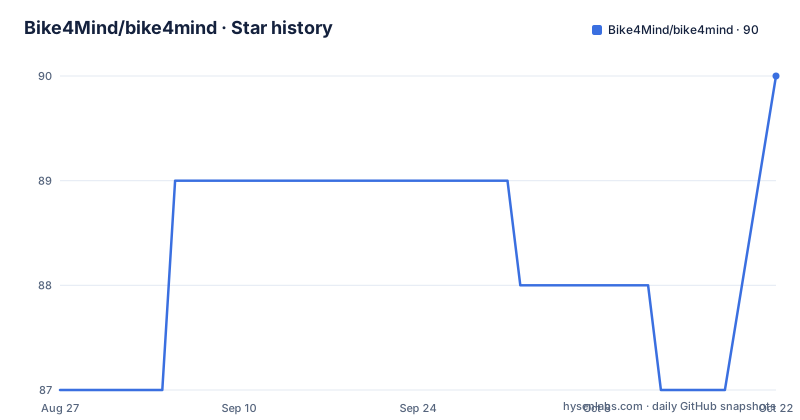
- Bike4Mind/bike4mind87 ★ · +0
| Repository | 2026-08-27 | 2026-10-18 |
|---|---|---|
| Bike4Mind/bike4mind | 87 | 87 |
0 Stars in the last 52 days, measured from the daily GitHub snapshot. Compare with other projects
Editorial analysis
What Bike4Mind Actually Solves
Bike4Mind addresses a specific pain: teams that want to use multiple AI models without being locked into one vendor's workspace. The README describes it as an "AI-powered knowledge platform" that wires notebooks, autonomous agents, and a RAG knowledge engine into one interface. The target user is an engineer or knowledge worker who needs to switch between Anthropic, OpenAI, Google Gemini, xAI, and local models like Ollama or vLLM, all while keeping data on their own infrastructure. It is not a lightweight wrapper. It is a full application with a client, a backend, a database, and a queue system. The self-host path means you do not need a cloud provider account, which is a deliberate contrast to hosted-only AI tools.
The Open-Core Split and What It Means for You
Bike4Mind is open core, and the split is explicit. The repository contains the agent engine, LLM adapters, CLI, data models, and the self-host path, all published as @bike4mind/* packages. The closed part is the multi-tenant hosted service, including billing, entitlements, and hosted infrastructure, plus premium overlays like Overwatch. The README points to CONTRIBUTING.md for the exact boundary, but that file is not in the material we have. That is a gap you must fill before relying on this for production. The license is Business Source License 1.1 with an Additional Use Grant. You can read, modify, redistribute, and make production use, including self-hosting for internal use and building commercial products on top. You cannot offer it to third parties as a competing hosted service. Each released version converts to Apache-2.0 two years after public release. That is a real time-based escape hatch, but it applies per version, so the version you deploy today will not be Apache until 2028.
Architecture and Data Flow from the Repository Layout
The repository is a pnpm and Turborepo monorepo running Node 24. The layout shows a clear separation: apps/client is a Next.js SPA with a pages API backend, packages/cli holds an interactive CLI and a ReAct agent, b4m-core contains the @bike4mind/* engine packages, and packages/database has Mongoose models and migrations. A separate @bike4mind/subscriber-fanout image handles realtime WebSocket fanout. The data flow implied by this structure is: the client talks to the Next.js API, which uses the core packages to call LLM adapters, store data in MongoDB, and push updates through the fanout service. The CLI runs the same agent engine outside the web app. This is a conventional architecture, but it is also a heavy one. You are not deploying a single binary. You are deploying an app, a database, object storage, queues, and a mail catcher, all orchestrated by Docker Compose.
Getting It Running: Commands and Config Keys
The quickstart gives two paths. Hosted is just signing in at app.bike4mind.com. Self-hosting requires Docker and a few steps. First, copy the env template: cp .env.selfhost.example .env.selfhost. Then generate JWT_SECRET, SESSION_SECRET, and SECRET_ENCRYPTION_KEY, and add your model keys. The README points to SELF_HOST.md for details, but that file is not in the material. Then run docker compose -f compose.selfhost.yaml --env-file .env.selfhost up -d. This brings up the full stack: the app, MongoDB, object storage, queues, and a mail catcher. The app runs at http://localhost:3000, and sign-in code emails land in Mailpit at http://localhost:8025. The self-host image is published to ghcr.io/bike4mind/bike4mind-selfhost. For development, the commands are pnpm i -r, pnpm turbo:core:build, pnpm turbo:typecheck, and pnpm turbo:test. The env setup is the first place you can trip. If you skip generating those secrets, the stack will likely fail to start or run with insecure defaults. The README does not show the actual generation commands, so you must read SELF_HOST.md.
The Agent and RAG Mechanism
The README describes two agent systems. Quest Master is an autonomous, multi-step task planner that can run text and image generation, vision review, web search, math, code, and human-in-the-loop steps in parallel. AI Agents are ReAct-style agents that act against your tools and knowledge. The Knowledge Engine is RAG over your documents, with smart chunking, vector search, collections, and tagging. The key point is that agents can use the RAG engine to reason about your data, and they can call external tools like web search. The human-in-the-loop steps in Quest Master are a notable design choice. Not every AI workbench includes a pause for human approval in the middle of a task. That is a practical feature for production use, but the README does not explain how the human step is presented or approved. You would need to run it to see the UX.
Limitations and Where It Is the Wrong Tool
The most obvious limitation is the license. BSL 1.1 is not an OSI-approved open-source license. If your organization requires Apache-2.0 or MIT for all dependencies, Bike4Mind fails that policy today. The two-year conversion is a promise, not a current state. Another limitation is operational complexity. The self-host stack includes MongoDB, object storage, queues, and a mail catcher. That is a lot of moving parts for a single-user notebook tool. If you only need to chat with a local model, something like a single-container Ollama setup is far simpler. The README also mentions a separate subscriber-fanout image, which means you have at least two containers to manage beyond the app. The mail catcher is for development; in production you will need a real SMTP service, which the README does not cover. Finally, the material gives no performance data. There are no benchmarks for RAG indexing speed, agent latency, or concurrent users. You cannot judge scalability from the README.
A Real Alternative: Direct Model APIs or a Simpler RAG Stack
A direct alternative is to skip the platform and use each model vendor's API directly, or use a minimal RAG library like LangChain or LlamaIndex. The difference in approach is fundamental. Bike4Mind gives you a unified workspace with notebooks, agents, and RAG bundled, but it also imposes its own data model, its own CLI, and its own agent framework. With LangChain, you assemble your own pipeline, choose your own vector store, and write your own orchestration. You get flexibility but you build the interface. Bike4Mind is the opposite: you get the interface but you accept its abstractions. For a team that wants a ready-made multi-model workspace, Bike4Mind is the higher-level option. For a team that needs to integrate AI into an existing application with specific data flows, a library approach is more direct. The trade-off is between speed of setup and control over the internals.
Maintenance and Upgrade Cost
The release history shows a fast cadence. Three releases on a single day, v2026.08.28.1 through v2026.08.28.3, with fixes and features. That suggests active development, but it also means you will need to track updates frequently if you self-host. The project uses a versioning scheme based on date, which is easy to sort but does not indicate semantic versioning. You cannot tell from the version number whether a release contains breaking changes. The README mentions migrations in packages/database, so database schema changes are expected. You will need to run those migrations on upgrade. The license conversion clock applies per version, so if you upgrade to a newer version, the clock restarts for that version. That is an important maintenance cost: staying on an older version gets you to Apache-2.0 sooner, but you miss bug fixes. The README does not specify an upgrade path or a migration script, so you should verify that in CONTRIBUTING.md or by testing a version bump.
Editorial conclusion
Adopt Bike4Mind if you need a self-hosted, multi-model AI workspace with notebooks, agents, and RAG, and you are comfortable with the BSL 1.1 license's restriction on offering a competing hosted service. Do not adopt it if you plan to build a managed AI service for third parties or require a pure open-source license from day one. Before committing, verify the exact open/closed boundary in CONTRIBUTING.md, confirm that the two-year conversion clock applies to the version you deploy, and test the self-host stack with your own model keys, especially the JWT and encryption key generation steps.
Frequently asked questions
What is in the open part of Bike4Mind and what is closed?
Open, and in this repository under BUSL 1.1: the agent engine, LLM adapters, CLI, data models and the self-host path, published as @bike4mind/* packages. Closed: operating the multi-tenant hosted service, meaning billing, entitlements and hosted infrastructure, plus premium overlays such as Overwatch.
Can I use Bike4Mind commercially?
Yes. The Additional Use Grant lets you read, modify, redistribute and make production use of the code, including self-hosting it for your organisation's internal use and building or commercialising your own products on top. What it forbids is offering the software to third parties as a competing hosted or managed service.
How do I self-host Bike4Mind?
Copy .env.selfhost.example to .env.selfhost, generate JWT_SECRET, SESSION_SECRET and SECRET_ENCRYPTION_KEY, add your model keys, then run docker compose -f compose.selfhost.yaml --env-file .env.selfhost up -d. The app answers on localhost:3000 and sign-in codes land in Mailpit on localhost:8025.
Which models does Bike4Mind support?
Anthropic, OpenAI, Google Gemini, xAI and Ollama for local models, plus the image models FLUX, DALL·E 3 and Stable Diffusion. The page does not describe a voice feature, although the repository description lists voice among the capabilities.
How is the Bike4Mind codebase developed and built?
pnpm plus Turborepo on Node 24. pnpm i -r installs, pnpm turbo:core:build builds the @bike4mind/* core packages, pnpm turbo:typecheck type checks and pnpm turbo:test runs the tests. The regions are apps/client, packages/cli, b4m-core/* and packages/database.
Official sources
Add this badge to your README
If you maintain this project, the badge below links readers to this analysis and shows its maintenance status from the daily GitHub snapshot. Paste the markdown into your README; add ?metric=license or ?metric=stars to the image URL for a different field.

[](https://hysenlabs.com/projects/bike4mind-bike4mind)Star history chart for your README
[](https://hysenlabs.com/projects/bike4mind-bike4mind)