2027 Tech Jobs: A Community-Maintained Internship and New Grad List
Frequently updated tech jobs repo for internships, off-cycle postings, and new grads
At a glance
- What is it?
- A GitHub repository tracks 2027 tech internships, off-cycle roles, and new grad positions, with a focus on US, Canada, and remote work. The list is collaborative and frequently updated, but its quality depends on community contributions.
- Who is it for?
- Adopt this repository if you are a 2027 graduate or current student seeking tech internships or new grad roles in the US, Canada, or remote, and you prefer a community-curated list over a paid aggregator. Do not rely on it as your sole job source, because the data is manually added and may miss postings or contain errors.
- Can I use it commercially?
- Yes. MIT is a permissive licence: you can use, modify and sell software built on it, as long as you keep its copyright and licence notices.
- Is it still maintained?
- Yes. The repository last received commits 3 days ago.
- What is it written in?
- Mainly TypeScript, according to GitHub's language statistics.
Answers come from the project's GitHub data, last synced on October 20, 2026, and from our analysis. They are not legal advice.
Star history
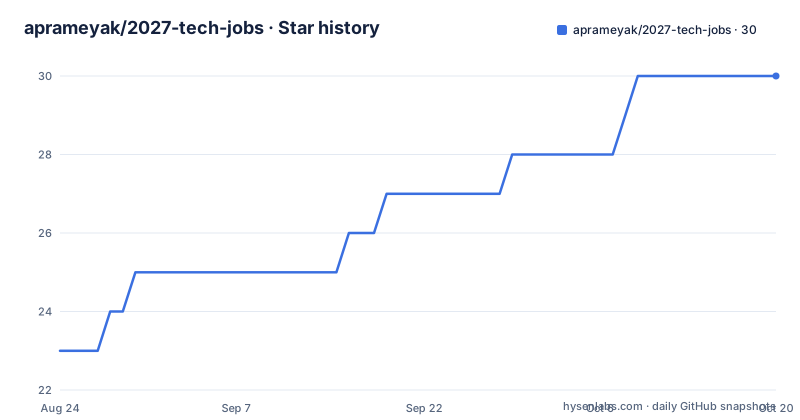
- aprameyak/2027-tech-jobs30 ★ · +7
| Repository | 2026-08-24 | 2026-10-20 |
|---|---|---|
| aprameyak/2027-tech-jobs | 23 | 30 |
7 Stars in the last 57 days, measured from the daily GitHub snapshot. Compare with other projects
Editorial analysis
What This Repository Solves
The 2027-tech-jobs repo addresses a specific pain point for computer science students and recent graduates: finding internship and new grad postings that are actually open for the 2027 cycle. Many job boards are cluttered with roles for earlier years, or they bury relevant postings under generic filters. This repository curates a list of tech internships, off-cycle internships, co-ops, and new grad roles, all tagged with the year 2027. The README is explicit about the geographic scope: exclusively internships and co-ops in the United States, Canada, or remote positions. That narrows the field for students who are location-constrained or who need remote flexibility. The intended audience is clear: undergrads, PhD students, and new graduates who are actively applying for roles in the 2027 hiring season.
How the List Is Structured and Maintained
The repository is organized into three main sections: Summer 2027 Internships, Off-Cycle Internships and Co-ops, and New Grad 2027. Each entry in the table lists the company, role, location, education level required, a direct application link, and the date the posting was added. The README includes a legend with three markers: a symbol for no sponsorship, a symbol for US citizenship required, and a symbol for closed applications. That legend is important because it lets a reader quickly filter out roles that are not viable for their visa status or citizenship. The list is maintained collaboratively, with the README asking contributors to submit an issue to add or update postings. There is also a contribution guidelines file referenced in the README, though its contents are not shown in the provided material. The date added column is a practical touch; it tells you how stale a posting might be.
Getting Started and Contributing
To use the repository, you do not need to install anything. You simply open the README on GitHub and browse the tables. The application links point directly to company career pages, such as Workday, Lever, Greenhouse, or Oracle Cloud. For example, the Workiva summer 2027 software engineering intern role links to a Workday job posting. To contribute, the README directs you to submit an issue via a specific URL: https://github.com/aprameyak/2027-tech-jobs/issues/new/choose. That implies you should have a GitHub account and be ready to provide the company name, role, location, education level, and a valid application link. There is no automated pipeline described; the list appears to be manually updated by the maintainer and contributors. The primary language listed for the repository is TypeScript, but the README itself is plain Markdown. The TypeScript likely relates to a website or script in the repository, but the provided material does not detail what that code does.
What the Data Shows and What It Does Not
The sample rows from the summer 2027 table reveal a mix of companies, from large firms like Amazon and American Express to smaller ones like AnaVation and Auto-Owners Insurance. Roles span software engineering, data analytics, cybersecurity, and quantitative trading. Education levels range from undergrad to PhD, and locations include major cities like New York and Chicago, plus remote options. However, the data is far from complete. The README is truncated in the provided material, so the full list is not visible. More importantly, the list only includes what contributors have added. If a company does not post early or if no one submits an issue, that role will not appear. The date added column shows entries from late August, which suggests the repository is active, but the last push date is unknown. That is a limitation: you cannot confirm how current the list is without checking the commit history yourself.
Limitations and Failure Modes
The biggest limitation is the manual, community-driven nature of the list. There is no guarantee that every posting is accurate or up to date. A link could break, a role could be filled, or a company could change its application requirements. The legend includes a closed application marker, but that marker has to be added by a contributor after the fact. In practice, you might click a link and find the application is no longer available. Another limitation is the geographic restriction. The README says exclusively US, Canada, or remote positions. If you are looking for roles in Europe, Asia, or elsewhere, this repository is not for you. Also, the education level is often listed as undergrad, but some roles require a PhD, as seen in the American Express entries. That means a casual reader might overlook a role that does not match their degree. The repository is also not a job board; it does not offer search or filtering. You have to scan the tables manually.
A Real Alternative: Traditional Job Boards
A direct alternative is to use a traditional job board like LinkedIn, Indeed, or a specialized tech job site like Levels.fyi or Glassdoor. The key difference is in the approach. This repository is a static, human-curated list that you have to check manually. A job board is a dynamic database with search filters, alerts, and application tracking. For example, on LinkedIn you can set a filter for 2027 internships and receive daily notifications. That is a more automated workflow. However, a job board will show many more postings, including ones that are not relevant or are for other years. The repository's advantage is its focus and the fact that it is free and open. The trade-off is that you trade comprehensiveness for curation. If you want to cast a wide net, a job board is better. If you want a targeted list of early 2027 roles, this repo is a starting point.
Maintenance, Licensing, and What to Verify
The repository is licensed under MIT, which means you can reuse the data or the code freely, with attribution. That is a permissive license, but it also means there is no warranty. The README does not mention a regular update schedule, so maintenance is sporadic. The last push date is unknown, which is a red flag if you are considering relying on it. You should check the commit history on GitHub to see how recent the last update was. The contribution process requires you to submit an issue, which is a low barrier but still depends on the maintainer's responsiveness. The repository is not archived, and there are no recent releases, but that is normal for a data repository. Before applying to any role, you should verify the posting on the company's official career page, not just rely on the link in the table. Also, check the date added to see if the posting is more than a few weeks old, as early postings may have already closed.
Editorial conclusion
Adopt this repository if you are a 2027 graduate or current student seeking tech internships or new grad roles in the US, Canada, or remote, and you prefer a community-curated list over a paid aggregator. Do not rely on it as your sole job source, because the data is manually added and may miss postings or contain errors. Before applying, verify each posting directly on the company's career page, check the date added to gauge freshness, and confirm sponsorship or citizenship requirements using the legend. If you want a more structured or automated feed, consider a traditional job board or a paid service, but this repo offers a free, transparent alternative.
Frequently asked questions
Which careers does the 2027 tech jobs list say will be in demand?
The repository makes no forecast. It lists postings and nothing else, split into SUMMER.md with 5230 entries, OFFCYCLE.md with 1493 and NEWGRAD.md with 2594, each row carrying company, role, location, education level, application link and the date it was added.
Which jobs does this repo think AI will replace by 2027?
It does not analyse that, and it carries no such column. What the tables show is that several listed roles have AI in the title, including an associate scientist post doc fellow in AI/ML and computational biology, a data analytics and AI intern, a commercial project management and AI innovation intern, and a machine learning engineer intern.
Can I find out from this repo which tech jobs pay the most?
No salary information appears anywhere in the tables, and there is no compensation column. The six columns are Company, Role, Location, Education, Application/Link and Date Added, so pay has to be checked at the employer through the application link.
How do I know if a role in the 2027 tech jobs list still accepts applications?
The legend carries three signals: one marker means the employer does not offer sponsorship, one means it requires US citizenship, and a lock marker means the application is closed. The date added column shows when a row appeared rather than when the employer last updated it, so open the link to confirm.
Official sources
Add this badge to your README
If you maintain this project, the badge below links readers to this analysis and shows its maintenance status from the daily GitHub snapshot. Paste the markdown into your README; add ?metric=license or ?metric=stars to the image URL for a different field.

[](https://hysenlabs.com/projects/aprameyak-2027-tech-jobs)Star history chart for your README
[](https://hysenlabs.com/projects/aprameyak-2027-tech-jobs)