Bloomberg Beta runs its venture firm out of a GitHub repository
You were probably looking for our website... this is it. We moved our website here, so you can see the insides of how we work.
At a glance
- What is it?
- The website of an early-stage fund is a set of Markdown files in a public repository, including the operating manual it once kept internally. There is no software to install, which is precisely the argument the repository is making.
- Who is it for?
- Read this repository if you are a founder deciding whether to spend a meeting on Bloomberg Beta, because the diligence questions and check sizes are written down before the call rather than after it. Do not treat it as software to adopt; there is nothing to install, no build and no licence grant over code, and the repository has no releases and no detectable primary language.
- Can I use it commercially?
- Not without permission. GitHub finds no licence file in the repository, and without a licence all rights are reserved by default: you may read the code but not reuse it. Check the README, or ask the authors, before using it.
- Is it still maintained?
- Yes. The repository last received commits 10 days ago.
- What is it written in?
- GitHub does not report a main language for this repository.
Answers come from the project's GitHub data, last synced on November 7, 2026, and from our analysis. They are not legal advice.
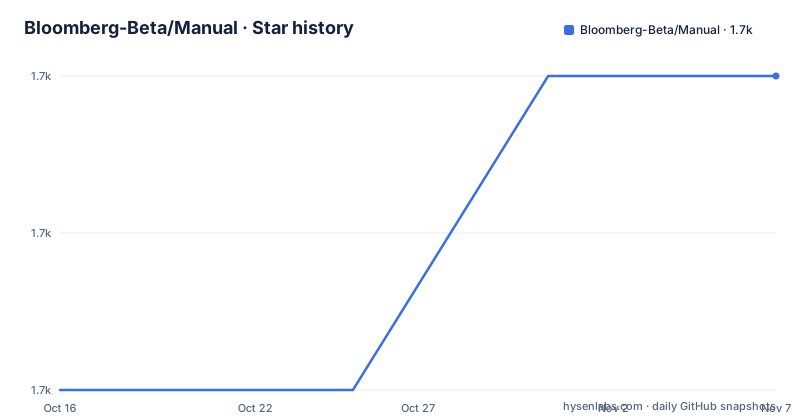
Star history
- Bloomberg-Beta/Manual1,725 ★ · +2
| Repository | 2026-10-16 | 2026-11-07 |
|---|---|---|
| Bloomberg-Beta/Manual | 1.7k | 1.7k |
2 Stars in the last 22 days, measured from the daily GitHub snapshot. Compare with other projects
Editorial analysis
The repository is the website, and that is the whole design
The README opens by anticipating confusion: readers looking for the website are told they have found it, because the website was moved here. There is no build step, no static site generator, no domain-hosted site. The entire web presence of an early-stage venture firm backed by Bloomberg L.P. is five Markdown files at the root of a public repository.
The file names carry a numbering scheme that functions as a table of contents. Alongside README.md there is 1 - Manual.md, the operating manual that was previously internal; 2 - In our portfolio.md; 3 - Criteria for investing.md, described as the questions the firm asks itself when evaluating startups; and 4 - Reading list.md.
The repository has no GitHub releases, and the primary language field is unknown. Both facts are consistent with what it is. There is no version to release because a document does not have a version boundary, and there is no dominant language because the content is prose rather than source.
The manual started internal and was published on founder demand
The origin story is specific enough to be useful. A few months after the fund started, the team was writing an operating manual for itself, covering what the README describes as everything from check sizes to diligence questions to core beliefs. They decided to open source it.
The stated reason is feedback rather than positioning. The README says founders told them repeatedly how much time it saved to have facts out in the open, and how it helped them decide whether to work with the firm. It adds a line that is easy to miss and honest about the effect: founders who decide against the firm also save a step, because founder time is precious.
That last observation is the actual argument for transparency here. Publishing the criteria does not only attract founders who are a good fit; it filters out the ones who were not going to say yes, and does so before anyone spends time. Publishing a portfolio and an evaluation framework is cheaper for the investor than running the process in reverse.
Why the whole site moved rather than just the manual
Moving the entire web presence to GitHub was a second step after the manual was already public. The README frames it as the same instinct taken further, so that a visitor can see how the firm's thinking changed over time, propose improvements through pull requests, or take the ideas and make them their own. It is explicit in the same breath that the investments are theirs.
The stated reason is trust. Treating founders as customers, the reasoning goes, means building as much trust as possible with them, and transparency about how the firm thinks and what it believes is the first step to that. Files in a public repository also carry something a rendered website does not: history. Changes are visible as diffs, and the argument is that a reader can check whether a stated principle survived contact with real decisions.
The README closes by inviting the reader to skip straight to the manual, which is a fair description of what most visitors will do.
The fund has changed scale since that manual was written
The numbers are worth separating into two eras. Bloomberg Beta began as an early-stage firm investing out of a $75M seed fund focused broadly on the future of work. The README then notes they are now investing out of a fifth fund, of the same size and focus as the first four, plus a $75M opportunity fund that invests at later stages in companies already backed. Total under management is stated as $450M.
So a founder reading a check size or an investment criterion written in the first year is reading a document from a $75M single-vehicle firm, read by a firm now deploying across five seed funds and an opportunity fund. That does not invalidate the manual. It does mean the criteria in 3 - Criteria for investing.md deserve a second look against current behaviour, and the last push was on 2026-10-08.
The investment stance itself is stated in one paragraph. Choices are made independently, without preference for companies that have or want a relationship with Bloomberg. The firm invests for financial return and says so plainly. Bloomberg is described as a template rather than a filter: a powerful founding idea, transparency in markets, global scale, and a strong open culture led by its founders for decades.
Five Markdown files, no build, nothing to install
There is no install step to document here. The repository has no package manifest, no lockfile and no CI configuration. The way to obtain the content is to clone it or read it in the browser. What you get is 1 - Manual.md, 2 - In our portfolio.md, 3 - Criteria for investing.md and 4 - Reading list.md, and the README that links to them. The README does not describe a build, a contribution workflow beyond the implicit ability to propose changes, or any structure for generating a site from these files.
The licence is Creative Commons Attribution 4.0, not an open source licence
The README states that the manual is open sourced under a Creative Commons licence, linking to the Attribution 4.0 deed. That is a meaningful distinction and it is worth being precise about, because open source is a term of art that carries obligations about what a derivative work must do.
Creative Commons Attribution 4.0 permits copying, distribution and adaptation for any purpose, including commercial ones, on the condition that attribution is given and changes are indicated. It says nothing about software, and there is no software here to speak of. The practical effect is that a founder, a competitor or a journalist can quote, translate, summarise or extend the manual's content and the criteria, as long as they credit Bloomberg Beta.
A company operating this way is giving away the thinking rather than the tooling, and the licence matches that choice. Anyone expecting a code licence, and the obligations that come with it, will not find one here.
The rest of the README is a hiring page with a stated turnover
The lower half of the README lists the team with social profile links, the two offices (140 New Montgomery St. on the 22nd floor in San Francisco, and 731 Lexington Ave. in New York), and the ways to work with them, which are an SF-based associate role and a fellowship taken opportunistically with individual outreach encouraged.
One paragraph is unusual enough to reproduce as a fact rather than a quote. Most roles last a few years and then people go into a startup or start one. The README names where alumni have gone, spanning large technology companies, other venture firms, media, and founders building in cybersecurity, disability tech and women's empowerment.
The equal opportunity statement is explicit about the commitment and the reasoning, noting that the work depends on being inclusive, and it credits Textio for the inspiration on how to phrase it. That last detail is the kind of small transparency this repository is built on.
What this repository is not for
There are clear mismatches between this project and the things people usually want from an open source repository. It is not a template: cloning it gives you a document about a venture firm, not a Next.js starter, a monorepo skeleton or a deployment pipeline. It is not a dataset: the portfolio file is a list of companies, not a structured export with a schema. It is not a tool with a failure mode, because there is nothing to run.
The honest criticism is also the flip side of the design. A firm that publishes its manual invites evaluation of its own consistency, and a reader can check whether the criteria read well against the portfolio list. That is a deliberate trade. For a firm whose product is trust, making the reasoning auditable is worth more than controlling the message.
For an engineer, the practical use is narrow and real: before or instead of a first call, read 3 - Criteria for investing.md and 1 - Manual.md and decide whether this is a firm worth an hour.
Editorial conclusion
Read this repository if you are a founder deciding whether to spend a meeting on Bloomberg Beta, because the diligence questions and check sizes are written down before the call rather than after it. Do not treat it as software to adopt; there is nothing to install, no build and no licence grant over code, and the repository has no releases and no detectable primary language. What you are adopting is an argument, not a tool. Verify first that the investment criteria file still matches the fund's current behaviour, since the last push was on 2026-10-08 and the fund has moved from its first $75M seed vehicle to a fifth one.
Frequently asked questions
What does the Bloomberg-Beta Manual repository contain?
Five Markdown files at the root: README.md, the operating manual in 1 - Manual.md, the portfolio list in 2 - In our portfolio.md, the evaluation questions in 3 - Criteria for investing.md, and 4 - Reading list.md.
Can I use the content of the Bloomberg Beta manual commercially?
The manual is published under a Creative Commons Attribution 4.0 licence, which permits copying, distribution and adaptation for any purpose provided you give attribution. It is a content licence rather than an open source software licence.
How much money does Bloomberg Beta manage?
The README states they now invest out of a fifth fund of the same size and focus as the first four, plus a $75M opportunity fund for later-stage follow-ons, for $450M in total under management. The firm began with a $75M seed fund.
Does Bloomberg Beta require a relationship with Bloomberg to get funded?
No. The README says choices are made independently, without preference for companies that have or want a relationship with Bloomberg, and that the firm invests for financial return.
Official sources
Add this badge to your README
If you maintain this project, the badge below links readers to this analysis and shows its maintenance status from the daily GitHub snapshot. Paste the markdown into your README; add ?metric=license or ?metric=stars to the image URL for a different field.

[](https://hysenlabs.com/projects/bloomberg-beta-manual)Star history chart for your README
[](https://hysenlabs.com/projects/bloomberg-beta-manual)Was this useful?