bootdotdev/curriculum: the open roadmap behind Boot.dev's backend path
An open roadmap for Boot.dev's backend development curriculum
At a glance
- What is it?
- Boot.dev's curriculum repository is a set of Markdown roadmaps, not a course platform. It shows the order of courses for backend, data, DevOps and planned paths, and it is useful only if you already know why you are following it.
- Who is it for?
- Use bootdotdev/curriculum if you want to see the intended order of Boot.dev's backend, data analyst or DevOps courses before paying for the platform, or if you are mapping a self-study plan onto its sequence. Do not use it if you expect lesson content, exercises, or a standalone curriculum you can teach from: the repository holds roadmap files and links, and the courses live on boot.dev.
- Can I use it commercially?
- Not without permission. GitHub finds no licence file in the repository, and without a licence all rights are reserved by default: you may read the code but not reuse it. Check the README, or ask the authors, before using it.
- Is it still maintained?
- Yes. The repository last received commits 31 days ago.
- What is it written in?
- GitHub does not report a main language for this repository.
Answers come from the project's GitHub data, last synced on November 15, 2026, and from our analysis. They are not legal advice.
Star history
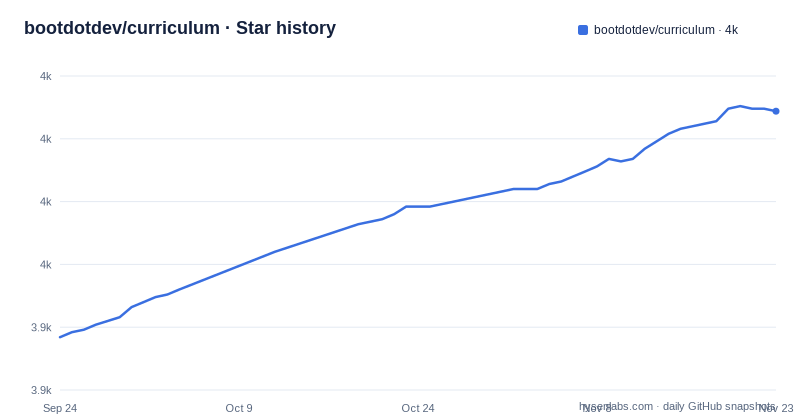
- bootdotdev/curriculum4,004 ★ · +83
| Repository | 2026-09-24 | 2026-11-15 |
|---|---|---|
| bootdotdev/curriculum | 3.9k | 4k |
83 Stars in the last 52 days, measured from the daily GitHub snapshot. Compare with other projects
Editorial analysis
What the Boot.dev roadmap repository actually contains
The repository is small. The top level holds README.md and a paths/ directory, and the README links into that directory for each roadmap: paths/backend.md, paths/data-analyst.md, paths/devops.md, paths/ai-engineer.md, paths/data-engineer.md, paths/fullstack.md and paths/computer-science.md. Nothing else is listed at the top level.
The README describes the project as "a living roadmap for Boot.dev's coding curriculum" and points to https://www.boot.dev for the courses themselves. That split matters. This is a planning document for a commercial learning platform, published openly so that prospective students and outsiders can see the intended sequence. It is not a course, not a syllabus with readings, and not a set of exercises.
The audience is narrow and specific: people evaluating Boot.dev's backend developer path, its Python and Go or Python and TypeScript variants, its data analyst path built on Python and SQL, or its DevOps path. If you are not considering that platform, the roadmap still has some value as a sequence reference, but you are reading someone else's table of contents.
How the path files relate to the courses on boot.dev
The structure is a two-level index. The README names each learning path and, under it, the technology combinations that path supports. The Backend Developer Roadmap, for example, is listed with a Python and Go path and a Python and TypeScript path, each linking to a boot.dev URL with a tech query parameter. The Data Analyst Roadmap lists Python and SQL. The DevOps Roadmap lists Python and Go. The AI Engineer, Data Engineer, Fullstack and Computer Science roadmaps are marked "wip/planned" and name Python, Python and Go, or Python and TypeScript.
Each paths/*.md file is where the actual ordering lives. The README does not reproduce that ordering, so the repository's real content is one level down. Data flow is manual and one-directional: a maintainer edits a path file, and the corresponding boot.dev path page is the thing students actually follow. There is no build step, no schema, no generated site, and no validation that the two stay in sync. The README's own framing supports that reading, calling the curriculum something that "will always be improving and never be 'complete'."
That is a deliberate trade-off. Markdown roadmaps are cheap to edit and easy to read in a browser or an editor. They also have no mechanism to warn you when a course is renamed, split, or reordered on the platform.
Reading the roadmap without a Boot.dev account
Nothing in the repository requires an account. You open a path file and read it. The README documents no installer, package, build command or environment variable, so there is no setup sequence to follow here; the files are plain Markdown and any editor or browser will render them.
The README does give the links that matter. The Backend Developer Roadmap entry points to https://www.boot.dev/paths/backend?tech=python-golang and https://www.boot.dev/paths/backend?tech=python-typescript. The Data Analyst Roadmap points to https://www.boot.dev/paths/data-analyst?tech=python. The DevOps Roadmap points to https://www.boot.dev/paths/devops?tech=python-golang.
So the first real use is comparison, not installation. Open paths/backend.md from the repository, then open the matching boot.dev path page from the README, and read them side by side. You are checking whether the course order in the file still matches what the platform presents. The README gives no expected output for that comparison, because the files are prose roadmaps rather than programs. If the two disagree, the platform page is the one students actually follow.
Where the roadmap stops being useful
The most obvious limitation is that the repository contains no teaching material. If you want lessons, projects, or graded exercises, the README sends you to boot.dev and to the contact page. Opening this repository gets you planning documents.
The second limitation is freshness. The README calls the curriculum living and says it will never be complete, which is an explicit statement that the order can change. Since the path files and the platform pages are edited separately, a path file can lag behind what boot.dev actually offers. There is no changelog in the repository and no published release, so you cannot diff versions to see what moved. If you are planning months of study around a sequence, check the live path page before committing to it.
The third is scope. Four of the seven roadmaps are marked wip or planned in the README: AI Engineer, Data Engineer, Fullstack and Computer Science. Treating those as finished plans would misread the repository. The DevOps and Data Analyst roadmaps are not marked that way, and the Backend Developer Roadmap is the one with the most visible detail in the README, including its two technology variants.
Finally, the repository is not a neutral comparison. It is Boot.dev's own description of Boot.dev's curriculum, so it will not tell you what the sequence leaves out relative to other ways of learning backend development.
Roadmap repository versus a full curriculum project
The natural comparison is with curricula that ship the material alongside the plan. The Open Source Society University computer science curriculum, for instance, is a community-maintained list that links to third-party courses and books, and it is independent of any single paid platform. freeCodeCamp's curriculum repository goes further in the other direction: the exercises and challenges live in the repository itself, and the site is built from them.
bootdotdev/curriculum sits between those models but closer to the first. Like OSSU, it is a sequence of pointers. Unlike OSSU, the pointers lead to one vendor's paid courses, and the repository is maintained by that vendor rather than by volunteers. That difference shapes what you get. An independent list can recommend whatever it thinks is best at each step; this one is bounded by what Boot.dev sells. In exchange, the sequence is coherent by construction, because the same organization controls both the roadmap and the courses.
If your goal is a vendor-neutral plan you can assemble from free resources, this repository is the wrong starting point. If your goal is to understand exactly what Boot.dev's backend path covers and in what order, it is the most direct source outside the platform's own pages.
Maintenance, licensing and what the repository does not state
The last push to the default branch was on 2026-09-10, which is recent, and the repository is not archived. Those are the only maintenance signals available here. The repository has no published GitHub releases, so there is no version history to track and no upgrade path to plan. Practically, the cost of following this repository is the cost of re-reading a path file when the sequence changes. There is no dependency graph to maintain and nothing to deploy.
The license is not stated in the README. That is worth knowing before you reuse the roadmap text in your own documentation, training material, or a derivative curriculum. Absent a license file, the default copyright position applies, and the README does not grant reuse rights beyond reading and linking. If reuse matters to you, ask through the contact channels the README lists rather than assuming permission. This is a factual gap, not legal advice.
The README also does not document rollback, versioning, contribution guidelines, or how path changes are decided. Contact happens through the Boot.dev contact page, Discord and X, and the README says the team is most responsive on Discord. For a repository whose stated purpose is to keep improving, the absence of a public change process is the weakest part of the package.
Editorial conclusion
Use bootdotdev/curriculum if you want to see the intended order of Boot.dev's backend, data analyst or DevOps courses before paying for the platform, or if you are mapping a self-study plan onto its sequence. Do not use it if you expect lesson content, exercises, or a standalone curriculum you can teach from: the repository holds roadmap files and links, and the courses live on boot.dev. Before relying on it, open paths/backend.md and compare its course order against the live path page it links to, because the README calls the roadmap living and the two can drift.
Frequently asked questions
What is bootdotdev/curriculum?
It is the open roadmap repository for Boot.dev's coding curriculum, described in its README as "a living roadmap." It holds a README and a paths/ directory with Markdown files for the backend, data analyst, DevOps and several planned learning paths.
Does bootdotdev/curriculum include the actual courses?
No. The repository contains the roadmap files, and the README points to https://www.boot.dev for the courses themselves. Opening the repository gives you the sequence, not the lessons or exercises.
Which learning paths does the roadmap cover?
The README lists Backend Developer, Data Analyst and DevOps roadmaps, plus AI Engineer, Data Engineer, Fullstack and Computer Science roadmaps marked as wip or planned. Each entry names the technology combinations, such as Python and Go or Python and TypeScript.
Is the Boot.dev roadmap finished?
No. The README answers this directly, saying you should get started anyway because the program "will always be improving and never be 'complete'." Four of the listed roadmaps are marked wip or planned.
Official sources
Add this badge to your README
If you maintain this project, the badge below links readers to this analysis and shows its maintenance status from the daily GitHub snapshot. Paste the markdown into your README; add ?metric=license or ?metric=stars to the image URL for a different field.

[](https://hysenlabs.com/projects/bootdotdev-curriculum)Star history chart for your README
[](https://hysenlabs.com/projects/bootdotdev-curriculum)Was this useful?