Auto-Empirical-Research-Skills: a skill catalog that treats the whole paper as a pipeline
A curated collection of 23,000+ agent skills for empirical research across 8 social science disciplines. CoPaper.AI completes a reproducible, standardized empirical paper in 20 minutes and supports user-uploaded skills. Maintained by CoPaper.AI from Stanford REAP.
At a glance
- What is it?
- AERS is a directory of skill folders for coding agents, laid out as a nine-stage path from a rough idea to a submission draft. The interesting part is the scoring harness bolted to it, and the gap between the 23,000 headline count and the 1,151 skills the catalog actually indexes.
- Who is it for?
- Adopt AERS if your agent already drives Stata, R or Python and you want the estimator, the robustness checks and the table layout chosen for you, because that routing is the thing this repository actually contributes. Skip it if you need estimation output you can defend line by line, or if you expect the skill count to be your evidence: only 9 of the 42 eval scenarios carry fixtures proven to separate a right answer from a wrong one.
- Can I use it commercially?
- Check first. The repository uses a licence we do not classify automatically, so read its LICENSE file before any commercial use.
- Is it still maintained?
- Yes. The repository last received commits 6 days ago.
- What is it written in?
- Mainly Stata, according to GitHub's language statistics.
Answers come from the project's GitHub data, last synced on November 15, 2026, and from our analysis. They are not legal advice.
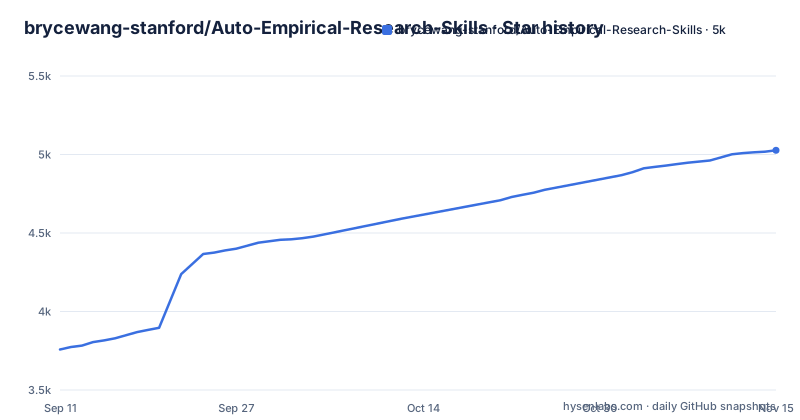
Star history
- brycewang-stanford/Auto-Empirical-Research-Skills5,027 ★ · +1,269
| Repository | 2026-09-11 | 2026-11-15 |
|---|---|---|
| brycewang-stanford/Auto-Empirical-Research-Skills | 3.8k | 5k |
1,269 Stars in the last 65 days, measured from the daily GitHub snapshot. Compare with other projects
Editorial analysis
77 collections mapped onto nine stages of a paper
The unit of work in this repository is a skill collection, not a library. The numbers sit at the top of README.md: 78 collections in the summary table, and a Skill Search page under docs/ that filters 1,151 skills by method, stage, language and licence. The nine stages run from topic refinement through literature review, data acquisition, identification strategy, estimation, robustness auditing, publication-ready tables and figures, writing with peer review, and AIGC reduction before submission. Every stage points at named collections, such as 25 Diverga and 33 claude-scholar for stage 1, or 36 literature-review-skill and 59 openalex-skill for stage 2. The audience is a researcher who already knows econometrics and wants an agent to pick the estimator, not a beginner who needs the concept explained. The repository's primary language is listed as Stata, though the plugin list also includes Python and R pipelines.
SKILL.md is the entire contract between a folder and the agent
Nothing compiles the catalog. There is no runtime that loads these folders and dispatches on stage numbers; the agent reads a SKILL.md file, looks at its description field, and decides whether the skill applies to what you just asked. That single fact explains both the flexibility and the fragility. You can install one collection or the whole repository and the agent will still route, because routing happens in the model's reading of front matter rather than in a dispatcher. The documentation is explicit that a copied folder must carry its own SKILL.md, and that in some collections the file sits one level deeper, so you have to copy that level instead. Failure mode: paste a collection root, no SKILL.md appears in the pasted tree, and the agent has nothing to match against. The description field is also the only index consulted before you name a method, so a vague description costs you the auto-selection the repository advertises.
Copying one collection is more honest than registering the marketplace
The quickest first use is deliberately low ceremony: hand the repository URL to Claude Code or Codex, name the scope you want, and it clones and places the skills for you. For a first look, copying one collection beats that, because you can read exactly what you installed. The clone needs submodules, and the copy target differs by scope.
git clone --recurse-submodules https://github.com/brycewang-stanford/Auto-Empirical-Research-Skills.git
cd Auto-Empirical-Research-Skills

cp -R skills/00.1-Full-empirical-analysis-skill_Python  .claude/skills/   # 项目级
cp -R skills/00.1-Full-empirical-analysis-skill_Python  ~/.claude/skills/ # 全局
The first copy line writes into the current project, the second into your home directory so the collection is available everywhere. After the copy, open a fresh session and describe the analysis in plain language; the agent reads each description field and picks a skill. If it picks wrong, name the method instead, for example event study with Callaway and Sant'Anna.
Three install scopes write into three different directories
Directory scope, project scope and global scope each land somewhere different, and the difference matters for a team. Project scope puts the folders under the repository root so they can be committed and shared; global scope writes to ~/.claude/skills/, which the documentation gives as ~/.agents/skills/ for Codex (~/.codex/skills/ in older versions). A plugin route exists for Claude Code v2.1 and above, and it upgrades rather than pinning, which makes it the only install path that gives you a version handle. That path also splits the catalog into four separately installable plugins, so a team can take the Stata pipeline without the R plus Quarto pipeline. Register the marketplace once, then install the pipelines you want:
claude plugin marketplace add brycewang-stanford/Auto-Empirical-Research-Skills
claude plugin install aer-skills@auto-empirical-research-skills                 # 顶刊投稿全流程(9 skills)
claude plugin install empirical-analysis-python@auto-empirical-research-skills  # Python 计量流水线
claude plugin install empirical-analysis-stata@auto-empirical-research-skills   # Stata 计量流水线
claude plugin install empirical-analysis-r@auto-empirical-research-skills       # R + Quarto 流水线
Run the first line once, then any of the install lines. You should see the chosen plugin registered rather than a folder in .claude/skills/, and later upgrades come through the marketplace instead of a re-clone.
The harness proves nine of 42 scenarios can tell right from wrong
Trust claims in this project are counted, and the counts deserve a close look. README.md lists 19 numeric benchmark tasks whose gold values are recomputed from real data on each run, 42 behavioural eval scenarios carrying 217 rubric items, and only 9 scenarios demonstrated to separate a correct answer from an incorrect one, those 9 covering all 6 critical scenarios. So of the 42 scenarios you might assume back the catalog's quality, nine have pass and fail fixtures that prove they discriminate. If you picked this repository because you want evidence the skills produce correct econometrics, the honest number is the nine, not the 42.
The headline says 23,000 skills and the search page says 1,107
The repository description advertises a curated collection of 23,000+ agent skills across 8 social science disciplines, maintained by CoPaper.AI from Stanford REAP. README.md points the Skill Search at filtering all 1,151 skills, and the collection summary table has 78 rows. Those three numbers describe different objects: 1,151 is what the Skill Search filters, 78 is how many collections the summary table lists, and 23,000+ is the figure in the repository description. If you need an exact figure for a methods section, take it from catalog/skills.json rather than from the description. The repository takes that route itself: the statistics checker inside make validate reads catalog/skills.json, which is what keeps the summary table from drifting away from the index.
aers-score installs no dependencies, then insists on the checkout
The only packaged Python artifact is a console script named aers-score. pyproject.toml declares dependencies = [] on purpose, so the scorer can be installed in the minimal environment an agent author already has, and the repository stays stdlib-only. That choice collides with the task the CLI serves: aers_score/exam.py resolves the exam, meaning task specs plus datasets plus graders, from a checkout at runtime, because a bundled second copy of the datasets would be a drift surface. So an editable install gives you a command that cannot score anything until the repository sits beside it. The pinned scientific stack in requirements.txt is a separate matter: numpy, pandas, matplotlib, statsmodels, linearmodels and python-pptx exist for CI and the Paper-WorkFlow demo gate, and the file says the Python 3.9 leg of the quality matrix installs nothing at all. Installing the scorer and listing the exam is a two step affair:
pip install -e .
aers-score tasks
The install step is documented in pyproject.toml as an editable install from a checkout, with uv tool install --editable . as the alternative. The second line lists tasks, and it only returns anything useful when the repository is the directory you installed from.
StatsPAI executes estimators, AERS tells the agent which to call
StatsPAI is the closest real alternative and it shares a maintainer, which makes the difference in approach easy to state. StatsPAI is a Python package with a built-in MCP server returning structured result objects, so estimation happens in code and the agent inspects and audits real output. It replaces reghdfe, csdid, rdrobust, synth, fixest and did in Python, needs no Stata or R session, and installs with pip install statspai under MIT. AERS does none of that computation. It supplies prompts, folder structure and the stage map, and delegates the actual estimation to whatever Stata, R or Python environment you already run. Pick StatsPAI when the numerical result matters and you want one reproducible path. Pick AERS when you want an agent to walk a full paper workflow and you already trust your own estimators. Running both is the arrangement the two repositories were built for, since the README says they are maintained by the same team and deeply integrated.
Editorial conclusion
Adopt AERS if your agent already drives Stata, R or Python and you want the estimator, the robustness checks and the table layout chosen for you, because that routing is the thing this repository actually contributes. Skip it if you need estimation output you can defend line by line, or if you expect the skill count to be your evidence: only 9 of the 42 eval scenarios carry fixtures proven to separate a right answer from a wrong one. Verify first that the collection you plan to copy carries a SKILL.md at the level you paste, since some collections keep it one directory deeper and a silent miss means the agent never sees the skill. Then run the 19 benchmark tasks in benchmark/ against your own agent and read the resulting failures before you trust a single stage-5 result.
Frequently asked questions
What is Auto-Empirical-Research-Skills (AERS)?
It is a curated collection of skill folders for coding agents covering empirical research across eight social science disciplines, laid out as a nine-stage path from topic refinement to submission. The Skill Search page under docs/ filters 1,151 skills by method, stage, language and licence, grouped into 78 collections.
How do I install Auto-Empirical-Research-Skills into Claude Code?
You can hand the repository URL to Claude Code or Codex and name a scope, or register the plugin marketplace with claude plugin marketplace add brycewang-stanford/Auto-Empirical-Research-Skills and then install one of four plugins. A manual install copies a collection folder into .claude/skills/ in the project or in your home directory, and it needs the clone to include submodules.
Does Auto-Empirical-Research-Skills ship a Python package you can pip install?
Only one artifact is packaged, the aers-score console script, and it declares an empty dependency list so it installs into a minimal environment. It resolves the exam from a checkout at runtime, so it cannot score anything until the repository is present on disk.
What licence does Auto-Empirical-Research-Skills use?
The pyproject.toml license field for the packaged aers-score tool reads CC-BY-SA-4.0, and the repository carries a LICENSE file plus a Creative Commons attribution badge. Licence detection on the repository itself does not resolve an identifier, so read the LICENSE file before redistributing anything.
Official sources
Add this badge to your README
If you maintain this project, the badge below links readers to this analysis and shows its maintenance status from the daily GitHub snapshot. Paste the markdown into your README; add ?metric=license or ?metric=stars to the image URL for a different field.

[](https://hysenlabs.com/projects/brycewang-stanford-auto-empirical-research-skills)Star history chart for your README
[](https://hysenlabs.com/projects/brycewang-stanford-auto-empirical-research-skills)Was this useful?