bytedeco/javacpp: mapping C++ onto Java through JNI instead of inventing a wrapper language
The missing bridge between Java and native C++
At a glance
- What is it?
- A Java library whose argument is that C++ and Java are similar enough to translate directly, covering overloaded operators, templates, callbacks and virtual inheritance through annotations and a build-time parser.
- Who is it for?
- JavaCPP is most convincing where other bridges are weakest, in the long tail of C++ features that a wrapper generator normally skips, and least convincing where it would need to be a complete C++ implementation, which the README itself concedes by calling the release a proof of concept. For an evaluator, the practical sequence is short.
- Can I use it commercially?
- Check first. The repository uses a licence we do not classify automatically, so read its LICENSE file before any commercial use.
- Is it still maintained?
- Yes. The repository last received commits 73 days ago.
- What is it written in?
- Mainly Java, according to GitHub's language statistics.
Answers come from the project's GitHub data, last synced on October 23, 2026, and from our analysis. They are not legal advice.
Star history
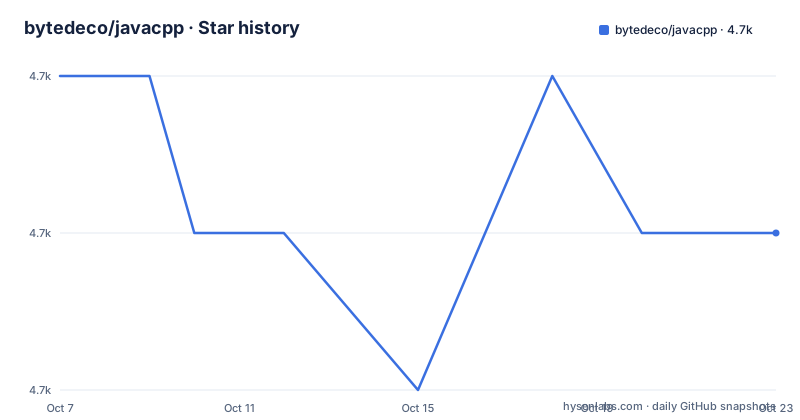
- bytedeco/javacpp4,705 ★ · -1
| Repository | 2026-10-07 | 2026-10-23 |
|---|---|---|
| bytedeco/javacpp | 4.7k | 4.7k |
-1 Stars in the last 16 days, measured from the daily GitHub snapshot. Compare with other projects
Editorial analysis
The argument is similarity, not a new language
The introduction makes a specific claim and then defends it against a long list of rivals. JavaCPP provides efficient access to native C++ inside Java, described as not unlike the way some C and C++ compilers interact with assembly language.
From there it does something unusual for a binding library: it names its competitors and explains why none of them are needed. No need to invent new languages, as SWIG, SIP, C++/CLI, Cython and RPython each do. Instead, the stated approach is to exploit the syntactic and semantic similarities between Java and C++, with cppyy named as the project doing the same idea for Python.
The comparison list that follows is longer and more useful than the opening. On the Java side: JNIWrapper, GlueGen, the LWJGL Generator, JNIDirect, JNA, JNIEasy, HawtJNI, JNR, BridJ, JNIGeneratorApp, CableSwig, cxxwrap and JniMarshall. On other languages: Platform Invoke for .NET, ctypes, CFFI, fficxx, pybind11, rust-bindgen, Panama Native for Java itself, and cgo. SWIG and SIP reappear because they are the reference points everyone knows.
Placing Panama in that list is worth noting. Panama is the project for native interop inside the JDK itself, and JavaCPP lists it as a comparable rather than dismissing it. The README also notes that under the hood it uses JNI, which is why it works across all Java SE implementations plus Android, Avian and RoboVM, each with its own instructions section further down the page.
What it claims to map, feature by feature
The sentence enumerating supported features is the technical heart of the README, and it is worth reading as a list of things other generators usually skip.
Overloaded operators. Class and function templates. Callbacks through function pointers. Function objects, described in the README as functors. Virtual functions and member function pointers. Nested struct definitions. Variable length arguments. Nested namespaces. Large data structures containing arbitrary cycles. Virtual and multiple inheritance. Passing and returning by value, by reference, by string and by vector. Anonymous unions. Bit fields. Exceptions. Destructors and shared or unique pointers, handled via either try-with-resources or garbage collection. Documentation comments.
That list is a map of where C and C++ interoperability usually degrades. Overloaded operators have no Java equivalent, so a binding has to invent a name. Function pointers have no object representation, so callbacks become interfaces or proxies. Multiple inheritance has no Java counterpart at all. Templates have no runtime representation, so they become type erasure. Each of those is a place where a naive generator produces something awkward, and naming them is a better argument than claiming general support.
The README is also candid about the limit. Neatly supporting the whole of C++ would require more work, with a parenthetical about the intrinsic neatness of C++, and it describes what is being released as a proof of concept. Early parsing capabilities of C and C++ header files are mentioned as showing promising and useful results, which locates the parser's maturity honestly: good enough to work with, early enough that you should expect edges.
Presets are where the proof actually is
The case study paragraph is short and it is the strongest evidence in the README. JavaCPP Presets, a separate subproject at bytedeco/javacpp-presets, is described as complete interfaces already produced with the tool.
The named list runs from computer vision through numerics to machine learning: OpenCV, FFmpeg, libdc1394, PGR FlyCapture, OpenKinect, videoInput, ARToolKitPlus, Leptonica, Tesseract, GSL, LLVM, HDF5, MKL, CUDA, Caffe, MXNet and TensorFlow, plus System APIs and others.
The pattern there is instructive. These are libraries whose C++ APIs use templates and overloaded operators heavily, which is exactly the class of library that defeats a conventional wrapper generator. FFmpeg's AVFrame, OpenCV's Mat and HDF5's arbitrary structures all push on the parts of C++ that JavaCPP set out to translate. Getting complete interfaces for that list is a stronger claim than any amount of feature-list prose.
It also changes where you should look when evaluating the project. If you want to call FFmpeg or OpenCV from Java, the artifact you depend on is a preset, not this core library, and the compatibility questions live in the presets repository. The core repository is the machinery that generated them.
Four build tools, one dependency line each
The Downloads section is the most practical part of the page. Archives containing JAR files are available as releases, and automated installation is supported from four build tools with the same version number in each.
Maven, inside the `pom.xml` file:
  <dependency>
    <groupId>org.bytedeco</groupId>
    <artifactId>javacpp</artifactId>
    <version>1.5.14</version>
  </dependency>
Gradle, inside the `build.gradle.kts` or `build.gradle` file:
  dependencies {
    implementation("org.bytedeco:javacpp:1.5.14")
  }
sbt, inside the `build.sbt` file, uses the same coordinates in Scala triple-quoted form, and Leiningen, inside the `project.clj` file, uses the clojure vector form. All four resolve `org.bytedeco:javacpp` at 1.5.14, which matches the most recent tag.
Two companion plugins are mentioned for people who want more than a plain dependency: Gradle JavaCPP at bytedeco/gradle-javacpp for Gradle users and SBT-JavaCPP for Scala users. The badges at the top point at Maven Central for releases and Sonatype Nexus for snapshots, so there is a real snapshot channel if you need to be on a fix before it ships.
What you need installed before any of this works
The Required Software section is where the project stops being a jar and becomes a toolchain, and it is the section most likely to surprise someone expecting a drop-in dependency.
The first requirement is an implementation of Java SE 8 or newer, and the README lists four ways to satisfy it: OpenJDK, Oracle JDK, IBM JDK and Microsoft JDK, with a link to the OpenJDK install page and an etc at the end of the list.
The second is a C++11 compiler, and here the README names what it has been tested against rather than what it theoretically supports: the GNU C/C++ Compiler for Linux and other systems, with a pointer to mingw-w64 for Windows x86 and x64; LLVM Clang for Mac OS X; and the Microsoft C/C++ Compiler that ships as part of Visual Studio, with a link to Microsoft's own walkthrough for compiling a native program on the command line.
A third requirement appears only if you are targeting mobile: to produce binary files for Android 7.0 or newer you also need the Android NDK r18 or newer.
The C++11 floor is the substantive constraint. It sets the baseline for how modern a native codebase must be before JavaCPP can generate bindings for it, and it is a floor rather than a ceiling, so newer language features are not addressed here. Combined with the separate instructions for Android, Avian and RoboVM mentioned in the introduction, the picture is of one core that needs a real compiler on the host and per-platform configuration for each target you add.
A small repository with a long release cadence gap
The tree is short: `.github/`, `.gitignore`, `.travis.yml`, `CHANGELOG.md`, `LICENSE.txt`, `README.md`, `platform/`, `pom.xml` and `src/`. Nine entries for a library with 4,707 stars and 597 forks.
That is a deliberate split rather than an oversight. `src/` is the Java and native source of the bridge itself, `platform/` holds platform-specific pieces, and everything generated lives in the presets repository. Reading the changelog rather than the tree is the way to track real changes, which is why `CHANGELOG.md` sits at the top level.
The release record shows a project that ships on a slow clock with occasional bursts. Three tags are visible: 1.5.14 on 2026-08-10, 1.5.13 on 2026-02-22, and 1.5.12 on 2025-07-01. That is roughly six months between the first two and thirteen months between the last two, which tells you that patch numbers move when a change is worth making rather than on a schedule.
Other metadata: 113 open issues, `master` as the default branch, not archived, and a last push on 2026-08-10 that matches the 1.5.14 tag. The license field is unasserted in the repository metadata while the tree carries a LICENSE.txt file, so the licensing answer lives in that file rather than in the GitHub sidebar. The README closes by inviting questions on the mailing list and the GitHub discussions, and the author concedes in the same sentence that the software is far from perfect, which is the most accurate sentence on the page.
Editorial conclusion
JavaCPP is most convincing where other bridges are weakest, in the long tail of C++ features that a wrapper generator normally skips, and least convincing where it would need to be a complete C++ implementation, which the README itself concedes by calling the release a proof of concept. For an evaluator, the practical sequence is short. Read the installation section to see that four build tools are supported with one dependency line each, confirm a C++11 compiler and Java SE 8 are present, then look at JavaCPP Presets to see whether the library you actually want already has generated bindings, since that subproject is where the proof is. The core repository is small in structure, `src/`, `platform/`, `pom.xml` and a `CHANGELOG.md`, and the generated interfaces live elsewhere, which tells you where the boundary between the bridge and its bindings sits.
Frequently asked questions
What is JavaCPP and does it require a separate wrapper language?
JavaCPP gives Java direct access to native C++ through JNI. The stated approach is to exploit the syntactic and semantic similarities between the two languages rather than invent an intermediate language, which is how it differs from SWIG, SIP, C++/CLI, Cython and RPython. The README describes the current state as a proof of concept.
How do I add javacpp to a Maven or Gradle project?
Both use the same coordinates, org.bytedeco:javacpp at version 1.5.14. The README shows a dependency block for Maven inside pom.xml and a dependencies block for Gradle inside build.gradle.kts or build.gradle, plus equivalent lines for sbt and Leiningen. Companion plugins exist for Gradle and sbt.
Which C++ features does JavaCPP support that other JNI wrappers skip?
The README names overloaded operators, class and function templates, callbacks through function pointers, functors, virtual functions and member function pointers, nested structs, variable length arguments, nested namespaces, virtual and multiple inheritance, anonymous unions, bit fields, exceptions, destructors and smart pointers, plus documentation comments.
Official sources
Add this badge to your README
If you maintain this project, the badge below links readers to this analysis and shows its maintenance status from the daily GitHub snapshot. Paste the markdown into your README; add ?metric=license or ?metric=stars to the image URL for a different field.

[](https://hysenlabs.com/projects/bytedeco-javacpp)Star history chart for your README
[](https://hysenlabs.com/projects/bytedeco-javacpp)Was this useful?