WrenAI: A Governed Text-to-SQL Engine That Treats Context as Code
GenBI (Generative BI) for AI agents, an open-source, governed text-to-SQL through an open context layer that turns natural-language questions into trusted dashboards, charts, and SQL across 20+ data sources, such as BigQuery, Snowflake, PostgreSQL, ClickHouse, Amazon Redshift, Databricks and more.
At a glance
- What is it?
- WrenAI is an open-source generative BI engine that pairs a semantic layer with an AI context layer to let agents produce governed SQL and dashboards. The real test is whether its Git-friendly, reviewable approach fits your data stack.
- Who is it for?
- Adopt WrenAI if you run AI agents against a warehouse and need business definitions, approved joins, and memory to live outside prompts, in versionable files. Skip it if you only need a quick chart from a CSV or you are comfortable letting an agent guess at SQL without guardrails.
- Can I use it commercially?
- Check first. The repository uses a licence we do not classify automatically, so read its LICENSE file before any commercial use.
- Is it still maintained?
- Yes. The repository received new commits within the last day.
- What is it written in?
- Mainly Python, according to GitHub's language statistics.
Answers come from the project's GitHub data, last synced on November 13, 2026, and from our analysis. They are not legal advice.
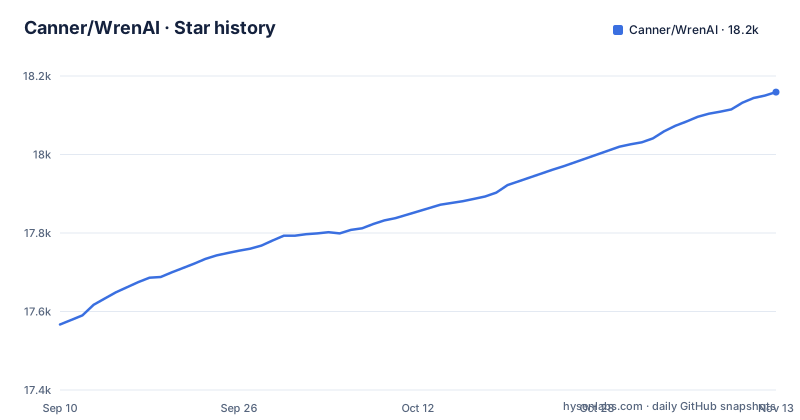
Star history
- Canner/WrenAI18,159 ★ · +592
| Repository | 2026-09-10 | 2026-11-13 |
|---|---|---|
| Canner/WrenAI | 17.6k | 18.2k |
592 Stars in the last 64 days, measured from the daily GitHub snapshot. Compare with other projects
Editorial analysis
The Problem: Agents That Guess at SQL Without Business Context
A raw LLM agent can write SQL, but it does not know that 'revenue' means net of returns in your company, or that a particular join is the approved one. Schemas do not carry that meaning. WrenAI addresses this by adding a governed semantic layer, called MDL, plus an AI context layer that includes tribal knowledge buried in docs and chat threads. The intended user is a developer or data team building agents with tools like Claude Code or Cursor who wants those agents to produce not just plausible SQL but trustworthy dashboards. The README is explicit about who should skip it: anyone who only needs a one-off chart from a single CSV, or anyone happy with ungoverned guesses.
How It Works: MDL Planning, Dry-Plan Validation, and Structured Errors
The architecture rests on a few named mechanisms. Schema-aware retrieval pulls the relevant tables and columns for a question. MDL planning then uses the semantic model to map business terms to physical schema. A dry-plan validation step checks the generated SQL plan before execution, and structured errors with hints are returned when something fails. The README also lists row limits and value profiling. The key design choice is that the semantic layer is not a prompt hack; it is versionable files. Definitions, examples and memory are written as reviewable YAML and Markdown files. This is a concrete data flow: the agent recalls MDL context and past queries, writes governed SQL, and executes it via `wren query`.
Getting It Running: CLI First, Agent Drives the Rest
Installation is via pip. A bundled `jaffle_shop` sample lets you start without a database of your own. The README shows: pip install wrenai for the core, and pip install "wrenai[postgres,memory]" to add per-datasource and memory extras. The workflow is agent-driven: you install the CLI, install a one-file discovery stub for your AI client, and then let the agent handle the rest. Workflow guides are served on demand from inside the CLI, which means the instructions always match the installed version. That is a practical touch, because it avoids the common problem of stale documentation. If you are in mainland China and pip is slow, the README suggests `pip install wrenai -i https://pypi.tuna.tsinghua.edu.cn/simple`, and setting `HF_ENDPOINT=https://hf-mirror.com` if HuggingFace model downloads time out.
The Open-Core Boundary: What Is Free vs. What Costs Money
The repository license is marked NOASSERTION in the metadata, and the root carries LICENSE-APACHE-2.0, LICENSE-AGPL-3.0 and LICENSE-CC-BY-4.0 alongside LICENSE. The README states that the core engine, SDK, and skills are under Apache-2.0 and that it runs without the vendor. The team-wide path is different: Git Sync turns the same project repo into a governed deployment in Wren Cloud or a self-hosted installation, including air-gapped. The project's homepage is its open-core page, which is where to check which features sit outside the Apache-2.0 core. If your compliance regime requires row- or column-level controls, confirm where they live before adopting.
Deployment and the Wasm Dashboard Path
One distinctive feature is the ability to deploy dashboards from an answer. The README describes turning any answer into a shareable, browser-side dashboard then shipping it to your own Vercel or Cloudflare Pages account with one command. This is a different model from a traditional BI tool where dashboards live inside the vendor's UI. Here the dashboard is generated and deployed to infrastructure you control. The README describes it as a browser-side app, so rendering happens client-side, which is worth testing with very large result sets.
A Real Alternative: A Bare Semantic Layer or a Raw LLM Agent
The README's own comparison table gives the alternatives. A raw LLM agent writes SQL but is often wrong and knows nothing about business definitions. A traditional BI tool can generate dashboards but requires manual work and does not work through your own agents. A bare semantic layer, like a pure MDL store, gives you definitions but not non-schema knowledge or agent-driven deployment. WrenAI sits in the middle: it adds an AI context layer on top of the semantic layer, and it adds deployment. The difference is not just feature count. A bare semantic layer is a passive store; WrenAI is an active engine that validates plans and returns structured errors. If you already have a semantic layer, the README says Wren sits on your existing stack, including existing semantic models, warehouses and transformation pipelines.
Maintenance and Upgrade Cost: What the Repo Layout Tells You
The repository holds several components side by side, including core/, sdk/ and skills/, and releases are tagged per component, such as wren and wren-core-py, so check which component a release applies to. The README states that workflow guides inside the CLI always match the installed version, which helps with documentation drift. The release cadence is active, with wren v0.17.1 on 2026-10-30, wren v0.17.0 three days earlier, and wren-core-py v0.8.2 on 2026-10-23. The project is not archived and the default branch is main. For an open-source project, the cost of upgrading depends on how much you customize the semantic layer. Since definitions live in Git, you can diff changes across versions, which is an advantage over a UI-driven tool.
The Verdict: Governed Context Is the Product, Not the SQL
WrenAI is not just another text-to-SQL wrapper. The core value proposition is that business context becomes a versionable, evidence-linked asset. The mechanisms, MDL planning, dry-plan validation, structured errors, and memory, are all in service of that. The limitations are real: an open-core boundary to check and a dependency on the agent ecosystem to drive the workflow. If you are a data engineer who wants to keep control of definitions and let agents do the heavy lifting, this is a serious candidate. If you need a team-wide deployment, Git Sync targets Wren Cloud or a self-hosted installation. The project is worth a proof of concept with your own warehouse, but only after you confirm your data source is in the 22+ list and you can live with the open-core boundary.
Editorial conclusion
Adopt WrenAI if you run AI agents against a warehouse and need business definitions, approved joins, and memory to live outside prompts, in versionable files. Skip it if you only need a quick chart from a CSV or you are comfortable letting an agent guess at SQL without guardrails. Before committing, verify that your required data source is in the 22+ list and check the open-core page for which features sit outside the Apache-2.0 core. Then test the CLI's dry-plan validation with your own schema to see if the structured errors match your team's workflow.
Frequently asked questions
What is wren AI?
An open-source generative BI engine that gives existing AI agents such as Claude Code, Cursor, MCP clients and LangChain a governed semantic layer and an AI context layer, so they turn business questions into governed SQL and dashboards. It runs 22+ data sources on one Apache DataFusion engine.
Is wren AI free?
The core engine, SDK and skills are stated to be under Apache-2.0, and the project says it runs without the vendor. A hosted deployment path exists through Wren Cloud, and the repository root carries AGPL-3.0, Apache-2.0 and CC-BY-4.0 license files while the repository license field reads NOASSERTION, so check which file covers the part you plan to use.
how to use wren ai
Three commands: `pip install wrenai`, then `npx skills add Canner/WrenAI` to install a roughly 50-line discovery stub, then open your agent in a project folder and ask it to set up your database. If you have no database, ask it to use the bundled `jaffle_shop` sample instead.
What are the benefits of using WrenAI?
Agents get approved metric definitions, enums, units, joins, worked examples and tribal knowledge stored as reviewable YAML and Markdown in a repository you own, rather than inferred from a schema alone. Governance comes from named mechanisms including schema-aware retrieval, MDL planning, dry-plan validation, row limits, value profiling and structured errors with hints.
wren ai vs vanna ai
The README's comparison is by category rather than by named project, so it does not set WrenAI against Vanna AI directly. What WrenAI states about itself is that it is a layer rather than a chat UI, that it covers 22+ sources on Apache DataFusion, and that Git Sync deploys the model through a plain git push with 600-second push tokens.
wren ai alternatives open source
The built-in comparison is by category rather than by named project, setting a raw LLM agent, a traditional BI tool, a bare semantic layer and WrenAI against rows for SQL generation, business definitions, dashboards, working through your agents, reviewable context and governed execution. The comparison table names no specific alternative open-source project.
Official sources
Add this badge to your README
If you maintain this project, the badge below links readers to this analysis and shows its maintenance status from the daily GitHub snapshot. Paste the markdown into your README; add ?metric=license or ?metric=stars to the image URL for a different field.

[](https://hysenlabs.com/projects/canner-wrenai)Star history chart for your README
[](https://hysenlabs.com/projects/canner-wrenai)Was this useful?