no-free_vpn: a service guide for a paid Shadowsocks provider, not free software
亲测可用的 VPN。亲测有效的科学上网,同时支持 windows、mac、linux、ios 和 andrioid 系统。并提供 chrome、firefox、opera 等浏览器的插件使用。
At a glance
- What is it?
- The no-free_vpn repository is not an implementation of anything. It is a Chinese language guide to buying and using a commercial Shadowsocks service, complete with an affiliate link, a price table in Australian dollars, release notes pointing at client binaries and a log of server changes, plus a set of notes on other VPN providers. Read it as vendor documentation, and the name of the repository is the first thing to question.
- Who is it for?
- Treat no-free_vpn as a vendor announcement channel rather than as software you can adopt. It is worth reading if you are already a customer of the service it describes, because the announcements are where the operator publishes client migration instructions and node changes, but check prices and terms directly with the provider before comparing plans.
- Can I use it commercially?
- Not without permission. GitHub finds no licence file in the repository, and without a licence all rights are reserved by default: you may read the code but not reuse it. Check the README, or ask the authors, before using it.
- Is it still maintained?
- Yes. The repository last received commits 114 days ago.
- What is it written in?
- GitHub does not report a main language for this repository.
Answers come from the project's GitHub data, last synced on November 7, 2026, and from our analysis. They are not legal advice.
Star history
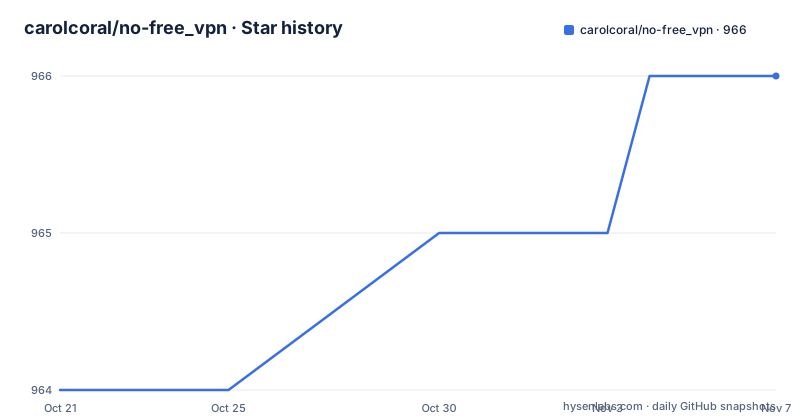
- carolcoral/no-free_vpn966 ★ · +2
| Repository | 2026-10-21 | 2026-11-07 |
|---|---|---|
| carolcoral/no-free_vpn | 964 | 966 |
2 Stars in the last 17 days, measured from the daily GitHub snapshot. Compare with other projects
Editorial analysis
What the repository actually contains
The repository name says no-free_vpn and the description in Chinese says the same, promising a personally tested VPN that supports Windows, macOS, Linux, iOS and Android along with browser plugins for Chrome, Firefox and Opera. The README, however, is not a description of software. It is a purchasing guide for a commercial Shadowsocks service, starting with a link to the provider's portal, then registration, then a client centre where a product is bought, then a download page for the client, and finally a pointer to the help centre for people who are not familiar with Shadowsocks usage.
The first link in the README carries an affiliate parameter, which is the plainest statement of the arrangement. The parameter may identify a referral, but the link alone does not establish whether the maintainer receives a payment. That is not a criticism of affiliate links, which fund a lot of writing, but it is the fact a reader needs before treating the recommendations as neutral.
The rest of the repository follows from that. The top level holds README.md, an older README-old.md, and a set of Markdown files named after other providers: BVPN.md, Bandwagon.md, ExpressVPN.md, VYPRVPN.md, Winscribe.md, nordvpn.md, vultr.md and kuli.md. Those read as notes on how those services work, collected in one place. There is an _config.yml, which is the configuration file for a GitHub Pages site built with Jekyll, which is how the homepage at carolcoral.github.io is generated, and an img directory for the images it uses.
The metadata is thin in a way that reflects the nature of the repository. The primary language is listed as unknown, the licence is unknown, and there are no GitHub releases for the project itself, only tags that point at client binaries belonging to other people. The last push was on 2026-07-16 and the repository is not archived.
The plans, the prices and what the README refuses
The pricing table is the most concrete content in the README, and it is presented in Australian dollars across three tiers with the Chinese names for entry, advanced and flagship, and four payment periods.
The monthly row has a value only in the flagship column, at 12.95. The annual row is 19.95 for the entry tier, 79.95 for the advanced tier and 99.95 for the flagship. The two year row is 35.95, 139.95 and 159.95, and the three year row is 49.95, 199.95 and 209.95. The pattern is clear from the numbers, which is that the entry tier is priced for occasional use and the two expensive tiers are priced for a commitment of one to three years, and the three year price is close to the annual price multiplied by two rather than by three.
The notes section answers the question a reader has first, which is whether there is a free option, and the answer is that the product does not currently support a free trial. The same section states that payment is accepted through Alipay, WeChat, PayPal, credit card and Bitcoin, that the minimum payment period is annual except that the flagship tier supports monthly, and that the longest period is three years.
That last detail deserves attention as a purchase decision rather than as a warning. A three year prepayment for a service whose nodes change, whose ports change and whose client compatibility breaks, is a bet on a provider that will still exist and still work in 2029. The history in the README shows a business that has been running for years, with a November 2024 announcement stating that the operator has been working on privacy and a real internet for eleven years, so the continuity is plausible, but a prepayment is still a prepayment.
The platform support claimed in the notes is Windows 7, 8 and 10, macOS, Android, and a Chrome plugin mode, which is a list written at a time when Windows 7 was current, and that dates the notes considerably.
The client announcements and the Clash migration
The release tags in this repository are not releases of the guide. They are pointers to client software, and that is the most operationally useful thing in the whole repository.
The most recent tag, from 2026-05-04, is Clash Verge REV, and the announcement that goes with it says that subscription failures and inability to subscribe were appearing in the client, and that people should use the Clash Verge REV client instead. The note is specific that this was happening in the Windows environment and that the author's own macOS setup with the Shadowsocks client had no problem. The tag before that is Clash@2024, from 2024-12-27, and the oldest is BVPN@20190225 from 2019.
So the repository doubles as a release channel for third party binaries. That is a convenience, and it is also a supply chain consideration, because a link in a README to a client release is a link to a binary that the reader has to trust, and the reader has to decide whether the tag points at a build they would otherwise have found on the client's own site.
The older announcements give the per-client update procedure for the major platforms, which is a useful sign of how the user base is distributed. For Clash for Windows, the instruction is to open the Profiles tab and click the circular arrow next to the configuration file. For Clash for Android, go back to the home page, open the configuration, click the three dots next to the file and choose update. For iOS with Shadowrocket, press and hold the configuration name and swipe right, then tap update. For iOS with Spectre, switch servers at the bottom and then tap the circular arrow next to the configuration file. The troubleshooting step for all of them is to switch the selected node to DIRECT first.
The README also notes a support centre with usage tutorials for people who are not familiar with Shadowsocks, which confirms that the expected user is a consumer rather than someone who already runs a proxy.
The operational history: port changes, node churn and maintenance
The announcements section reads like an operations log, and it is the part that tells you what kind of service this is.
In March 2023, an announcement says that because the firewall had been upgraded, users should update their server configuration subscription or manually reset the client, and it gives one specific change: the server port should be changed from 443 to 465, with no other number altered. In the same announcement, the update instructions for the four clients are spelled out, with the advice that if updating fails, the subscription should be re-added.
A service whose clients must be reconfigured because an external filter changed its behaviour is a service that depends on things outside its control, and the README is honest about it rather than pretending otherwise. That is the single most important thing for an engineer reading this repository before paying for a plan.
The December 2022 announcement is about maintenance and a reduction in capacity. The operator says the server maintenance was complete and the nodes restored, and that to keep each node stable, while holding total bandwidth constant, the number of servers per node was reduced to lower the chance of a node being unavailable. The advice is to update the subscription or re-import the server list. Fewer servers behind the same bandwidth is a stability and privacy trade, and a reader who cares about how many operators can see traffic should read that sentence carefully.
The July 2022 announcement covers new nodes, and it is unusually specific about routing. Two new Australian nodes, AU1 and AU2, connect to China Telecom AS4809 CN2 and China Unicom International AS10099 CU Premium, and a new Hong Kong node HK1 connects to China Mobile International AS58453 CMI and Telstra Global AS4637, all described as direct connections to networks in mainland China. The mention of named autonomous systems and premium routes is a sign of an operator that buys transit deliberately, which is the kind of detail you would not find in a consumer-facing page.
The remaining announcements are seasonal discount campaigns, with a Double Eleven promotion recurring each November since 2021, and a 2020 promotion with a discount code for renewals and for merging validity periods by opening a support ticket.
The other provider notes and the older README
A cluster of provider notes sits at the root of the repository, and they are worth understanding as a category rather than individually.
Bandwagon.md, Vultr.md and kuli.md are about the same thing from different angles: server providers that a technically inclined user can rent a virtual machine from and run a proxy on directly, rather than buying a managed subscription. ExpressVPN.md, NordVPN.md, VYPRVPN.md and Winscribe.md are about commercial consumer VPN brands, and BVPN.md is about a different tool entirely. The grouping suggests the maintainer was researching the space, comparing the managed consumer services against the do it yourself route, and writing up what each option involved.
That is genuinely useful reading for someone deciding how to spend money, because the two categories have completely different trust and cost profiles. A rented virtual machine puts the operator, not a vendor, between you and the traffic, and the cost is the server plus the time. A consumer VPN puts a vendor in that position and charges a subscription for the convenience. The repository is, in that reading, an argument laid out in files: buy the service, or rent the box and do it yourself.
The README-old.md is the previous version of the guide, and its presence suggests the service relationship changed at some point, with the current README oriented around Shadowsocks and a different set of client notes. Keeping the old one is a small courtesy to readers who arrive through a search engine on older terms.
The _config.yml and the GitHub Pages setup make the whole thing a small static site, with the Markdown files as the source. That explains the repository structure without needing a build system, and it is consistent with a site whose purpose is to be read rather than to be run.
What to weigh before you rely on anything here
The first point is that there is no software to adopt. This repository is a website with a search index, not a library, a tool or a service you can install. Anyone who reaches for it expecting a free VPN client will find a link to buy a subscription.
The second is the cost structure. A plan is a subscription, in Australian dollars, with a minimum term of a year and a maximum of three, and no free trial to try. There is no open source component whose behaviour you can inspect and no configuration you can audit, because the service itself is a set of servers run by the operator.
The third is what the announcements reveal about the dependency. The client had to be migrated to Clash Verge REV in 2026 because subscription handling broke. The port on the servers changed from 443 to 465 in 2023 because an external filter was upgraded. The node servers were reduced in number in 2022 for stability, and the routing for the Australian and Hong Kong nodes depends on specific carrier autonomous systems that can change their policy at any time. A subscription is therefore a standing dependency on a moving environment, and the annual and multi year prepayments are the price of convenience in exchange for that.
The fourth is privacy, which the service's own marketing invokes, and the README gives almost nothing to evaluate it with. There is no description of the protocol configuration, no key handling policy, no statement about logging, and no published audit. The note about reducing the number of servers per node is the only operational privacy hint in the document, and it cuts both ways.
The fifth is the supply chain. A repository that links to third party client builds and to a vendor portal is a convenient index, and an index is a trust decision. Nothing in the repository is signed or checksummed in the visible documentation, and the licence is not recorded, so there is no clear statement of what rights a reader has over the content beyond the default of the repository owner.
None of this means the service is bad. It means the repository is advertising, and should be read as such.
Editorial conclusion
Treat no-free_vpn as a vendor announcement channel rather than as software you can adopt. It is worth reading if you are already a customer of the service it describes, because the announcements are where the operator publishes client migration instructions and node changes, but check prices and terms directly with the provider before comparing plans. It is not worth adopting for anything else, because the repository contains no implementation, its licence is not recorded, and the service it points at is a paid subscription that routes your traffic through third party servers. If you are evaluating a proxy client, evaluate the client, and treat anything that arrives through a repository named for free access with the same suspicion you would apply to any other advertising.
Frequently asked questions
What is the no-free_vpn repository?
It is a Chinese language guide to buying and using a commercial Shadowsocks service, with an affiliate link, a price table in Australian dollars, announcements about client changes and node updates, and a set of notes on other VPN providers. It contains no implementation of a VPN client.
Is there a free trial of the service described in no-free_vpn?
The README states that the product currently does not support a free trial, that payment is accepted through Alipay, WeChat, PayPal, credit card and Bitcoin, and that the minimum payment period is annual, with monthly available on the flagship tier and a maximum period of three years.
Why did the service ask clients to change the server port from 443 to 465?
The March 2023 announcement says the firewall was upgraded, so users should update their configuration subscription or reset the client manually, changing the server port from 443 to 465 and no other number. It also gives per-client update steps for Clash for Windows, Clash for Android, Shadowrocket on iOS and Spectre on iOS.
What do the tags in the no-free_vpn repository point to?
They point to client software rather than to releases of the guide. The most recent is Clash Verge REV from 2026-05-04, used because subscription failures were appearing in the Windows client, before that Clash@2024 from 2024-12-27, and BVPN@20190225 from 2019.
What other providers does the no-free_vpn repository cover?
The repository root holds Markdown notes named BVPN.md, Bandwagon.md, ExpressVPN.md, VYPRVPN.md, Winscribe.md, nordvpn.md, vultr.md and kuli.md, covering both commercial consumer VPN services and the rented virtual machine route, alongside an older README-old.md and a Jekyll configuration for the GitHub Pages site.
Official sources
Add this badge to your README
If you maintain this project, the badge below links readers to this analysis and shows its maintenance status from the daily GitHub snapshot. Paste the markdown into your README; add ?metric=license or ?metric=stars to the image URL for a different field.

[](https://hysenlabs.com/projects/carolcoral-no-free-vpn)Star history chart for your README
[](https://hysenlabs.com/projects/carolcoral-no-free-vpn)Was this useful?