Ropey is a Rust text rope for editors, and it tells you when it is the wrong tool
A utf8 text rope for manipulating and editing large texts.
At a glance
- What is it?
- Ropey is a UTF-8 text rope for Rust, built as the backing buffer for a text editor, with char-indexed editing, configurable line breaks and cheap clones. Its README is unusually direct about the sizes and workloads where it is a poor fit.
- Who is it for?
- Ropey fits a team writing a text editor, a language server or a document tool where a user edits a file far larger than a few kilobytes and edits arrive at incoherent positions. It does not fit a config parser, a template renderer or any workload with mostly small documents, because Ropey allocates in kilobyte chunks and its own README calls that out.
- Can I use it commercially?
- Yes. MIT is a permissive licence: you can use, modify and sell software built on it, as long as you keep its copyright and licence notices.
- Is it still maintained?
- Yes. The repository last received commits 57 days ago.
- What is it written in?
- Mainly Rust, according to GitHub's language statistics.
Answers come from the project's GitHub data, last synced on November 7, 2026, and from our analysis. They are not legal advice.
Star history
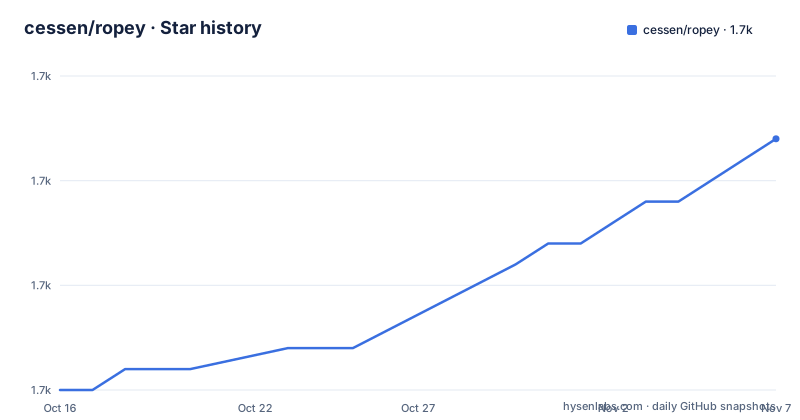
- cessen/ropey1,692 ★ · +12
| Repository | 2026-10-16 | 2026-11-07 |
|---|---|---|
| cessen/ropey | 1.7k | 1.7k |
12 Stars in the last 22 days, measured from the daily GitHub snapshot. Compare with other projects
Editorial analysis
Char indices, and why that closes off invalid UTF-8 by construction
Ropey's atomic unit of text is the Unicode scalar value, the `char` in Rust, encoded as UTF-8. Every editing and slicing operation is expressed in char indices. That is the whole Unicode story in one sentence, and it has a direct consequence: it is impossible to create invalid UTF-8 through Ropey, because there is no index at which a split could land mid-codepoint.
The library also converts between scalar value indices and UTF-16 code unit indices, for interoperation with external APIs that still work in UTF-16. That matters in practice, because the OS windowing layer on some platforms hands text to you as UTF-16 while your buffer is UTF-8.
Line awareness is the second property. Ropey knows where line breaks are, so you can index and iterate over lines directly rather than scanning for newlines. Which line breaks count is a build-time decision, made with cargo feature flags rather than runtime configuration:
[features]
default = ["unicode_lines", "simd"]
cr_lines = []
unicode_lines = ["cr_lines"]
simd = ["str_indices/simd"]
With defaults on, all Unicode line breaks are recognized, including carriage returns. `simd` is a separate switch that passes SIMD support through to `str_indices`, the crate used to find indices inside chunks.
The CRLF claim in the README is about correctness rather than speed: all Unicode line endings are tracked, including CRLF.
The example in the README is the API tour
The README's example is short enough to read as documentation of the intended usage, and it shows the shape of every operation you will need.
let mut text = ropey::Rope::from_reader(
    File::open("my_great_book.txt")?
)?;

println!("{}", text.line(515));

let start_idx = text.line_to_char(515);
let end_idx = text.line_to_char(516);

text.remove(start_idx..end_idx);
text.insert(start_idx, "The flowers are... so... dunno.\n");
Reading is by line, lines are zero-indexed, and positions are obtained by converting a line index into a char index with `line_to_char`. Editing is then expressed as a char range plus `remove` and `insert`, which is what makes the char indexing pay off: the range boundaries were derived from line structure, not from a byte offset you had to compute.
`slice` returns a rope slice rather than a string, and it exposes the full set of read-only operations of a rope including iterators and further sub-slicing. That is how you inspect a region without copying it. Writing out uses `write_to` with a buffered writer.
The examples directory shows the next level of use: `simple_buffer.rs`, `front_page.rs`, `graphemes_iter.rs`, `graphemes_step.rs`, `read_latin_1.rs` and `search_and_replace.rs`. Grapheme iteration and a Latin-1 reader are not part of the core indexing scheme; they are built on the low-level access Ropey exposes, which is the point of that feature.
Kilobyte chunks make it wrong for small documents
The README has a section titled when should I use Ropey, and the negative list is specific enough to save you an experiment.
Ropey is not good at texts smaller than a couple of kilobytes. The wording is careful: it will handle them fine, but it allocates space in kilobyte chunks, which introduces unnecessary bloat if your texts are almost always small. A configuration file, a short template, a JSON document under a few kilobytes: Ropey will work and will waste memory doing it.
It is also not good at texts larger than available memory, because it is an in-memory data structure. There is no spill-to-disk mode, no mmap and no lazy loading in the README's description. A multi-gigabyte log or a repository-scale search index is out of scope.
Third, Ropey is not good at getting the best performance for every use-case, because it puts work into tracking both line endings and Unicode scalar values. That is overhead you may not need. If your workload never asks for a line index and never slices at a codepoint boundary, that tracking is pure cost.
The README's closing line on this point is the right posture: Ropey is very good at what it does, but like all software it is designed with certain applications in mind.
What it is good at is stated as three claims: frequent edits to medium-to-large texts, correct Unicode handling, and flat, predictable performance characteristics, with the assertion that Ropey will never be the source of hiccups or stutters.
The numbers, and the design that produces them
The README gives measured figures with the hardware named, and they are worth reading as design targets rather than as promises for your machine.
On a recent mobile i7 Intel CPU, Ropey performed over 1.8 million small incoherent insertions per second while building a text roughly 100 MB large. Coherent insertions, meaning all near the same place, do the same task at over 3.3 million insertions per second. The gap between those two numbers is the argument for a rope at all: random edits stay fast because they touch only the chunks they land in.
Loading costs about 10% memory overhead, with the example given as a 100 MB file occupying about 110 MB. Clones are described as extremely cheap, because rope clones share data and an initial clone takes 8 bytes of memory, growing incrementally as clones diverge through edits. Thread safety follows from the sharing: clones can be sent to other threads for both reading and writing.
That sharing has a consequence worth planning for. Because clones share until they diverge, an undo stack built from clones is nearly free in memory, but memory grows as soon as the clones start differing. For an editor with deep undo history this is a trade you get nearly for free at first and pay for over a long session.
The design document is linked separately at design/design.md in the repository, and the repository also carries a fuzz/ directory, benches/ with six named benchmarks and a tests/ directory. The benches cover create, insert, hash, remove, queries and iterators, which maps onto the operations the library actually promises.
Two dependencies, an unsafe-code warning, and an explicit fuzzing invitation
Ropey's dependency list is short: `smallvec` at 1.0.0 and `str_indices` at 0.4 with default features disabled. The contribution guide states that pull requests adding dependencies are very likely to be rejected, because Ropey aims to have minimal dependencies. That is a policy you can rely on when you are auditing a supply chain.
The package metadata sets rust-version to 1.65 and version 1.6.1, with documentation on docs.rs and the crate published to crates.io.
Then there is the unsafe code section, and it is the most honest paragraph in the README. Ropey uses unsafe code to achieve some of its space and performance characteristics. Effort has been put into compartmentalizing it and making it correct, but the README asks readers to be cautious about using Ropey in software that may face adversarial conditions.
That sentence matters for a parser exposed to untrusted input. A text editor opening a file from the internet is processing adversarial bytes, and the README is telling you to weigh that yourself rather than claiming the unsafe code is unreachable.
The project then asks for auditing and fuzzing, welcomes issue reports for any unsoundness, and also welcomes recommendations for how to remove unsafe code without introducing space or performance regressions, or how to compartmentalize it better. That is a project inviting scrutiny rather than defending a boundary.
One feature is marked internal and not part of the public stable API: `small_chunks`, which enables a much smaller chunk size so bugs surface during fuzzing without needing huge text sizes.
Against a plain String, and where Ropey stops
The alternative is not exotic. It is a `String` with careful index management, or a gap buffer, or an interval tree. The difference in approach is that all of those give you a byte-oriented or offset-oriented view that you maintain yourself, while Ropey maintains line and codepoint indexes as part of the structure.
That is the whole pitch and the whole cost. You give up the ability to store invalid UTF-8, you give up arbitrary byte slicing, and you give up small-document efficiency. In exchange, a line query is a lookup rather than a scan, an edit at a line boundary does not require counting bytes, and a large file does not degrade as it grows.
The scope is deliberately limited and the README says so. Ropey also provides APIs for efficiently accessing and working with its internal text chunk representation, so client code can build functionality the library does not ship with minimal overhead. Grapheme clusters are not part of the indexing scheme; the grapheme examples build on top.
Where Ropey stops is at the document. It is a buffer, not a syntax highlighter, not a diff engine and not a search index. The examples named search_and_replace and front_page are demonstrations of building those on top, not features of the crate.
For maintenance, the repository is not archived and the last push was on 2026-09-12, with no GitHub releases published on GitHub, so the crates.io version is the reference point rather than a GitHub tag. The licence is MIT, which permits use inside proprietary editors and modification, and the README notes that contributions are accepted under the same terms unless stated otherwise.
Editorial conclusion
Ropey fits a team writing a text editor, a language server or a document tool where a user edits a file far larger than a few kilobytes and edits arrive at incoherent positions. It does not fit a config parser, a template renderer or any workload with mostly small documents, because Ropey allocates in kilobyte chunks and its own README calls that out. Verify first by pointing Rope::from_reader at a real multi-gigabyte file and measuring memory, since the README states Ropey is in-memory and cannot handle texts larger than available memory.
Frequently asked questions
What dependencies does Ropey have?
Two runtime dependencies: smallvec 1.0.0 and str_indices 0.4 with default features disabled. The README states that pull requests adding dependencies are very likely to be rejected, since Ropey aims to keep its dependency count minimal.
Is Ropey a good choice for small text files?
The README says no. Ropey handles small texts fine but allocates space in kilobyte chunks, which introduces unnecessary bloat when texts are almost always small.
How does Ropey handle Unicode and CRLF line endings?
The atomic unit is the Unicode scalar value encoded as UTF-8, and all editing and slicing uses char indices, so creating invalid UTF-8 through Ropey is impossible. All Unicode line endings are tracked including CRLF, and conversion to and from UTF-16 code unit indices is supported.
Can Ropey handle files larger than available memory?
No. The README states that Ropey is an in-memory data structure and is therefore not suited to texts larger than available memory.
Does Ropey use unsafe Rust code?
Yes, and the README says so directly: unsafe code is used to achieve some space and performance characteristics, and it asks users to be cautious in software that may face adversarial conditions. Auditing and fuzzing contributions are welcomed.
How do I configure which line breaks Ropey recognizes?
Through cargo feature flags. The default is ["unicode_lines", "simd"], with unicode_lines enabling all Unicode line breaks and depending on cr_lines, which enables recognizing carriage returns as line breaks.
Official sources
Add this badge to your README
If you maintain this project, the badge below links readers to this analysis and shows its maintenance status from the daily GitHub snapshot. Paste the markdown into your README; add ?metric=license or ?metric=stars to the image URL for a different field.

[](https://hysenlabs.com/projects/cessen-ropey)Star history chart for your README
[](https://hysenlabs.com/projects/cessen-ropey)Was this useful?