Minecraft Mod Language Package: community Chinese translations kept outside the mods
A language package for Minecraft Mods.
At a glance
- What is it?
- The Minecraft Mod Language Package is a CFPAOrg project that collects Simplified Chinese translations for Minecraft mods, published as timestamped resource packs and delivered either through the i18n Update Mod or by hand. It helps players who cannot read English and mod authors who never accepted translations, and its non-commercial licence rules out some commercial uses.
- Who is it for?
- Adopt the Minecraft Mod Language Package if you run a Chinese-language Minecraft client and want mods translated without waiting for the mod authors, because the resource packs are updated on a near daily snapshot cycle and can be pulled automatically by the i18n Update Mod. Do not adopt it as the translation source for a commercially released mod of your own, since the project is licensed CC BY-NC-SA 4.0 and the licence file is what governs use.
- Can I use it commercially?
- Check first. The repository uses a licence we do not classify automatically, so read its LICENSE file before any commercial use.
- Is it still maintained?
- Yes. The repository last received commits 13 days ago.
- What is it written in?
- Mainly C#, according to GitHub's language statistics.
Answers come from the project's GitHub data, last synced on November 7, 2026, and from our analysis. They are not legal advice.
Star history
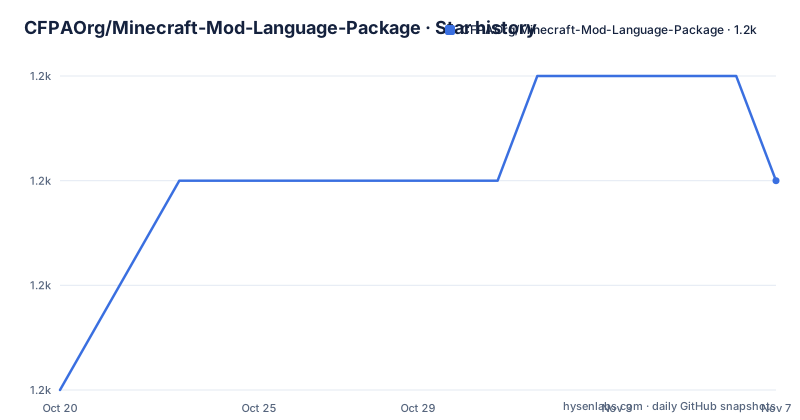
- CFPAOrg/Minecraft-Mod-Language-Package1,203 ★ · +2
| Repository | 2026-10-20 | 2026-11-07 |
|---|---|---|
| CFPAOrg/Minecraft-Mod-Language-Package | 1.2k | 1.2k |
2 Stars in the last 18 days, measured from the daily GitHub snapshot. Compare with other projects
Editorial analysis
The problem: mod authors who never took translations
This is the repository of the Minecraft Mod Simplified Chinese translation project, and the stated purpose is specific rather than aspirational. The project exists to solve problems such as mod authors not accepting translations and translations updating slowly.
That framing matters. The usual way a mod gets a Chinese translation is that a translator writes the language files and submits them to the mod's own repository, and the mod author merges them if they feel like it. When the author does not, the translation stops. When the mod updates, the translation lags until somebody updates it too.
This project moves that work out of the mod's repository and into one place, run by CFPAOrg, with the translations collected and released as resource packs.
The scope is Minecraft mods, with the repository description naming it a language package for Minecraft mods and the topics listing chinese, localization, minecraft and minecraft-mod. The main branch is 1-21-update, and the README links an English version at README-en.md, so the project is Chinese first with an English reader facing.
The last push to the repository was on 2026-09-29, and the release list shows snapshots published on 2026-09-29, 2026-09-18 and 2026-09-17, which is the release cadence described later in this article.
Two ways to get the translations onto your client
The project offers two paths, and the documentation recommends the first.
The recommended path is the mod. You download and install the i18n Update Mod, whose details are on its CurseForge page, and the documentation also points to its MC百科 page and to Modrinth as alternative download sources. This is the automatic route, and it is the same mod whose CurseForge page serves as the project homepage for this repository.
The second path is manual. You download the resource packs from the official site at cfpa.site and add them yourself as resource packs in the game.
The difference between them is who does the work of keeping the translation current. With the update mod, the game pulls new translations as they are published. With the manual path, you re-download and re-add the pack after each release. For a player who installs a dozen mods and updates them weekly, that difference is the entire value proposition of the update mod.
Neither path asks you to touch the individual mod files. The translations arrive as resource packs that override the language entries in game, which is why they work across many mods at once.
The Patchouli caveat: book translations need an extra patch
There is one warning in the usage section and it is easy to skim past. Some translations for 帕秋莉手册, which is Patchouli's Book, require the Patchouli manual loading patch to be installed for them to be applied fully in the game.
Patchouli is the mod that renders in-game books, and it has its own book format. A translation of a book that is not applied completely is not a small annoyance, because the missing pages are usually the ones with the technical content.
This is the clearest example of a general truth about this project. The translations are not part of the mods, they are overlays delivered as resource packs, and a mod that renders its text through a custom system rather than through the standard language keys can need an extra patch before the overlay works. Nothing else in the documentation promises a complete result for every mod, and the repository layout points the same way, with a directory named broken.
The repository is a C# project with a packer, not a folder of JSON
The top level of the repository is worth reading as an engineering artifact rather than as a file dump. It contains a Microsoft Visual Studio solution file, Minecraft-Mod-Language-Package.sln, and directories for src, data, config and projects, plus a directory named broken.
The workflow badge at the top of the README points to a GitHub Actions workflow called packer.yml and labels it 打包器, which is the packer, and there is a Packer-Doc.md file at the root explaining it. So the translation data is assembled by a tool rather than committed by hand, which is the only way a project publishing near daily snapshots across many mods can stay consistent.
The split between data and projects, with config alongside them, suggests the translations are organised per mod project and the packer turns that into release artifacts. The broken directory is the interesting one from a user's perspective, because it is the place where translations that are known to be unusable are kept out of the way rather than deleted.
The primary language of the repository is C#, which comes from the packer and the solution file rather than from the translations themselves, which are data.
Snapshot releases named by build timestamp
The releases do not carry semantic version numbers. The three most recent are named Snapshot-20260929014058, Snapshot-20260918141117 and Snapshot-20260917125024, with Chinese display names of the form 汉化资源包 followed by the same digits, and they were published on 2026-09-29, 2026-09-18 and 2026-09-17 respectively.
Two things follow from that naming. First, the artifact name is its build time, so an install can be traced to an exact moment and a user comparing packs can tell them apart without a version comparison tool. Second, there is no upgrade path to reason about: a snapshot is a snapshot, and the sensible operation is to take the latest one rather than to diff against the previous release.
It also means a stable release channel does not exist in the way most projects provide one. If you want a translation that has been reviewed rather than the newest possible one, the naming scheme does not help you identify it, and the update mod will pull whatever is current when it checks.
The release cadence visible in the list, on three consecutive working days in mid September 2026, is a daily snapshot cycle driven by the packer, which is why the whole thing can keep up with mods that ship changes constantly.
The dictionaries and tools the project points contributors to
The translation resources section is where the project explains its consistency problem. The tools listed are the Minecraft Mods Translator, described as a local Minecraft mod translation tool for versions 1.16 and above, and a Chinese helper tool that converts LANG files to JSON, updates JSON and completes JSON.
The dictionary list is long because the vocabulary is technical and the mod community has its own conventions. It includes the Cambridge dictionary, Wiktionary with a note that access may be blocked, etymonline, the Chinese dictionary site zdic, the Xinhua dictionary and the Modern Chinese Dictionary.
The Minecraft specific references matter more than the general ones. The Chinese Minecraft Wiki has a page on translation name standardization together with a history of how names changed, which is the reference for keeping a term consistent with what the base game already calls it. A separate service lets you look up how an original game term is translated across Simplified Chinese, Hong Kong and Taiwan traditional, and classical Chinese. A dictionary site lets you search the translations already in this repository by their English source, which is the fastest way to find whether a term has an established rendering.
There are also discussion venues, the MCBBS translation forum and the MC百科 community translation board, where terms get voted on. For a project whose product is a shared vocabulary, the voting threads are part of the process rather than an aside.
The licence is the real constraint: CC BY-NC-SA 4.0
The authorisation section states that the project is licensed under the Creative Commons Attribution-NonCommercial-ShareAlike 4.0 International licence, with the full text in the LICENSE file. The badge in the README agrees, showing CC BY-NC-SA 4.0.
The non-commercial clause is the part that deserves attention, and this is not legal advice but a reading of what the licence terms say on their face. Work published under this licence can be shared and adapted, provided attribution is given, derivatives are shared under the same licence, and the use is not primarily for commercial advantage.
For a player installing translations for personal use, none of that is a problem. For a mod author who wants to fold a community translation into a mod they sell, or for a studio that wants to ship the Chinese language files inside a paid product, the non-commercial term is a genuine boundary and the share-alike term propagates to any derivative that is distributed.
The repository licence field is reported as a custom licence that GitHub cannot classify, which is a common outcome when a licence file carries a non standard or decorated header, so the LICENSE file is the authority rather than the repository metadata.
Contributions have their own rules. The README asks anyone submitting translations or code to read the contribution policy carefully, and issue reports and feature requests are collected on GitHub, with a separate Chinese feedback channel.
Editorial conclusion
Adopt the Minecraft Mod Language Package if you run a Chinese-language Minecraft client and want mods translated without waiting for the mod authors, because the resource packs are updated on a near daily snapshot cycle and can be pulled automatically by the i18n Update Mod. Do not adopt it as the translation source for a commercially released mod of your own, since the project is licensed CC BY-NC-SA 4.0 and the licence file is what governs use. Before you rely on it, check whether the mod you need is covered, and check the Patchouli caveat, because some book translations need an extra loading patch before they apply fully in game.
Frequently asked questions
How do I install Chinese translations for Minecraft mods?
The recommended way is to install the i18n Update Mod, available on CurseForge, Modrinth and MC百科, which pulls the translations automatically. The alternative is to download the resource packs from the official site at cfpa.site and add them manually in the game.
Why do some book translations not apply fully in game?
The documentation notes that some 帕秋莉手册 (Patchouli's Book) translations require the Patchouli manual loading patch to be installed before they can be applied fully in the game.
What licence does the Minecraft Mod Language Package use?
The project states that it is licensed under the Creative Commons Attribution-NonCommercial-ShareAlike 4.0 International licence, with the full text in the LICENSE file at the repository root.
How often are new translation packs released?
The releases are named by build timestamp, for example Snapshot-20260929014058, and the three most recent listed releases were published on 2026-09-29, 2026-09-18 and 2026-09-17. A packer workflow in the repository builds them.
Official sources
Add this badge to your README
If you maintain this project, the badge below links readers to this analysis and shows its maintenance status from the daily GitHub snapshot. Paste the markdown into your README; add ?metric=license or ?metric=stars to the image URL for a different field.

[](https://hysenlabs.com/projects/cfpaorg-minecraft-mod-language-package)Star history chart for your README
[](https://hysenlabs.com/projects/cfpaorg-minecraft-mod-language-package)Was this useful?