Awesome Autoregressive Models in Vision: a TMLR 2025 survey repo now in maintenance mode
[TMLR 2025🔥] A survey for the autoregressive models in vision.
At a glance
- What is it?
- The repository is a curated paper list backing the TMLR 2025 survey Autoregressive Models in Vision. It is useful as a reading map, not as a runnable library, and the maintainers paused proactive updates on 2025-11-01.
- Who is it for?
- Adopt it if you need a structured entry point into autoregressive visual generation and you are willing to read the arXiv paper alongside the list. Do not adopt it if you need runnable code, a package to install, or a list that is actively updated: the maintainers moved the repository to maintenance mode on 2025-11-01 and paused proactive updates.
- Can I use it commercially?
- The repository metadata does not identify a licence. Check the project’s published terms and any component-specific licences before reuse.
- Is it still maintained?
- Activity is slowing. The repository last received commits 6 months ago.
- What is it written in?
- GitHub does not report a main language for this repository.
Answers come from the project's GitHub data, last synced on November 25, 2026, and from our analysis. They are not legal advice.
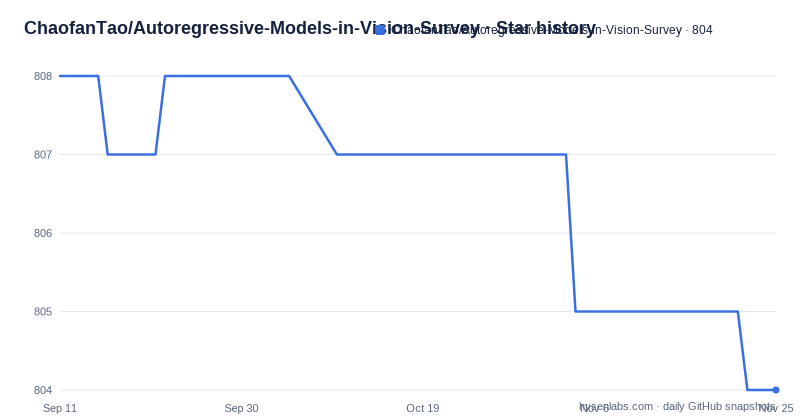
Star history
- ChaofanTao/Autoregressive-Models-in-Vision-Survey804 ★ · -4
| Repository | 2026-09-11 | 2026-11-25 |
|---|---|---|
| ChaofanTao/Autoregressive-Models-in-Vision-Survey | 808 | 804 |
-4 Stars in the last 75 days, measured from the daily GitHub snapshot. Compare with other projects
Editorial analysis
What the repository actually contains, and what it does not
This is a curated list of papers, not a library. The README describes it as "a curated list of papers about the latest advancements in autoregressive models in vision", and the repository has no releases and no stated primary language or licence in the metadata supplied. There is nothing to install, no API to call, and no inference code. The asset is the taxonomy plus the bibliography behind the TMLR 2025 survey of the same name, whose authors span HKU, Tsinghua, Duke, Rochester, Ohio State, ByteDance, UNC, Apple, PolyU and Princeton. If you arrived expecting a model checkpoint or a training script, you are in the wrong repository, and that is worth stating plainly because the name reads like a code project. What you get instead is an organised reading path through pixel-wise generation, token-based approaches, video, 3D, multimodal and acceleration work, with venue tags attached to entries such as the ICML 2021 oral on distribution smoothing for autoregressive modeling.
The problem it solves: finding the right paper among hundreds
Autoregressive visual generation sits at an awkward intersection. Image generation papers borrow tokenizers from language modelling, video papers borrow from diffusion, and 3D papers borrow from both. Searching arXiv directly returns a flat, undated pile. The repository's answer is a fixed hierarchy. The README's table of contents splits Image Generation into unconditional and class-conditioned, text-to-image, image-to-image translation and image editing; Video Generation into unconditional, conditional and embodied AI; 3D Generation into motion, point cloud and 3D medical; then Multimodal Generation, Other Generation, Benchmark and Analysis, Reasoning Alignment, Safety, Accelerating, Stability and Scaling, Tutorial, and Evaluation Metrics. That last group is the part most survey repositories omit. Having separate sections for safety and for evaluation metrics means a reader who cares about failure modes rather than architectures has somewhere to start. The intended audience is a graduate student or applied researcher entering the area, or someone already inside it who wants to check whether a subfield exists that they have not heard of.
How the taxonomy is organised and where it breaks
The structure is a two-level markdown outline: a top-level capability, then a sub-capability, then tagged entries. Each entry follows a consistent shape, with the venue in bold, the paper name, and links to the paper and to code where the authors provide one. The venue tag is doing real work here. It lets you filter out unrefereed preprints without opening each link, and the contributing instructions explicitly ask that an accepted version replace the preprint entry. The weakness is that the top level is organised by output modality, while the active research direction is organised by architecture. The maintainers say as much in the 2025-11-01 notice, writing that the current categories "no longer capture this evolving landscape" and naming unified multimodal models and autoregressive diffusion-forcing video generation as the two trends that broke the scheme. A reader looking for unified understanding-and-generation models will find one section for them, but a reader looking for diffusion-forcing video generation has no dedicated home for it. Treat the outline as a snapshot of how the field looked when the survey was written, not as a live map.
Getting value out of it: the actual workflow
There is no build step. You clone or browse, read the table of contents, and follow links. The one concrete convention is the entry format, which the README specifies in a markdown block: a bullet with the venue and year in bold, the paper name, then a Paper link and a Code link. If you intend to contribute, that format is the contract. The README directs additions to a pull request against the repository or to [email protected], and asks that you look for missed papers or update a preprint that has since been accepted to a venue. Note that the pull request URL printed in the README points at a repository path spelled autoregressive-vision-survey, which differs from the repository name Autoregressive-Models-in-Vision-Survey. If you are opening a PR, use the GitHub interface from the repository you are actually on rather than copying that link verbatim. For citation, the README supplies a BibTeX entry keyed xiong2024autoregressive with eprint 2411.05902 and primaryClass cs.CV.
The maintenance freeze is the decisive fact about this project
On 2025-11-01 the maintainers announced they were moving to maintenance mode and pausing proactive updates. The wording is specific: the repository remains available as a reference and targeted pull requests are welcome, covering additions, corrections, or reorganisations around new trends. That is a meaningful distinction from abandonment. The list will not silently rot, because corrections and new-trend reorganisations can still land, but nothing arrives on a schedule. For a survey companion this is a reasonable end state. For a reader in late 2025 or 2026, it means the newest sections are the least reliable. If your interest is unified multimodal models or diffusion-forcing video generation, the repository is at its weakest exactly where the field is at its most active. The prior update, on 2025-05-31, revised the arXiv paper to add continuous autoregressive methods, computational costs, metric details and an expanded application roadmap, so the paper is ahead of the README list in those areas. Read the paper for the argument and the repository for the links.
Finding newer papers and implementations
For newer work, compare the survey with a current paper index, venue proceedings, and the authors' project pages. Papers with Code's original service was retired in 2025; its open-source successor is developed by Hugging Face. Search results and paper-to-code links can be incomplete, so verify that a linked implementation is official and matches the paper version.
The survey remains useful for its authors' taxonomy and explanations. A current index can help discover more recent papers, but neither source is exhaustive; use both and check publication dates.
Licence, contribution cost and what to verify before citing
The repository metadata supplied does not state a licence, and the README does not mention one. That is a gap worth checking directly on GitHub before you reuse the list wholesale, redistribute it, or mirror it into an internal wiki. The BibTeX block in the README covers the paper, not the repository contents, and a citation to the survey does not settle the terms for the list itself. Contribution cost is low in effort and non-trivial in latency: you need to match the markdown format exactly, and after the 2025-11-01 notice, additions are described as targeted rather than routine, so expect a slower review than the pre-freeze period. Before citing the survey, confirm the venue status on the OpenReview page linked from the README and pull the latest arXiv version, since the 2025-05-31 revision changed content on continuous autoregressive methods and computational costs. The repository's own description marks it TMLR 2025, and the README's update news confirms acceptance on 2025-03-11.
Editorial conclusion
Adopt it if you need a structured entry point into autoregressive visual generation and you are willing to read the arXiv paper alongside the list. Do not adopt it if you need runnable code, a package to install, or a list that is actively updated: the maintainers moved the repository to maintenance mode on 2025-11-01 and paused proactive updates. Before relying on it, open the arXiv abstract page for 2411.05902, confirm which taxonomy sections match your subfield, and check the most recent entries under Accelerating and Evaluation Metrics, since the README states those categories no longer capture unified multimodal models and autoregressive diffusion-forcing video generation.
Frequently asked questions
What is the Autoregressive Models in Vision survey?
A curated list of papers on autoregressive models in vision, published as a TMLR 2025 survey paper under arXiv 2411.05902 with twenty authors from ten institutions. The list itself is a single README in the repository.
Is the autoregressive vision survey still being updated?
The update log states that the project moved to maintenance mode and paused proactive updates as of 2025-11-01, while still welcoming targeted pull requests. A contributing section further down the same file says new research is being incorporated as it emerges.
How is the survey list organized?
Twelve top-level sections with eleven subsections, running from Image Generation through Video Generation, 3D Generation, Multimodal Generation, Other Generation, Benchmark and Analysis, plus flat sections for Reasoning Alignment, Safety, Accelerating, Stability and Scaling, Tutorial and Evaluation Metrics.
How do I cite the autoregressive models in vision survey?
The README supplies a BibTeX entry of type @misc with year 2024, eprint 2411.05902 and primaryClass cs.CV, even though the venue is TMLR 2025. Cite the TMLR record if you need a journal-style year.
How do I add a paper to the list?
Open a pull request using a single markdown line with the venue and year in bold, the paper title, a paper link, and a code link where one exists, or email the address given in the contributing section.
What license is the autoregressive vision survey under?
The repository has no license file and no stated license field, so re-use of the curated list has no terms written down anywhere in the project.
Official sources
Add this badge to your README
If you maintain this project, the badge below links readers to this analysis and shows its maintenance status from the daily GitHub snapshot. Paste the markdown into your README; add ?metric=license or ?metric=stars to the image URL for a different field.

[](https://hysenlabs.com/projects/chaofantao-autoregressive-models-in-vision-survey)Star history chart for your README
[](https://hysenlabs.com/projects/chaofantao-autoregressive-models-in-vision-survey)Was this useful?