LeetCode-Solutions: a multi-language problem list kept in a Git repository
This repository consists of solutions to the problem from LeetCode platform. Subscribe to our Channel for more updates
At a glance
- What is it?
- The codedecks LeetCode-Solutions repository collects answers to LeetCode problems in Python, Java, C++ and JavaScript, organised by algorithm topic and annotated with time and space complexity. It is a reading list and a contribution target rather than a library, it still tags Hacktoberfest issues, and its last release tag is from 2021 even though the repository is pushed to weekly.
- Who is it for?
- Use LeetCode-Solutions when you want one repository that shows the same problem solved in several languages and grouped by algorithm family, and when you would rather read a worked approach than work from a bare problem statement. Do not treat it as a library, a judge or a curriculum, because nothing in it is packaged or tested for you.
- Can I use it commercially?
- Yes. MIT is a permissive licence: you can use, modify and sell software built on it, as long as you keep its copyright and licence notices.
- Is it still maintained?
- Yes. The repository last received commits 21 days ago.
- What is it written in?
- Mainly C++, according to GitHub's language statistics.
Answers come from the project's GitHub data, last synced on November 7, 2026, and from our analysis. They are not legal advice.
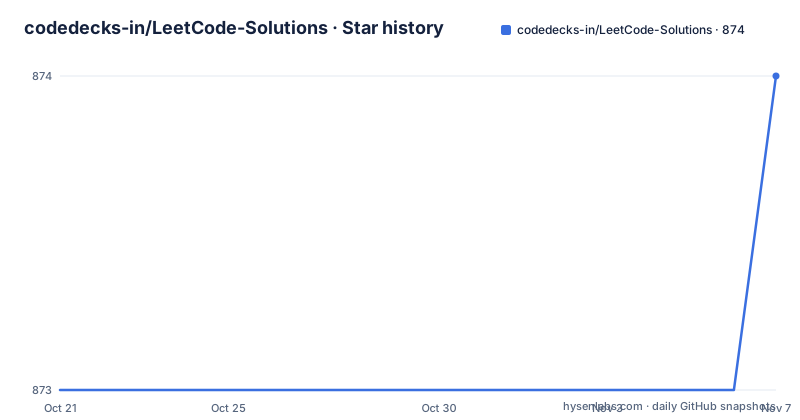
Star history
- codedecks-in/LeetCode-Solutions874 ★ · +1
| Repository | 2026-10-21 | 2026-11-07 |
|---|---|---|
| codedecks-in/LeetCode-Solutions | 873 | 874 |
1 Stars in the last 17 days, measured from the daily GitHub snapshot. Compare with other projects
Editorial analysis
What the repository actually holds
This repository consists of solutions to problems from the LeetCode platform. The README's framing is that it helps you when you are stuck on a LeetCode question, by providing an approach to solving the problems, and that contributors helped by providing those solutions.
The structure at the top level shows what that means in practice. There is a directory per language: C++, Java, JavaScript and Python, plus a dart/ directory that the language badge does not mention. Alongside them sit CONTRIBUTING.md, PULL_REQUEST_PROCESS.md and a PULL_REQUEST_TEMPLATE, which is the standard set of files for a repository that wants outside contributions rather than merely hosting them.
What you will not find is a package, a build file or a test suite. There is no library API here and nothing to import. Each file is a standalone answer to one numbered problem, and the repository's value is that those files are organised and cross-referenced rather than scattered across a personal notes app.
The project is also part of a small set. The README points to sibling repositories for HackerRank solutions and for Project Euler, and describes them as places to look for more challenging solutions and for a full summary. The homepage is a YouTube channel rather than a documentation site, which tells you what kind of artefact this is: a teaching channel with a repository attached.
The topic index: twenty-six algorithm families
The README's main table of contents lists the algorithm families covered, and the list is long enough to be useful as a study index.
It starts with bit manipulation and arrays, then strings, linked lists, stack, queue, heap, tree and hash table. It continues through math, two pointers, sort, recursion, binary search and binary search tree, then the graph and search families: breadth-first search, depth-first search and backtracking. The last stretch covers dynamic programming, greedy, graph, geometry, simulation, design and concurrency.
That ordering is roughly how a curriculum for these problems is usually sequenced, which means the list doubles as a map of what the repository believes a data structures and algorithms curriculum looks like. The README closes with the hope that you enjoy the journey of learning data structures and algorithms, which is the intent stated plainly.
Each family then becomes a table. The columns are the problem number, the problem title linked to its LeetCode page, the solution files, the time complexity, the space complexity, the difficulty, a tag column and a tutorial column that sometimes links to a video. The complexity columns are given in the usual notation, such as O(n) time and O(1) space.
A single problem can have several solutions. The Single Number entry, problem 136, links a Java file, a Python file, a C++ file and a JavaScript file, with a tutorial column that points at using XOR as the approach. So the same problem doubles as a cross-language comparison and as a link to the technique behind it.
Reading the tables: what a solution row tells you
The tables carry more metadata than a bare list of links, and that metadata is where the practical value sits.
The file names follow the platform's own numbering. The problem number leads, then the title with a link to the LeetCode page, then one or more solution paths written as relative links into the language directories, then complexity, difficulty, tag and tutorial. A Python file is named after the problem in kebab case, as in Python/single-number.py, while the C++ files use a capitalised hyphenated form such as C++/Single-Number.cpp. The naming is not perfectly uniform across languages, which is the sort of detail that matters when you are writing a script to check coverage.
The difficulty column carries the platform's own Easy or Medium label. There is no Hard in the rows shown, but the table structure supports it.
Two things are absent, and both matter. There is no test file column, so nothing in the repository tells you that a solution is verified against the platform's judge. And there is no date or author column, so you cannot tell from the table whether an entry was written during a hacktoberfest drive or last month. The tag column exists but is empty in the rows shown, which means it is a placeholder rather than a filled-in taxonomy.
One note in the README deserves attention because it affects which problems you can read: a lock symbol means the question requires a LeetCode premium membership subscription to read. The answers are in the repository, but the problem statement itself may be behind the paywall, which changes what you can learn from a row.
Contributing: pull requests, first-timers and Hacktoberfest
The README gives explicit instructions for contributing, which is unusual for a repository of this kind and says a lot about its intent.
The instruction is to create a pull request, and for anyone new to GitHub there is a pointer to a pull request procedure document in the repository, along with a sample pull request to look at. Both files are in the tree, PR process and template, which means a new contributor is told what a good pull request looks like here rather than left to infer it.
The repository is decorated for that goal. The topic list includes first-timers-only, good-first-issue, hacktoberfest, hacktoberfest-accepted, hacktoberfest-starter and hacktoberfest2023, plus low-hanging-fruit and beginner-friendly, and the README carries a first-timers-only-friendly badge. The topics also include help-wanted and several LeetCode practice topics.
The reading of these labels is important. They describe an ongoing intake mechanism for outside contributions, with the Hacktoberfest tags marking the periods when the repository is actively recruiting. The last push to the repository was on 2026-10-18 and the README says there are new LeetCode questions every week and that the author keeps updating for a full summary and better solutions, so the intake is still happening.
What is not documented anywhere in the README is how a contribution gets reviewed, what the acceptance bar is beyond the pull request process document, and how a solution is checked against the platform's expected output. For a repository that has run hacktoberfest campaigns, that gap is worth asking about before you invest an evening in a solution.
Limits: an archive of answers, not a curriculum or a test harness
Several limits follow from what the repository is.
The first is that solutions are unverified from the reader's point of view. There is no test harness, no CI configuration in the tree to run solutions against expected outputs and no statement that any particular file has been submitted to the platform's judge. The complexity figures in the tables are annotations, and annotations can drift from the code they describe. If you plan to build on a solution, treat the table as a claim and the file as the truth.
The second is that the release history stops. The only tagged versions are v2.0, marked as prod, from 2021-04-26 and v1.0, marked as beta, from 2020-10-07. There is a CHANGELOG.md in the tree, but the tags themselves have not moved in five years while the commits have continued. For a repository of source files that are read rather than depended upon, that is not fatal. It does mean there is no version marker to reference when you tell someone which revision you were reading.
The third is coverage and consistency. The README notes there are new LeetCode questions every week, so any collection of solutions lags the platform, and the older LeetCode problems also age: the platform revises problem statements and adds constraints, and a solution written against the original statement can fail against the current one.
The fourth is that the repository competes with the platform it mirrors. LeetCode itself provides discussion threads, and the official approach explanations exist for most problems. What this repository adds is the cross-language view and the topic grouping. What it does not add is editorial depth, and it is worth being clear about that before treating it as a substitute for working through a problem yourself.
This repository against the platform's own editorials and against a paid course
Two comparisons are worth making.
The first is against the editorials and discussions on LeetCode itself. The platform's own approach explanations are written by the company that wrote the problems, so they carry the intended insight and the constraint reasoning, and they are maintained alongside the problem statement. This repository's answers are written by contributors, which means they may show a different route to the answer than the intended one. That is the interesting case: reading two different correct solutions is how you learn that a problem has more than one solution shape. But the editorial is authoritative about why the problem is structured the way it is, and a contributed file is not.
The second comparison is against a paid course or a structured bootcamp. A course has a sequence, exercises with feedback and a person to ask. This repository has a sequence, the twenty-six topic families, but no feedback loop and no exercises: the problems are already solved, so the reader is looking at answers rather than attempting them. The repository's own framing supports this reading, since it is presented as a help for when you are stuck, not as a course.
There is a third option that the repository makes easier to reach. Using the topic index as a checklist and attempting each problem yourself, consulting the file only when you have tried, gets you the same practice the repository supports while keeping the solving work yours. The README's difficulty column helps here, since it lets you pick problems at a level you want rather than taking the order of the table.
Editorial conclusion
Use LeetCode-Solutions when you want one repository that shows the same problem solved in several languages and grouped by algorithm family, and when you would rather read a worked approach than work from a bare problem statement. Do not treat it as a library, a judge or a curriculum, because nothing in it is packaged or tested for you. Verify first that the problem you are stuck on is actually covered, that the entry names the language you intend to write in, and that the complexity figures in the table match the code rather than the reverse.
Frequently asked questions
Which programming languages does the LeetCode-Solutions repository cover?
The top level of the repository has directories for C++, Java, JavaScript and Python, and a language badge in the README names Python, Java, JavaScript and C++. The tree also contains a dart directory that the badge does not mention, and individual problems may only have solutions in some of the languages.
How is the LeetCode-Solutions repository organised?
The README groups problems into twenty-six algorithm families, from bit manipulation and arrays through to dynamic programming, graph, design and concurrency. Each family has a table with the problem number, title, links to the solution files, time and space complexity, difficulty and sometimes a tutorial link.
How do I contribute a solution to the LeetCode-Solutions repository?
The README asks contributors to create a pull request and points newcomers to a pull request procedure document and a sample pull request in the repository. The repository also carries first-timers-only, good-first-issue and Hacktoberfest topic labels, so issues are tagged for newcomers.
Official sources
Add this badge to your README
If you maintain this project, the badge below links readers to this analysis and shows its maintenance status from the daily GitHub snapshot. Paste the markdown into your README; add ?metric=license or ?metric=stars to the image URL for a different field.

[](https://hysenlabs.com/projects/codedecks-in-leetcode-solutions)Star history chart for your README
[](https://hysenlabs.com/projects/codedecks-in-leetcode-solutions)Was this useful?