The Coding Train Machine Learning list: a curated map of where to learn ML
Examples and experiments around ML for upcoming Coding Train videos
At a glance
- What is it?
- The Coding Train Machine Learning repository is not a library but a curated, tagged reading list for machine learning, gathered as background for videos and an ITP course. It suits someone who does not know where to start with ML and wants one list with difficulty markers, and it is a snapshot of links rather than maintained documentation.
- Who is it for?
- The list is worth bookmarking for a beginner who cannot yet tell a reinforcement learning paper from a scikit-learn tutorial, because the four attribute markers turn a wall of links into a route. Skip it if you need a maintained tool, a working codebase or anything with a stated licence, since the repository contains only a README and an image, and the licence field is empty.
- Can I use it commercially?
- Not without permission. GitHub finds no licence file in the repository, and without a licence all rights are reserved by default: you may read the code but not reuse it. Check the README, or ask the authors, before using it.
- Is it still maintained?
- Yes. The repository last received commits 63 days ago.
- What is it written in?
- GitHub does not report a main language for this repository.
Answers come from the project's GitHub data, last synced on November 7, 2026, and from our analysis. They are not legal advice.
Star history
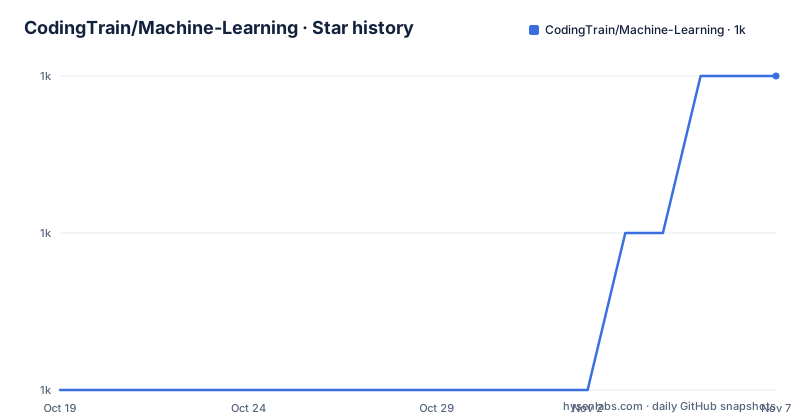
- CodingTrain/Machine-Learning1,005 ★ · +2
| Repository | 2026-10-19 | 2026-11-07 |
|---|---|---|
| CodingTrain/Machine-Learning | 1k | 1k |
2 Stars in the last 19 days, measured from the daily GitHub snapshot. Compare with other projects
Editorial analysis
The repository is a README and an image, nothing else
It is worth stating the shape of this project before anything else, because the name suggests something different. The top level of the repository contains two entries: `README.md` and `codingdream.jpg`, an image that the README displays at the top as a banner.
There is no source code, no package manifest, no test suite and no build. The description calls it examples and experiments around ML for upcoming Coding Train videos and ITP course, and the file listing does not show the examples themselves. What you get is a document, and that document is a link list.
This is not a criticism. A curated list with a consistent tagging scheme is a real artefact and it is something a lot of people build and maintain for years. But it sets the expectation for what a reader gets, and it decides the questions worth asking. You cannot install it, you cannot call it, and there is no API to integrate with. Its only failure mode is a link going stale or a resource aging badly.
The documentation itself says the purpose plainly, examples and experiments around ML for upcoming Coding Train videos and ITP course. That tells you the audience, which is people learning machine learning through the Coding Train's visual, example-driven style, plus participants in an intensive course where a reading list saves the instructor from repeating herself.
Four emoji markers turn a wall of links into a route
The most useful idea in the file is the attribute scheme, and it comes with an explicit rationale. Since resources across the internet vary in terms of their pre-requisites and general accessibility, the documentation says it is useful to give attributes to them so it is easy to understand where a resource fits into the wider machine learning scope.
The four markers are:
- :rainbow: = creative
- :bowtie: = beginner
- :sweat_smile: = intermediate, some pre-requisites
- :godmode: = advanced, many pre-requisites
The scale is about prerequisites, not about how good a resource is. That distinction is the design decision that makes the scheme work, because difficulty and quality are independent axes, and a tagging system that conflated them would be useless for navigation. A creative project can be beginner level, and an advanced paper can be the best thing on the list.
The documentation invites extension, with a note asking readers to extend the set of suggested attributes, so the taxonomy is meant to grow. A few entries carry two markers, such as the Berkeley Machine Learning Crash Course tagged as both beginner and advanced, which is a signal that a single resource can serve two entry points depending on how much of the surrounding material you already know.
The categories run from articles to tools
The table of contents is generated by a MarkdownTOC tool with depth 4, and it lists the sections the document uses: Articles and Posts, Books, Courses, Examples, Projects, Videos, Resources, Newsletter, and Tools. The Tools section has two named subsections, Tensorflow and t-SNE.
The Articles and Posts section is the longest and the most useful for someone with a specific concept to look up. It mixes classic reading with practical walkthroughs. A Return to Machine Learning and A Visual Introduction to Machine Learning are both marked creative and beginner. Deep Reinforcement Learning: Pong from Pixels and the Unreasonable Effectiveness of RNNs sit at the harder end. There is a cluster of Big O notation resources, which tells you something about the order in which the material is meant to be consumed, since complexity analysis comes before the algorithms it analyses.
The Books section is short, with Machine Learning for Designers, a Machine Learning Book, A first encounter with machine learning, Natural Language Processing with Python and A Brief Introduction to Neural Networks among them.
The Courses section is the one with dated entries, including the Google Machine Learning Crash Course, a Coursera Machine Learning with TensorFlow on GCP specialisation, The Neural Aesthetic at SchoolOfMa from summer 2016, and two Kadenze programs. The Neural Aesthetic is marked creative and beginner, which is a good example of the tagging doing its job, since a course on machine learning and art is beginner friendly even though its subject is not standard.
Where the list stops being useful
A link list has a shelf life, and this one is explicit about it. The last push was on 2026-09-05, which is recent enough that the file is not abandoned, but the resources inside it span years. The SchoolOfMa class is labelled summer 2016, and several of the linked blog posts carry 2015 and 2016 dates. Machine learning tooling has moved several times since then, and a link to a tutorial written against an old API is a link to a broken experience.
The second limitation is the link format itself. Every entry is a bare URL to an article, a book page, a course page or a video playlist, with a title and sometimes a marker. There is no annotation about why the resource is on the list, no summary of what it covers, and no indication of which framework or language it assumes. A reader has to click through and judge for themselves.
The third limitation is the size of the file relative to its coverage. The table of contents promises nine sections, but the resource selection is a snapshot from a particular period of the field rather than a thorough survey. Some genuinely important topics are represented by a single link, and the Tools section narrows to two named entries.
The fourth limitation is the licensing picture. The licence field for the repository is empty, and the file itself is a list of links to other people's work. A list of links is not usually a problem legally, but if you plan to reuse the selection in a course or an internal document, the fact that the repository states no licence means there is no permission to assume, which is a question to settle rather than guess at.
An alternative to a single curated list
The obvious alternative is not a better list but a different shape of resource. A structured course gives you a path with dependencies handled for you, which is what the Courses section of this repository points at. A textbook gives you a coherent argument rather than a set of independent pieces. A textbook, in the Books section, is listed here too, so the repository itself offers both routes.
The difference in approach between a tag-filtered list and a course is ordering. A list answers the question of what exists and how hard each thing is, leaving the sequence to the reader. A course answers the sequence question too, at the cost of being slower to start and harder to skim.
A second alternative is to build your own list from a source you trust, tagging it with the same four markers. The documentation's own invitation to extend the attributes is a hint that this is the intended mode of use, since the file is a scaffold rather than a finished product.
The third alternative, for a working engineer, is to skip reading lists and start with a framework's own tutorial. The Tools section already points at Tensorflow and t-SNE, and for someone who needs to ship a model this week, an example that runs is worth more than a survey. The list works best for the person who has time to read, not the person who has a deadline.
Editorial conclusion
The list is worth bookmarking for a beginner who cannot yet tell a reinforcement learning paper from a scikit-learn tutorial, because the four attribute markers turn a wall of links into a route. Skip it if you need a maintained tool, a working codebase or anything with a stated licence, since the repository contains only a README and an image, and the licence field is empty. Before you rely on any single entry, check that the link still resolves and that its content still matches the tag it carries, because the file has not been touched since the last push on 2026-09-05 and several of the listed resources are dated, from the summer 2016 SchoolOfMa course to the 2015 and 2016 blog posts.
Frequently asked questions
What is the Coding Train Machine Learning repository?
It is a curated list of machine learning articles, books, courses and videos, gathered as background for Coding Train videos and an ITP course. The repository contains a README and an image, with no code.
What do the emoji markers in the list mean?
They mark difficulty and prerequisites: a rainbow marker means creative, a bow tie means beginner, a sweat smile means intermediate with some prerequisites, and a god mode marker means advanced with many prerequisites.
Which beginner friendly machine learning resources are listed?
Among the beginner tagged entries are A Return to Machine Learning, A Visual Introduction to Machine Learning, Machine Learning is Fun, the Google Machine Learning Crash Course, A first encounter with machine learning and the Coursera Machine Learning course.
Does the repository contain runnable machine learning examples?
The repository description mentions examples and experiments for upcoming videos, but the repository top level contains only README.md and an image file, so what is published here is the reading list rather than the code.
What licence applies to the Coding Train Machine Learning list?
The repository records no licence. The file is a list of links to other people's articles, books, courses and videos, so it is worth settling any reuse question directly rather than assuming permission.
Official sources
Add this badge to your README
If you maintain this project, the badge below links readers to this analysis and shows its maintenance status from the daily GitHub snapshot. Paste the markdown into your README; add ?metric=license or ?metric=stars to the image URL for a different field.

[](https://hysenlabs.com/projects/codingtrain-machine-learning)Star history chart for your README
[](https://hysenlabs.com/projects/codingtrain-machine-learning)Was this useful?