community/community: GitHub's Public Feedback Forum, Reviewed
Public feedback discussions for: GitHub Mobile, GitHub Discussions, GitHub Codespaces, GitHub Sponsors, GitHub Issues and more!
At a glance
- What is it?
- community/community is GitHub's public feedback repository, a set of discussion categories covering Mobile, Codespaces, Sponsors, Issues and more. It is a forum, not a library, and the README is explicit that Issues are disabled.
- Who is it for?
- Adopt this as a place to file product feedback, not as a dependency. If you are shipping software and need a bug tracker, this repository is the wrong tool: its Issues feature is disabled and the README points elsewhere.
- Can I use it commercially?
- Yes, with credit. CC-BY-4.0 allows commercial use as long as you credit the authors and indicate what you changed. It is written for creative content, so check how it applies to any code.
- Is it still maintained?
- Yes. The repository last received commits 4 days ago.
- What is it written in?
- Mainly Ruby, according to GitHub's language statistics.
Answers come from the project's GitHub data, last synced on November 13, 2026, and from our analysis. They are not legal advice.
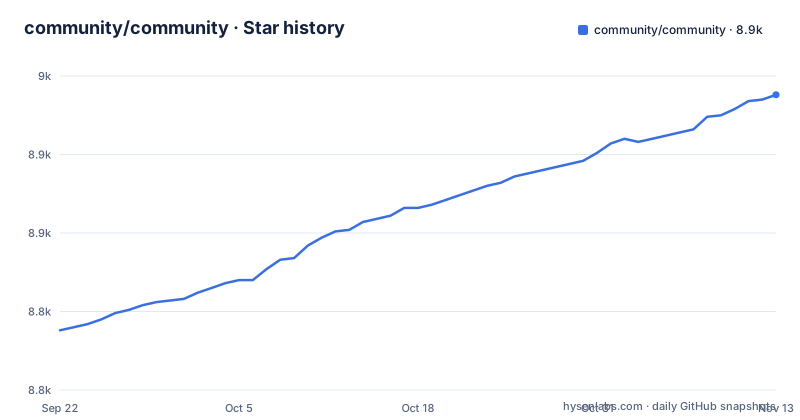
Star history
- community/community8,938 ★ · +150
| Repository | 2026-09-22 | 2026-11-13 |
|---|---|---|
| community/community | 8.8k | 8.9k |
150 Stars in the last 52 days, measured from the daily GitHub snapshot. Compare with other projects
Editorial analysis
What community/community actually is
This repository is not a codebase you build against. It is the public feedback venue for a list of GitHub products, and the README describes its purpose plainly: "In this repository, you will find categories for various product areas." The categories cover Accessibility, Actions, Apps API and Webhooks, Code Security, Codespaces, Copilot Conversations, Discussions, Enterprise, GitHub Education, GitHub Learn, Mobile, npm, Packages, Programming Help, Projects and Issues, Pull Requests, Repositories, Welcome to GitHub, and a catch-all for other features and feedback. Each row in the README's table pairs a feedback category with a link to the product it concerns.
The audience is anyone who uses those products and wants to report a problem, propose a change, or ask a question where GitHub staff and other users can see it. That includes people filing accessibility reports, enterprise administrators asking about rollout behaviour, and developers confused by an API response. It is not for reporting security vulnerabilities, and it is not a support desk with a response guarantee.
The repository does carry Ruby tooling. The top-level entries include Gemfile, Gemfile.lock, .ruby-version and .rubocop.yml, so there is linting infrastructure in the tree. Treat them as repository maintenance, not as something a participant in a discussion needs.
How a discussion becomes a roadmap item
The mechanism is a discussion thread, not an issue. GitHub disabled the Issues feature for this repository, and the README explains why: the repository "works in conjunction with the GitHub public product roadmap", which is where feature work and timing are tracked. That single design decision shapes everything else. A thread is a conversation, and its lifecycle is social rather than technical.
The README lays out the intended path from suggestion to shipped feature. You open a discussion; the product team evaluates the feedback but, in the README's words, "will not be able to respond to every submission". If the team decides to prioritize a fix, it may open an issue and track development in the public roadmap. If the team decides not to pursue it, it may comment on the discussion explaining the reasoning.
That is the whole data flow, and it is worth being honest about the shape of it. The feedback repository is an intake funnel; the roadmap repository is the pipeline. Nothing in this repository tells you the status of your request after it leaves the intake stage. If you want to follow a feature, you follow it on the roadmap, not here. Categorization matters for discoverability: the README says choosing the right category ensures conversations "are indexed by their corresponding product or feature", and that topics outside the listed categories will be moved into General.
Posting your first piece of feedback
There is nothing to install. The repository is used through the GitHub website, and the README links directly to the discussion index at https://github.com/orgs/community/discussions. The only preparation the README asks for is reading the code of conduct and checking whether your point already exists.
Start by reading the category table in README.md and picking the closest match. If you are unsure, the README says off-topic posts are transferred into the General category, so a wrong guess is recoverable but costs a round trip.
Search before posting. The README is direct about this: look at previous discussions, and if you find a similar one, "reply with additional details or upvote the discussion to signal your support rather than creating a new one". Upvotes are the signal the team reads, so a duplicate thread actively dilutes your own point.
# No installation step exists for this repository.
# Participation happens at:
# https://github.com/orgs/community/discussions
If you want the repository locally, for example to read CODE_OF_CONDUCT.md or the docs directory, a normal clone works:
git clone https://github.com/community/community.git
cd community
After cloning you should see the top-level entries listed in the repository: .github/, .rubocop.yml, .ruby-version, CODE_OF_CONDUCT.md, Gemfile, Gemfile.lock, LICENSE, LICENSE-CODE, README.md and docs/.
The Issues tab is disabled, and that is the main limitation
The single most important constraint is that you cannot file an issue here. The README states it without hedging: "the Issues feature of this repository has been disabled." If your habit is to open a bug report and wait for triage, this repository will not accommodate it. You write a discussion, and discussions have no severity, no reproduction checklist and no automatic escalation.
That design choice has a cost. A discussion thread can accumulate dozens of replies, drift into tangents, and become hard to scan for the original problem statement. For a user trying to determine whether a known problem is fixed, the roadmap is the better place to look.
If you need a guaranteed response, a contractual support channel, or a private way to report something sensitive, this is the wrong venue. It is a public forum and should be treated as one.
How it differs from the roadmap repository and from a support ticket
The closest alternative in the same ecosystem is github/roadmap, and the difference is structural rather than stylistic. The roadmap is where the README says you "can learn about what features we're working on, and when they'll be available". It is a forward-looking record maintained by the product team. community/community is the reverse direction: it is where users push information in, and the roadmap is where the team pushes information out. Reading the roadmap tells you what is coming; posting here is how you try to influence it.
Compared with a conventional support ticket, the trade is visibility for guarantees. A ticket is private, tracked and expected to close. A discussion is public, searchable and may never receive a staff reply. The README is candid that the team "will not be able to respond to every submission", which is the opposite of a service-level commitment. What you get instead is a searchable archive where someone with the same problem can find your thread, add detail, and upvote it. For product feedback that accumulation is the point. For an outage or a broken account, it is not.
Licence, maintenance and what you are agreeing to
The repository is licensed CC-BY-4.0, with a separate LICENSE-CODE file alongside it in the root. That split matters if you intend to reuse anything: the CC-BY-4.0 licence is a content licence, and the presence of a distinct code licence suggests the Ruby tooling and any scripts are governed separately. If you plan to redistribute repository contents, read both files rather than assuming one covers everything. This is a description of what the files are, not legal advice.
The last push to the repository was on 2026-10-28, which is recent. The repository has no published GitHub releases, which is consistent with its nature: there is no version to upgrade and no changelog to follow. Your upgrade cost is effectively zero because there is no artifact to install.
The ongoing cost is attention. If you open a discussion and it gains traction, you should expect to return to it, because the README's process is conversational and a thread without follow-up from its author tends to stall. The other cost is duplication: the README's instruction to search first exists because repeated threads split the upvote signal that the team uses to judge demand.
Editorial conclusion
Adopt this as a place to file product feedback, not as a dependency. If you are shipping software and need a bug tracker, this repository is the wrong tool: its Issues feature is disabled and the README points elsewhere. Before posting, read the category table in README.md, pick the closest category, search for an existing discussion and upvote it rather than opening a duplicate. Check the CODE_OF_CONDUCT.md and LICENSE files in the repository root before you quote or redistribute anything from a thread.
Frequently asked questions
Can I open an issue in community/community?
No. The README states that the Issues feature of this repository has been disabled, and that feedback goes through discussion categories instead. The repository works in conjunction with the GitHub public product roadmap, where feature development is tracked.
What should I do before creating a new discussion in community/community?
The README asks you to look at previous discussions first. If you find a similar one, reply with additional details or upvote it to signal support rather than creating a new thread.
What happens after I post a suggestion in community/community?
The GitHub product team evaluates the feedback but, per the README, cannot respond to every submission. If the team prioritizes a fix it may open an issue and track it in the public roadmap; if it decides not to pursue the problem, it may comment on the discussion with its reasoning.
What licence applies to community/community?
The repository carries a CC-BY-4.0 licence, and a separate LICENSE-CODE file is present in the root.
Official sources
Add this badge to your README
If you maintain this project, the badge below links readers to this analysis and shows its maintenance status from the daily GitHub snapshot. Paste the markdown into your README; add ?metric=license or ?metric=stars to the image URL for a different field.

[](https://hysenlabs.com/projects/community-community)Star history chart for your README
[](https://hysenlabs.com/projects/community-community)Was this useful?