scraping-apis-for-devs is a README index of 2,622 Apify listings with no code of its own
This GitHub repo is a powerhouse collection of scraping APIs for developers that you can start using immediately to build everything from simple automations to full-scale applications.
At a glance
- What is it?
- A GitHub repository that sorts 2,622 third-party scraping tools into 17 category folders. Every entry is a link out with a short description, and no scraper, SDK or install step lives in the repository.
- Who is it for?
- Use this repository as a directory to browse when you want to see what ready-made scrapers exist for a site or task, then evaluate each linked page on its own terms. Do not expect code, a client library or a license you can build on, because the repository holds links and the license is unknown.
- Can I use it commercially?
- Not without permission. GitHub finds no licence file in the repository, and without a licence all rights are reserved by default: you may read the code but not reuse it. Check the README, or ask the authors, before using it.
- Is it still maintained?
- Yes. The repository last received commits 19 days ago.
- What is it written in?
- Mainly JavaScript, according to GitHub's language statistics.
Answers come from the project's GitHub data, last synced on November 7, 2026, and from our analysis. They are not legal advice.
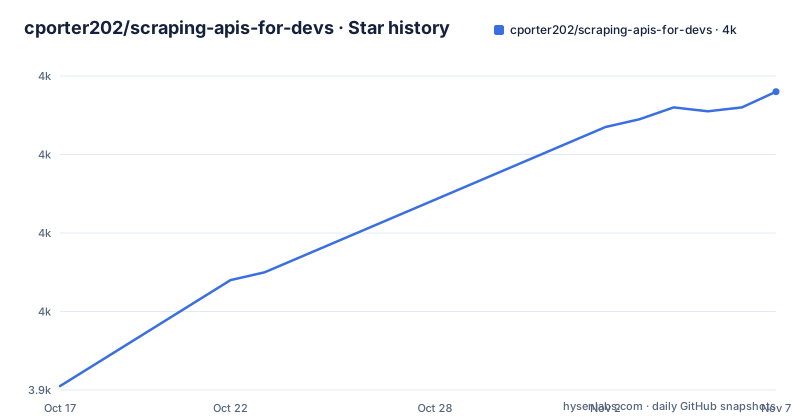
Star history
- cporter202/scraping-apis-for-devs4,016 ★ · +75
| Repository | 2026-10-17 | 2026-11-07 |
|---|---|---|
| cporter202/scraping-apis-for-devs | 3.9k | 4k |
75 Stars in the last 21 days, measured from the daily GitHub snapshot. Compare with other projects
Editorial analysis
The repository holds a list of links, and the scrapers run somewhere else
The first thing to know is what you do not get. The repository describes itself as a collection of scraping APIs that you can start using immediately. In practice it is a Markdown index. The top level contains README.md, FOLLOW_CREATOR.md, a settings folder, a .github folder and seventeen category folders. No package manifest, no source directory and no example script appears among the top-level entries.
Each row in the README tables names an API and gives a one or two sentence description, and the name is a hyperlink to an external page on apify.com. The listed tools are therefore run by their individual authors on that platform, and the repository does not ship, host or test any of them.
The primary language shows as JavaScript, but the visible content is documentation. A developer who clones the repository to get working scraper code will find directories of listings, not implementations. The license shows as unknown, so there is no stated permission to copy or reuse the repository's text either.
Seventeen category folders add up to exactly 2,622 listings
The headline figure is 2,622 APIs across 17 categories, and the Table of Contents breaks it down: Agents 250, AI 173, Automation 218, Developer Tools 172, Ecommerce 147, Integrations 191, Jobs 167, Lead Generation 80, MCP Servers 28, News 198, Open Source 216, Other 133, Real Estate 130, SEO Tools 159, Social Media 73, Travel 139 and Videos 148. Those figures sum to 2,622, so the count is internally consistent.
Each category has a folder whose name ends in its count, for example agents-apis-250 and mcp-servers-apis-28. The folder name is part of the link, which means the name changes whenever the count does. Any bookmark or link to a category folder breaks when a listing is added or removed.
The README section for each category shows a table of API names and truncated descriptions, then a link labelled View all that points at the folder. The README itself is long because it embeds category tables, and the truncation marks (descriptions end with an ellipsis) show you only the start of each description. The full text sits on the linked page.
Categories overlap, so a lead finder shows up under Agents
Browsing by category does not always find what you expect. The first rows in the Agents table include a YouTube Channel Comment Collector, a Leads Finder priced at $1.5 per 1,000 leads with emails, a YouTube Transcript Scraper at $0.5 per 1,000, a Tweets / X scraper and a set of AI copywriting tools. A leads tool sits in Agents even though a Lead Generation category exists with 80 entries.
The count of 250 for Agents against 73 for Social Media suggests how loosely the labels are applied. A social media scraper is listed in Agents, and the table does not mark it as belonging to both. If you want every YouTube tool, you cannot trust one folder. Search the README text, or browse several categories.
Some entries come in pairs. The Podcast Episode Ideas Creator, the Emotion-Focused Taglines Creator and the Facebook Ad Copywriter Creator each appear once as a plain listing and once with (Rental) in the name. The README does not explain the difference, so you learn it only by opening both external pages.
Every link carries the same fpr=p2hrc6 query parameter
The URLs in the tables follow one pattern, an apify.com path followed by ?fpr=p2hrc6. For example, the YouTube Channel Comment Collector links to apify.com/n.nobar/youtube-channel-comment-collector?fpr=p2hrc6, and the Leads Finder links to apify.com/code_crafter/leads-finder?fpr=p2hrc6. The same value appears on every row shown.
The README does not say what the parameter does. A reader who copies a link into their own documentation carries the parameter along, and anyone who cares about what a tracking value attaches to their visit can strip it before sharing.
The README also contains a featured block for APIMesa, described as a pay-per-call API marketplace with 150+ live APIs for AI, scraping, data, SEO, lead generation, media and developer utilities. The block promises one API key, clear per-call credit pricing and a live playground for every API. It sits between HTML comment markers named APIMESA-FEATURED-START and APIMESA-FEATURED-END, which suggests it is a placement that can be swapped. Whether it is paid is not stated.
The stated update date is 2025-12-09, but pushes continued into October 2026
The Collection Statistics table lists a Last Updated value of 2025-12-09. The repository is not archived, and its last push landed on 20 October 2026. The two dates do not match, which means either the statistics table is stale or later pushes changed other parts of the repository without touching it. The README does not say which.
There are no GitHub releases, so no tagged snapshot of the list exists. The only reference point is the current state of the main branch.
The README asks readers to star the repository, and says that support keeps the author motivated to maintain and update it regularly. It does not describe how listings are checked, how dead links are removed or how often a category folder is refreshed.
That has a practical consequence for a list of this size. With 2,622 external pages run by independent authors, some will be renamed, repriced or removed, and nothing in the repository tells you which. Treat the descriptions and the dollar figures in names as a snapshot taken when the entry was added.
The claim that each API is production-ready has no evidence in the repository
The README says each API is production-ready and that you simply integrate it and start building, with no need to build scrapers from scratch or maintain complex infrastructure. It calls the collection the most comprehensive of its kind on GitHub.
Neither claim is backed by anything in the repository. There are no ratings, no uptime figures, no test results and no sample output. The descriptions are the marketing text from each tool's own page, such as the Tweets / X scraper that promises to auto-detect what to collect and deliver clean, structured data. The repository does not verify that.
The nine use cases the README lists, from data collection and lead generation to real estate and the job market, are headings and not documented workflows. There is no tutorial that connects an entry to code.
The four questions people search about this topic, including whether web scraping is legal, are not answered anywhere in the repository. The README says nothing about terms of service, rate limits or the legality of collecting data from social media or e-commerce sites, so that checking falls to you and the tool's own page.
A directory to browse beats a dependency to install
Because nothing here installs, the right way to use the repository is as a catalog. Pick the category that matches your target, scan the table for the site you want to extract from, and follow the link to read the real documentation, pricing and input format on the external page.
The MCP Servers category, with 28 entries, is the smallest by count after Social Media's 73 and Lead Generation's 80, and it is the one aimed at AI assistants. The AI category lists 173 and Developer Tools 172. These numbers show where the list is thin and where it is deep: it is strongest on Agents, Automation and Open Source, and lightest on MCP servers.
If you want a scraper you can read, fork and run under your own control, a link to an external hosted actor does not give you that. The repository offers breadth of discovery and no depth of implementation. Its README lists a creator follow page too, FOLLOW_CREATOR.md, which belongs to the promotional side and not the technical side of the project.
Editorial conclusion
Use this repository as a directory to browse when you want to see what ready-made scrapers exist for a site or task, then evaluate each linked page on its own terms. Do not expect code, a client library or a license you can build on, because the repository holds links and the license is unknown. Before you rely on any entry, open its external page and check who runs it, what it charges and whether it still works, since the repository gives no ratings or health checks.
Frequently asked questions
What is scraping-apis-for-devs?
It is a GitHub repository that indexes 2,622 scraping APIs in 17 category folders. Each entry links to an external apify.com page, and the repository contains no scraper code itself.
Does scraping-apis-for-devs include code I can install?
No. The top level holds README.md, FOLLOW_CREATOR.md, a settings folder and category folders of listings. The license is shown as unknown, and there are no GitHub releases.
How many categories does scraping-apis-for-devs have?
It has 17 categories, from Agents with 250 APIs to MCP Servers with 28. Together they add up to 2,622 listings.
Official sources
Add this badge to your README
If you maintain this project, the badge below links readers to this analysis and shows its maintenance status from the daily GitHub snapshot. Paste the markdown into your README; add ?metric=license or ?metric=stars to the image URL for a different field.

[](https://hysenlabs.com/projects/cporter202-scraping-apis-for-devs)Star history chart for your README
[](https://hysenlabs.com/projects/cporter202-scraping-apis-for-devs)Was this useful?