crossplane: turning a Kubernetes cluster into a cloud control plane
The Cloud Native Control Plane
At a glance
- What is it?
- The Cloud Native Computing Foundation project that lets platform teams manage cloud infrastructure as Kubernetes custom resources, and the release cadence that says whether you should pin it or chase it.
- Who is it for?
- Crossplane is one of the few projects where the boring operational signals are more informative than the feature list. Twelve thousand stars and a Cloud Native Computing Foundation charter say the ecosystem will be around for the v3 era, while a 200 issue backlog, a three-way patch release drop and a v1.20 end-of-life date inside the same quarter tell you to treat the moving minor releases as a stream rather than a set of pins.
- Can I use it commercially?
- Yes. Apache-2.0 is a permissive licence: you can use, modify and sell software built on it, as long as you keep its copyright and licence notices.
- Is it still maintained?
- Yes. The repository received new commits within the last day.
- What is it written in?
- Mainly Go, according to GitHub's language statistics.
Answers come from the project's GitHub data, last synced on November 25, 2026, and from our analysis. They are not legal advice.
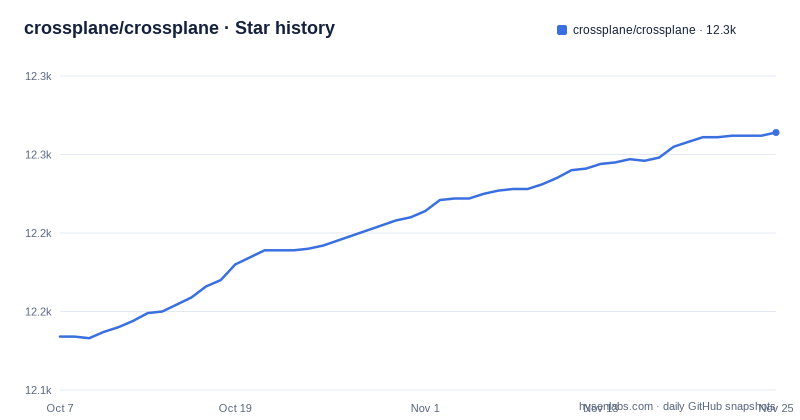
Star history
- crossplane/crossplane12,264 ★ · +130
| Repository | 2026-10-07 | 2026-11-25 |
|---|---|---|
| crossplane/crossplane | 12.1k | 12.3k |
130 Stars in the last 49 days, measured from the daily GitHub snapshot. Compare with other projects
Editorial analysis
The premise is a control plane you do not have to write
The README's opening paragraph makes a narrow claim, and it is worth staying inside it. Crossplane is a framework for building cloud native control planes without needing to write code, with a highly extensible backend that orchestrates applications and infrastructure regardless of where they run, and a configurable frontend that puts you in control of the schema of the declarative API it offers.
Two halves come out of that sentence. The backend is the reconciliation machinery, the part that turns a desired state into an actual state on a cloud provider's API and then keeps watching for drift. The frontend is the API surface, the custom resource definitions that platform engineers write YAML against.
The project's positioning is deliberately narrow. This is not a general provisioning engine that happens to run in a cluster, and it is not a Terraform replacement with a Kubernetes skin. It is infrastructure as code expressed in the Kubernetes resource model, where the resource lifecycle, the reconciliation loop and the API server are all things you already have if you run Kubernetes. That inheritance is the whole appeal: no separate state backend, no lock contention between two people editing the same file, and permissions that come from RBAC instead of a separate policy system.
It is a Cloud Native Computing Foundation project, which is not a marketing line so much as a governance structure. The repository carries the expected charter document set: CHARTER.md, GOVERNANCE.md, CODE_OF_CONDUCT.md, CODEOWNERS, DCO and SECURITY.md. The presence of DCO means contributions require a sign-off rather than a copyright assignment, and the presence of AI_POLICY.md suggests the maintainers have thought about generated code in a project this size.
Release channels and the dates that decide your upgrade policy
The README publishes a support window table, and it is the most operationally useful thing in the document. It lists maintained releases alongside upcoming ones, with end-of-life dates nine months after release for v2.2 onward and eighteen months after release for v1.20.
|  v1.20  | May 21, 2025 | Nov 2026 |
|  v2.2   | Feb 18, 2026 | Nov 2026 |
|  v2.3   | May 21, 2026 | Feb 2027 |
|  v2.4   | Aug 20, 2026 | May 2027 |
|  v2.5   |   Nov 2026   | Aug 2027 |
|  v2.6   |   Feb 2027   | Nov 2027 |
|  v2.7   |   May 2027   | Feb 2028 |
Two entries in that table deserve attention. First, v1.20 and v2.2 share the same end-of-life month of November 2026, and the README states plainly that when v2.5 ships in that month, v1.20 reaches end of life and stops receiving support or maintenance entirely. If you are on v1.20 today, you have a hard deadline in November 2026.
Second, the project ships on a quarterly rhythm. From v2.2 on, the listed releases are three months apart: February 2026, May 2026, August 2026, November 2026, February 2027, May 2027. A nine month support window on a quarterly train means you will be upgrading regularly, which is a very different upgrade experience from a library where you upgrade on your own schedule.
The README also flags the roadmap's own caveat, which is unusually candid for a project document: milestones assigned to roadmap issues are intended to give a sense of overall priority and expected order of delivery, and should be considered approximate estimations and not a strict commitment to a specific delivery timeline. The roadmap is a GitHub project board, updated by the maintainer team on an as needed basis and updatable at any time.
Three patch releases, one fix, three dependency bumps
The release feed currently lists v1.20.14, v2.2.7 and v2.3.7, all published within about fifteen seconds of each other on 2026-10-22, one patch release for each of three maintained lines.
The dependency tree says how much Kubernetes this is wearing
The go.mod is where the architectural bet shows up as version numbers. The module path is github.com/crossplane/crossplane/v2, the Go directive is 1.26.7, and there is a single replace directive pointing the API module at a local path:
module github.com/crossplane/crossplane/v2

go 1.26.7

replace github.com/crossplane/crossplane/apis/v2 => ./apis
The direct dependency list is the interesting part, because it is a Kubernetes control plane dependency list rather than an application list. k8s.io/api, k8s.io/apimachinery, k8s.io/client-go, k8s.io/apiextensions-apiserver and k8s.io/apiserver all sit at 0.37.1. sigs.k8s.io/controller-runtime is at 0.25.2, which is the standard controller framework.
Three entries there are unusual enough to be deliberate. github.com/alecthomas/kong is a command line parser, which tells you the project has real operator-style binaries rather than only a library surface. github.com/robfig/cron/v3 is a cron scheduling library.
The test dependencies are just as telling. sigs.k8s.io/e2e-framework and sigs.k8s.io/kind are direct requirements, which means the project's own tests run against a disposable Kubernetes cluster created in a container. That is a meaningful commitment for a project whose whole thesis is that it is the control plane: it is testing itself the way it expects you to deploy it.
Providers, SIGs and the shape of the surrounding community
Crossplane's own repository is only half of the story, because the other half is the provider ecosystem. The README refers to opening an issue against Crossplane or the relevant provider, and says the release process is documented in the separate crossplane/release repo. ADOPTERS.md exists for public user listings, and the README explicitly invites users to add themselves.
That provider split has consequences for anyone evaluating the project. Your dependency surface is the core control plane plus every provider you install, and those two update on different schedules. A provider that trails the core by a minor version is not necessarily broken, but it is a compatibility question you inherit and maintain.
The community structure is unusually formal for a project of this age. There are fourteen Special Interest Groups listed, and the README is careful about what they are: discussion groups that bring together members with shared interests, with no decision making authority or ownership responsibilities, serving purely as collaborative forums. The list itself is a map of where the project's friction actually lives.
`sig-v2-migration` tells you the v1 to v2 transition is still generating work. `sig-composition-functions` and `sig-composition-environments` cover the composition pipeline. `sig-deletion-ordering` deals with the hard problem of tearing down resources that depend on each other. `sig-secret-stores` and `sig-prod-readiness` are the two you would want to read before a production rollout.
Meetings happen every four weeks on Thursday at 10:00am Pacific Time, with the schedule published on a community calendar.
What the repository is actually made of
The file tree is worth reading for what it contains and what it does not. There is no application code directory, no frontend and no web assets beyond a banner image. What there is, is a control plane laid out the way you would expect one: an apis directory that the replace directive points at, a cluster directory, a cmd directory for binaries, internal packages, proto definitions with buf configuration for gRPC, and a test directory.
Two directories tell you something specific. The proto directory with buf.gen.yaml and buf.yaml means Crossplane exposes a real gRPC surface rather than relying only on the Kubernetes API server, which is how composition functions communicate with the control plane. The design directory holds design documents, so the architectural arguments are recorded in the repository rather than only in chat.
Tooling around the edges is Nix based. flake.nix, flake.lock, nix.sh and a nix directory suggest the project pins its development environment, which is how a large Go project avoids the drift that makes a build work on one maintainer's laptop and fail on another. There is a .golangci.yml for linting, a .coderabbit.yaml for automated review, generate.go as a generation entry point, install.sh, and RELEASE.md documenting the release process that the README points at a separate repository for.
What is absent at the top level is informative too. There is no Dockerfile, no Helm chart directory and no examples directory there. The README delegates installation to the Get Started docs and links a Helm chart on Artifact Hub, and that is a reasonable division of labour for a project whose install story is a Helm release into a cluster you already operate. It also means there is no quickstart in the README itself, so if you want the shortest possible path you will need to go to the external docs.
Editorial conclusion
Crossplane is one of the few projects where the boring operational signals are more informative than the feature list. Twelve thousand stars and a Cloud Native Computing Foundation charter say the ecosystem will be around for the v3 era, while a 200 issue backlog, a three-way patch release drop and a v1.20 end-of-life date inside the same quarter tell you to treat the moving minor releases as a stream rather than a set of pins. Read the release table before you design your upgrade policy, because the project's own support windows decide that for you, and pick your provider family before you commit.
Frequently asked questions
What is crossplane used for?
Crossplane is used to manage cloud infrastructure and applications through declarative Kubernetes APIs. A control plane runs in your cluster, providers extend it to a specific cloud, and you describe the resources you want as custom resources so that reconciliation, drift correction and access control all happen through the Kubernetes model you already operate.
Is crossplane better than terraform?
It depends on what problem you are solving. Terraform is a general purpose provisioning tool with a large provider ecosystem and a familiar workflow. Crossplane fits situations where you already run Kubernetes, where you want infrastructure managed as custom resources with RBAC, audit and reconciliation handled by the cluster, and where resources are consumed as an API by other teams rather than applied from a workstation.
What is a crossplane?
The name refers to the framework: a Cloud Native Computing Foundation project for building cloud native control planes without writing code, with an extensible backend for orchestration and a configurable frontend for the schema of the API it serves.
Is crossplane a Kubernetes controller?
It is more than that. Crossplane builds on sigs.k8s.io/controller-runtime and installs custom resource definitions, so controllers are the mechanism, but the README describes a framework for building cloud native control planes, which is a wider responsibility than a single controller loop.
Official sources
Add this badge to your README
If you maintain this project, the badge below links readers to this analysis and shows its maintenance status from the daily GitHub snapshot. Paste the markdown into your README; add ?metric=license or ?metric=stars to the image URL for a different field.

[](https://hysenlabs.com/projects/crossplane-crossplane)Star history chart for your README
[](https://hysenlabs.com/projects/crossplane-crossplane)Was this useful?