CSS Animation 101: A Free Book That Teaches Animation Through Theory and Practice
GitHub describes it as Learn how to bring animation to your web projects. The repository metadata lists CSS as its primary language. This article stays within the project description and details documented in the GitHub repository README.
At a glance
- What is it?
- This open source book from CSSAnimation.rocks offers a structured introduction to CSS animation, with downloadable ePub and PDF formats. It is a teaching resource, not a code library, and its value depends on how well it matches your learning style.
- Who is it for?
- Adopt CSS Animation 101 if you are a beginner who prefers a structured, book-length introduction to CSS animation and want a free resource you can read offline. Skip it if you need a reference for advanced techniques or a continuously updated code library.
- Can I use it commercially?
- Not without permission. GitHub finds no licence file in the repository, and without a licence all rights are reserved by default: you may read the code but not reuse it. Check the README, or ask the authors, before using it.
- Is it still maintained?
- Probably not. The repository last received commits 33 months ago, on January 18, 2024.
- What is it written in?
- Mainly CSS, according to GitHub's language statistics.
Answers come from the project's GitHub data, last synced on October 4, 2026, and from our analysis. They are not legal advice.
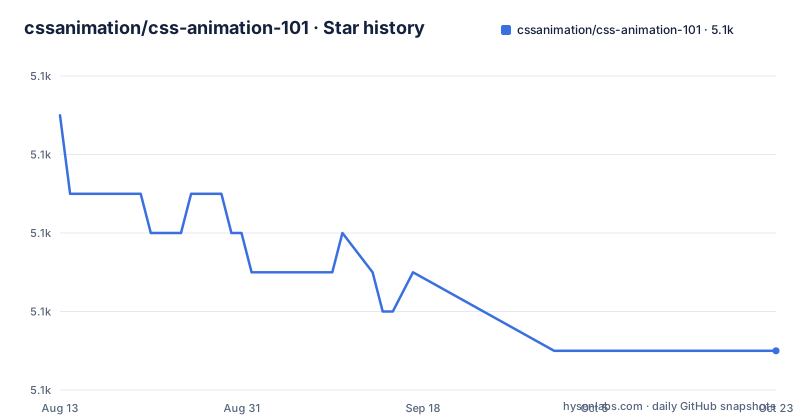
Star history
- cssanimation/css-animation-1015,051 ★ · -6
| Repository | 2026-08-13 | 2026-10-04 |
|---|---|---|
| cssanimation/css-animation-101 | 5.1k | 5.1k |
-6 Stars in the last 52 days, measured from the daily GitHub snapshot. Compare with other projects
Editorial analysis
What This Book Solves and Who It Serves
CSS animation can feel overwhelming when you try to learn it from scattered tutorials and documentation. This book addresses that by offering a structured introduction that combines theory with practical lessons. The intended reader is someone new to CSS animation who wants to understand both the how and the why. The README states that you will learn how and why to use animation on your web pages. It is not a reference for experts. It is a primer, and it is free. The target audience is clear: beginners who prefer a guided path over random blog posts.
The Format and Distribution: ePub, PDF, and Web
The book is distributed in three formats. You can download an ePub version, a PDF version, or read it directly on the web at cssanimation.rocks/css-animation-101. This range of formats makes it practical for different reading habits. The ePub is useful for e-readers, the PDF for printing or offline reading, and the web version for quick access. The repository itself contains the source files, which are generated with a Pandoc book template. That means the content is maintained in a text-based format and then compiled into the various outputs. If you want to read the book without touching code, you can simply download a ready-made file.
How the Book Is Built: Pandoc and a Book Template
The technical detail in the README is minimal but informative. The book is generated with the Pandoc book template by wikiti. Pandoc is a document converter that can take Markdown or other formats and produce ePub, PDF, and HTML. This explains how the project maintains multiple output formats from a single source. The repository likely contains the chapter files in a structured folder, and a build process compiles them. For a reader, this matters because it means the content is version-controlled and open to contributions. For a contributor, it means you need to understand Pandoc if you want to rebuild the book after making changes.
Getting It Running: Download and Read, No Installation
There is no installation or setup required to use this project. You download a file or open a web page. The README gives direct links to the ePub and PDF files. For example, the ePub is at github.com/cssanimation/css-animation-101/raw/master/downloads/epub/cssanimation-101.epub. The PDF is similarly located under downloads/pdf. If you prefer the web version, you go to cssanimation.rocks/css-animation-101. For those who want to contribute or create a translation, you fork the repository, rename it according to the pattern css-animation-101-xx where xx is a language code, and translate the chapters and meta information. There is no build command documented in the README, so the exact steps for regenerating the book are not specified here.
Translations and Community Contributions
The project explicitly encourages translations. The README provides a naming convention: fork and rename the repo to css-animation-101-xx, where xx is the language code, such as cn or ru. You must translate the chapters content and the meta information, and update the ReadMe file with a link back to the original repo and the site. The project lists a Chinese translation with source files and an Arabic PDF translation. This shows that the content is considered adaptable to other languages, and the author is willing to link to translations. For a learner, this means you might find a version in your language. For a contributor, it is a clear path to participate.
Limitations and the Wrong Use Cases
The most obvious limitation is that this is a static book, not a living codebase. It was created at some point, and the README does not show a recent push date or any releases. CSS animation techniques and browser support change over time. A book from a few years ago may contain examples that behave differently in modern browsers. Also, the book is an introduction. It does not claim to cover advanced topics like performance optimization or complex choreography. If you are an experienced developer looking for a reference, this book is the wrong tool. If you need to know the exact current syntax for a specific property, you are better off with official documentation. The lack of a license file in the repository metadata is another point to note, although the README states a Creative Commons Attribution 4.0 International license.
Alternatives and How They Differ
A common alternative is the CSS-Tricks Almanac, which is an online reference for CSS properties, including animation. That site is property-by-property and example-driven, not a narrative book. Another alternative is the MDN Web Docs on CSS animation, which provides detailed technical explanations and browser compatibility tables. The key difference is that CSS Animation 101 is a structured course-like book, while MDN and CSS-Tricks are references. If you want a guided learning path, the book is suitable. If you need to look up a specific detail, a reference is faster. There are also video courses, and the author promotes one on Udemy, but that is a paid product and not part of this repository.
Maintenance, License, and Upgrade Cost
The repository shows no recent releases and the last push date is unknown. That suggests the book may not be actively updated. The README does mention a newsletter that has been running for nearly three years, which indicates the author is still active in the CSS animation space, but the book itself might not receive frequent updates. The license is Creative Commons Attribution 4.0 International, which allows you to share and adapt the content as long as you give credit. This is permissive but not public domain. If you plan to redistribute or translate, you must include attribution. The upgrade cost for a reader is zero, as you can download a new version if one appears. For a contributor, the cost is learning Pandoc if you want to rebuild the book after editing the source.
Editorial conclusion
Adopt CSS Animation 101 if you are a beginner who prefers a structured, book-length introduction to CSS animation and want a free resource you can read offline. Skip it if you need a reference for advanced techniques or a continuously updated code library. Before using it, verify that the examples match current browser behavior, since the repository has no recent release information and the last push date is unknown. Also check the Creative Commons Attribution 4.0 license if you plan to redistribute or translate the content.
Frequently asked questions
What is CSS animation in css-animation-101?
It is the whole subject of the book. The README frames it as an introduction to animation on web pages that combines theory with practical lessons, written for people who find the topic overwhelming to learn all at once.
What are the benefits of using CSS animation according to css-animation-101?
The argument is about understanding rather than measurement: the book pairs how to animate with why you would, so you can apply it to your own pages. No performance figures or comparisons appear in the repository.
How do I get css-animation-101 without installing anything?
Three links are provided: an ePub file and a PDF file under downloads/ in this repository, and a web version hosted at CSSAnimation.rocks. There is no package to install and no build step needed to read them.
Can I translate css-animation-101?
Yes. Fork the repository, rename it css-animation-101-xx with your language code such as cn or ru, translate the chapters content and the meta information, update the ReadMe with a link back to this repository and to CSSAnimation.rocks, then tell the author so the work gets linked. Chinese and Arabic versions are already listed.
How do I rebuild css-animation-101 from the Markdown source?
The Makefile calls pandoc. The target all builds book, which covers epub, html and pdf; a word target also exists but nothing depends on it, and clean removes the build directory. The chapters come from the chapters/*.md glob.
Official sources
Add this badge to your README
If you maintain this project, the badge below links readers to this analysis and shows its maintenance status from the daily GitHub snapshot. Paste the markdown into your README; add ?metric=license or ?metric=stars to the image URL for a different field.

[](https://hysenlabs.com/projects/cssanimation-css-animation-101)Star history chart for your README
[](https://hysenlabs.com/projects/cssanimation-css-animation-101)