DataHaven: an EVM Substrate chain where storage proofs settle on EigenLayer
An EVM compatible Substrate chain, powered by StorageHub and secured by EigenLayer
At a glance
- What is it?
- DataHaven splits decentralized storage into off-chain providers and on-chain cryptographic commitments, with an EigenLayer AVS handling validator slashing. It is a full node and contract stack, not a drop-in SDK.
- Who is it for?
- Adopt DataHaven only if you are prepared to run Substrate infrastructure and read the operator, contracts, test and deploy READMEs before touching the Kurtosis launcher; teams that want a hosted storage API or a single-language SDK should not start here. Verify first that the runtime directory contains a chain spec matching the network you intend to join, and that the StorageHub pallet versions referenced by the runtime match the ones you expect to build against.
- Can I use it commercially?
- Yes, with conditions. GPL-3.0 is a copyleft licence: if you distribute software that includes it, you must release that software's source code under the same licence. Running it internally without distributing it does not trigger that obligation.
- Is it still maintained?
- Activity is slowing. The repository last received commits 7 months ago.
- What is it written in?
- Mainly Rust, according to GitHub's language statistics.
Answers come from the project's GitHub data, last synced on November 14, 2026, and from our analysis. They are not legal advice.
Star history
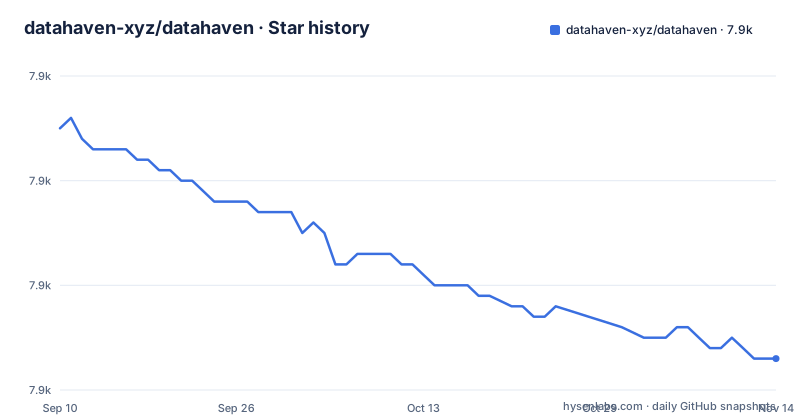
- datahaven-xyz/datahaven7,873 ★ · -22
| Repository | 2026-09-10 | 2026-11-14 |
|---|---|---|
| datahaven-xyz/datahaven | 7.9k | 7.9k |
-22 Stars in the last 65 days, measured from the daily GitHub snapshot. Compare with other projects
Editorial analysis
The problem DataHaven targets: proving that stored data still exists
Storing bytes on someone else's disk is easy. Proving, months later, that those bytes were not altered or quietly dropped is the hard part. DataHaven addresses that by separating the two halves of the job. Providers keep the data off-chain, where bandwidth and disk are cheap. Cryptographic commitments go on-chain, where they are expensive but tamper-evident. The README frames the network as being for AI training data, machine learning models and Web3 applications, which is a narrower audience than general-purpose file storage. The chain is EVM compatible through Frontier pallets, so the intended user already has Solidity tooling and an Ethereum mental model. If you only need a bucket to dump logs into, this is more machinery than the task requires.
Two provider roles and a proof challenge loop
The architecture diagram in the README splits storage providers into two classes with different incentives. Main Storage Providers are user-selected, offer data retrieval and manage users' buckets. Backup Storage Providers are network-assigned, replicate data and answer proof challenges. The replication step is described as the MSP coordinating with BSPs according to the bucket's replication policy, which means replication depth is a per-bucket setting rather than a network-wide constant. Verification runs on a challenge cycle: BSPs face periodic proof challenges, and the README states that failure to prove data custody results in on-chain slashing via StorageHub pallets. Two further roles sit alongside the providers. An Indexer indexes on-chain storage events for efficient querying, and a Fisherman audits storage proofs and can trigger challenges when it detects misbehavior. The storage flow is given as four steps: upload (files are chunked, hashed into Merkle trees, and the root anchored on-chain), replication, retrieval and verification. The default chunk size is stated as 8KB. That number matters more than it looks, because it fixes the granularity of every Merkle proof the network produces and every retrieval verification a client performs.
EigenLayer, Snowbridge and what the contracts directory actually holds
The security model is the reason this repository has a contracts directory alongside a Substrate node. DataHaven validators register as EigenLayer operators, and the README names two AVS contracts on Ethereum L1: DataHavenServiceManager for validator lifecycle and slashing, and RewardsRegistry for validator performance and rewards. Communication between L1 and the Substrate chain goes over Snowbridge, described as trustless cross-chain messaging for tokens and messages. The repository layout puts Solidity sources under contracts/src, deployment scripts under contracts/script and Foundry test suites under contracts/test. So the trust boundary is not inside the Substrate chain alone. A validator's economic exposure is defined by an Ethereum contract, and the Substrate runtime consumes that state through a bridge. That is a meaningful design commitment, and it means an incident in either layer is an incident for the whole system. The README notes that validator slashing is separate from BSP slashing, which happens on-chain via StorageHub pallets.
Building and launching: prerequisites and directory-level entry points
The Quick Start lists seven prerequisites: Kurtosis for network orchestration, Bun v1.3.2 or later as the TypeScript runtime, Docker for containers, Foundry for the Solidity toolkit, Rust for building the operator, Helm for Kubernetes deployments (optional), and Zig for macOS cross-compilation (macOS only). The README inlines launch, test and build commands and also points at per-directory documentation, with operator/README.md covering node building and runtime development, contracts/README.md covering smart contract work, test/README.md covering E2E testing and network deployment, and deploy/README.md covering Kubernetes. The test tree is where a local network comes from: test/suites holds integration scenarios and test/framework holds helpers. Runtime configuration for mainnet, stagenet and testnet lives in operator/runtime. The practical consequence is that a local network starts with cd test, bun i and bun cli launch, and the launcher expects Docker and Kurtosis to already be working on the host.
Where DataHaven is the wrong tool
The chunk size is the clearest limitation. An 8KB default is a reasonable unit for Merkle commitments, but it is a poor unit for large media files or model checkpoints, where the proof overhead per byte of payload is high and retrieval becomes a reassembly problem. The second constraint is operational weight. Running a node means Rust, a chain spec, and a runtime configuration chosen from mainnet, stagenet or testnet. Running a full local network means Docker and Kurtosis. None of that is unreasonable for a storage operator, and all of it is unreasonable for an application developer who just wants durable object storage with an HTTP client. Third, the README says retrieval returns files with Merkle proofs that users verify against on-chain commitments, so check the per-directory READMEs for which client performs that verification.
How this differs from Filecoin and Arweave
The comparison that matters is with Filecoin. Filecoin's storage market matches clients to miners through on-chain deals, and its proof system is built into the L1 consensus: storage proofs are a first-class consensus concern, and the chain exists largely to carry them. DataHaven inverts the relationship. The Substrate chain runs StorageHub's storage pallets, while the economic security for validators is rented from Ethereum through EigenLayer rather than bootstrapped by the storage token itself. That is the whole point of the AVS pattern, and it means DataHaven inherits Ethereum restaking exposure instead of running its own validator economy from zero. Arweave takes a third approach entirely, paying once for permanent storage rather than running recurring proof challenges. DataHaven is neither: it is a recurring-challenge network with a rented security layer and EVM compatibility bolted on via Frontier. The EVM compatibility is the differentiator worth weighing, because Frontier pallets give it smart contracts and familiar Web3 tooling.
Licence, release cadence and the cost of staying current
DataHaven is GPL-3.0. For anyone building on the node or runtime, that is a copyleft obligation that reaches derivative works distributed to others, which is a different proposition from the permissive licences common in the Substrate ecosystem. If you intend to fork the runtime and ship a modified chain, the licence question belongs with your own counsel before you write code, not after. On cadence, the release list shows Runtime RT1300 on 2026-02-26, then v0.26.0 and Runtime RT1400 both on 2026-03-12, and the repository's last push on 2026-04-17. The pairing of a node release with a separate runtime release tag is the detail to watch: runtime upgrades on a Substrate chain are governance actions, and RT1400 landing the same day as v0.26.0 suggests the two are expected to move together. A provider or validator that tracks the node but lags the runtime is running a configuration the release process does not appear to test. Budget for reading release notes on every runtime tag, not just every node tag.
Who should pick this up, and what to check on day one
The audience here is storage operators and infrastructure teams who already run Substrate or Ethereum validator infrastructure and want a storage network where slashing is backed by restaked ETH rather than a new token. Application developers building AI data pipelines are the second audience, but only if they are willing to depend on MSPs and the Indexer rather than a managed API. Before committing, check three things in the repository itself. First, whether operator/runtime contains a chain spec for the network you intend to join, since the README only names mainnet, stagenet and testnet as configuration categories. Second, whether the StorageHub pallet versions the runtime pins match the ones you plan to build against, because DataHaven is built on StorageHub and a version skew there is a build failure, not a runtime warning. Third, whether the bun cli launch environment brings up the Indexer and Fisherman alongside the providers, since a local network without them will not exercise the challenge path you are trying to evaluate.
Editorial conclusion
Adopt DataHaven only if you are prepared to run Substrate infrastructure and read the operator, contracts, test and deploy READMEs before touching the Kurtosis launcher; teams that want a hosted storage API or a single-language SDK should not start here. Verify first that the runtime directory contains a chain spec matching the network you intend to join, and that the StorageHub pallet versions referenced by the runtime match the ones you expect to build against.
Frequently asked questions
What is DataHaven?
An EVM compatible Substrate chain, powered by StorageHub and secured by EigenLayer, described as a verifiable storage network for AI training data, machine learning models and Web3 applications. Providers store data off-chain while cryptographic commitments are anchored on-chain for tamper-evident verification, and it bridges to Ethereum trustlessly with Snowbridge for tokens and messages.
How does DataHaven verify stored files?
Files are chunked, 8KB by default, hashed into Merkle trees, and the root committed on-chain. On retrieval the provider returns files with Merkle proofs that the user verifies against the on-chain commitment. Separately, backup storage providers face periodic randomized proof challenges to show ongoing custody, and failing to prove results in on-chain slashing through StorageHub pallets.
Who are the MSPs and BSPs in DataHaven?
Main Storage Providers are the ones a user selects, serving data with competitive offerings and managing that user's buckets. Backup Storage Providers are network-assigned and replicate data for redundancy according to the bucket's replication policy, with on-chain slashing if they fail a proof challenge. Two further services are named: Fisherman, an auditing service that monitors proofs and triggers challenges, and an Indexer that indexes on-chain storage events for querying.
What does it take to run a DataHaven node locally?
Seven tools, listed as prerequisites: Kurtosis for network orchestration, Bun 1.3.2 or newer, Docker, Foundry, Rust, Helm as optional, and Zig for macOS cross-compilation. Then cd test, run bun i and bun cli launch, which brings up an Ethereum network with two reth clients and two lodestar clients, a DataHaven node, MSP and BSP storage nodes, the AVS contracts and Snowbridge relayers.
Does DataHaven support Ethereum tooling?
Yes. The core capabilities list EVM compatibility via Frontier pallets for smart contracts and familiar Web3 tooling, plus a cross-chain bridge with native, trustless bridging with Ethereum via Snowbridge for tokens and messages. The contracts are EigenLayer AVS contracts, and validators register as operators through the DataHavenServiceManager contract.
Official sources
Add this badge to your README
If you maintain this project, the badge below links readers to this analysis and shows its maintenance status from the daily GitHub snapshot. Paste the markdown into your README; add ?metric=license or ?metric=stars to the image URL for a different field.

[](https://hysenlabs.com/projects/datahaven-xyz-datahaven)Star history chart for your README
[](https://hysenlabs.com/projects/datahaven-xyz-datahaven)Was this useful?