Abema-TV: A Minimalist M3U8 Playlist with EPG for Abema Channels
Watch Abema TV channels with EPG
At a glance
- What is it?
- This repository provides M3U8 playlists that point to Abema TV streams, usable in an HTML player with EPG overlays. It is a thin wrapper around existing streams, not a standalone app, and it works only from Japanese IP addresses.
- Who is it for?
- Use Abema-TV if you are in Japan (or have a Japanese IP) and want a quick way to load Abema channels into an M3U8-compatible player, especially the linked HTML player that reads EPG from the provided XML. Do not use it if you expect a maintained application, a standalone player, or access outside Japan; the repository is essentially a static playlist file.
- Can I use it commercially?
- Not without permission. GitHub finds no licence file in the repository, and without a licence all rights are reserved by default: you may read the code but not reuse it. Check the README, or ask the authors, before using it.
- Is it still maintained?
- Yes. The repository received new commits within the last day.
- What is it written in?
- GitHub does not report a main language for this repository.
Answers come from the project's GitHub data, last synced on October 23, 2026, and from our analysis. They are not legal advice.
Star history
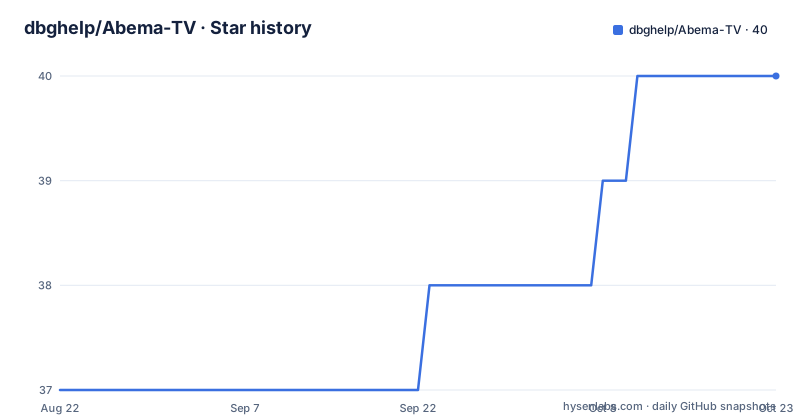
- dbghelp/Abema-TV40 ★ · +3
| Repository | 2026-08-22 | 2026-10-23 |
|---|---|---|
| dbghelp/Abema-TV | 37 | 40 |
3 Stars in the last 62 days, measured from the daily GitHub snapshot. Compare with other projects
Editorial analysis
What This Repository Actually Contains
The dbghelp/Abema-TV repository is not a player, not a downloader, and not a proxy. It is a set of playlist files, most notably abema.m3u8 and preview.m3u8, that reference Abema TV streams. The README gives two direct URLs: one for 1080p and one for a 240p preview. Those URLs point to the GitHub-hosted raw files, which in turn contain the actual stream references. The project also includes an epg.xml file, based on the README's mention of thumbnail images coming from it. So the whole thing is a data source, not a tool. For an engineer, the immediate question is whether those M3U8 files are stable enough to build anything on. The README does not say when the files were last updated, and there are no release notes. That lack of provenance is a real concern.
The Mechanism: M3U8 Playlists Plus a Web Player
The core idea is simple: you open a URL in a browser, and the player loads the M3U8 file. The README links to https://dbghelp.github.io/player.html, which is a generic HTML player that accepts a file parameter. For Abema-TV, that parameter is the raw GitHub URL of the abema.m3u8 file. The player then parses the playlist and streams the channels. The EPG part works by overlaying program information when you hover over a channel logo or click an EPG button. The README states that hovering shows EPG for a specific channel with thumbnails from epg.xml, while clicking the EPG button shows a traditional grid for all channels. This is a client-side approach: no server, no authentication, no transcoding. The data flow is static files hosted on GitHub, fetched by a browser-based player. That is lightweight, but it also means any change to Abema's stream URLs requires a manual update to the M3U8 files.
Getting It Running: The Exact Steps
To use the 1080p version, open this URL in a browser with JavaScript enabled: https://dbghelp.github.io/player.html?file=https://raw.githubusercontent.com/dbghelp/Abema-TV/refs/heads/main/abema.m3u8. For the lower-bandwidth option, replace abema.m3u8 with preview.m3u8 in the same URL structure. That is the entire setup. There is no installation, no command-line tool, no API key. The player itself is a separate project, html-iptv-player, which the README links to. If you want to use the M3U8 files in another player, such as VLC or a custom app, you would fetch the raw file and point your player at the stream URLs inside. But the README does not document that path. The only documented usage is through the provided player. Also note the README says it is accessible via Japan IP only, so a VPN or a Japanese VPS is required if you are outside Japan.
The Japan IP Restriction: A Hard Boundary
The README states plainly: 'Accessible via Japan IP only.' That is not a minor detail; it is a fundamental constraint. Abema TV geo-blocks its streams, so any attempt to play these M3U8 files from outside Japan will fail, or at least will not work as intended. This makes the repository useless for a global audience unless they have a Japanese IP. For an engineer evaluating this for a project, that means you must factor in a proxy or VPN service that exits in Japan. That adds cost and latency. Also, the geo-block may change without notice, and the repository provides no mechanism to detect or handle that. The README does not mention any error handling for geo-blocking. So if Abema changes its policy, the playlists simply stop working.
What the EPG Offers, and What It Does Not
The EPG is a key feature, because many M3U8 playlists for live TV lack program metadata. Here, the README describes two views: hover over a channel logo for a specific channel's EPG with thumbnail images, and click an EPG button for a traditional all-channel grid. That suggests the epg.xml file contains structured data with program titles, times, and image URLs. The player reads that XML and renders it. However, the repository does not include the player itself; you must use the linked html-iptv-player project. That separation means the EPG display depends on the player's implementation, not just the XML. If the player changes its EPG parsing, the Abema-TV files may or may not still work. Also, the README does not specify the EPG update frequency. If epg.xml is static, the program data will go stale. The screenshots section is empty in the README, so there is no visual confirmation of how the EPG looks.
Limitations and Failure Modes
The most obvious limitation is the lack of maintenance visibility. The repository has no recent releases, no last push date in the material, and the README is minimal. That means you cannot assess whether the M3U8 URLs are current. Stream URLs for Abema can change frequently, especially for live channels. If they do, the playlist breaks silently. Another failure mode is the geo-block: even with a Japanese IP, Abema may require specific headers or tokens, which a simple M3U8 file cannot provide. The README does not mention any authentication or token handling. Also, the 240p preview is a separate file, but there is no explanation of why you would choose it, other than bandwidth. The README does not state whether the preview includes the same channels or a subset. Finally, the license is unknown, so you do not know if you can legally redistribute or modify the playlists. That is a legal risk for any commercial use.
Comparison with the HTML IPTV Player
The README links to dbghelp/html-iptv-player, which is described as an 'HTML IPTV Player with EPG viewer for M3U8 playlist.' That is the natural alternative, or rather, the companion. The difference is that html-iptv-player is the software, while Abema-TV is the data. If you want to watch Abema, you could take the Abema-TV M3U8 files and use them in any player that supports M3U8, such as VLC or a custom HLS player. But the EPG feature is tied to the html-iptv-player, because it knows how to parse epg.xml. So the alternative is not a competing service; it is a different layer of the stack. If you only need the streams without EPG, you can ignore the player and use the M3U8 files directly. If you want the EPG overlay, you must use the html-iptv-player. That dependency is worth noting: the value of Abema-TV is partly contingent on another project's maintenance.
Maintenance Cost and License Implications
The material gives no indication of how often the M3U8 files are updated. The repository is not archived, but there are no releases and no push dates in the provided data. That suggests a low-maintenance project, possibly a one-time setup. For an adopter, the maintenance cost is on your side: you must periodically check that the streams still work, and if they break, you have to edit the M3U8 files yourself or wait for the maintainer to update. The license is listed as 'unknown,' which is a red flag. Without a license, you do not have explicit permission to use, modify, or redistribute the files beyond what GitHub's terms imply. For personal use, that may be fine, but for any commercial or public deployment, you should contact the maintainer or choose a different source. The README does not address this, so you are on your own.
Editorial conclusion
Use Abema-TV if you are in Japan (or have a Japanese IP) and want a quick way to load Abema channels into an M3U8-compatible player, especially the linked HTML player that reads EPG from the provided XML. Do not use it if you expect a maintained application, a standalone player, or access outside Japan; the repository is essentially a static playlist file. Before adopting it, verify that the M3U8 URLs still resolve, since stream links can break without notice, and check the license status, which is not stated. The project offers a simple, direct path to Abema streams, but its value depends entirely on the stability of those external links.
Frequently asked questions
How to watch Abema in the US?
The repository does not address it. Its one operational line states that the streams are accessible from a Japanese IP address only, and there is no mention of access from other regions, any routing guidance, or any alternative source. What it publishes is two playlist addresses for an HTML player hosted on the project's own pages domain.
Can I watch AbemaTV outside of Japan?
Nothing on the page suggests so. It states that access works from a Japanese IP address only and does not claim otherwise is possible. The repository contains no application and no configuration of any kind, just two playlist files, an image directory and a readme describing two programme guide modes.
Is AbemaTV free to watch?
The repository states no price for anything. It publishes its playlist addresses without a paywall or an account, and states no terms on redistribution. The guide file the readme refers to is not present in the repository, and the streams themselves are described as reachable from a Japanese IP address only.
what is abema tv, and what is this repository?
This repository is not a broadcaster. It holds two M3U playlist files, one for full resolution streams and one labelled as a lower resolution preview, plus an image directory and a short readme. Those playlists are passed to a static HTML player as a URL parameter, which renders channels with a guide you open either by hovering a logo or by clicking a guide button.
abema tv alternative
The page names no alternative channel source. What it does point at is an alternative player: a separate repository holding an HTML IPTV player with a guide viewer for M3U8 playlists, which is described as reusable for any playlist rather than specific to these channels.
Official sources
Add this badge to your README
If you maintain this project, the badge below links readers to this analysis and shows its maintenance status from the daily GitHub snapshot. Paste the markdown into your README; add ?metric=license or ?metric=stars to the image URL for a different field.

[](https://hysenlabs.com/projects/dbghelp-abema-tv)Star history chart for your README
[](https://hysenlabs.com/projects/dbghelp-abema-tv)Was this useful?