Bond 7: Swift Bindings That Bridge UIKit and View Models
GitHub describes it as A Swift binding framework. The repository metadata lists Swift as its primary language. The metadata lists the MIT license. This article stays within the project description and details documented in the GitHub repository README.
At a glance
- What is it?
- Bond is a Swift binding framework built on ReactiveKit. It turns UI properties into observable signals and offers one-line bindings, two-way sync, and observable collections for fine-grained updates.
- Who is it for?
- Adopt Bond if you want a declarative, type-safe way to connect UIKit or AppKit views to view models, and if you already use ReactiveKit or like its operator set. Skip it if you need an actively maintained library or prefer Combine, which Apple ships and updates.
- Can I use it commercially?
- Yes. MIT is a permissive licence: you can use, modify and sell software built on it, as long as you keep its copyright and licence notices.
- Is it still maintained?
- Probably not. The repository last received commits 53 months ago, on May 19, 2022.
- What is it written in?
- Mainly Swift, according to GitHub's language statistics.
Answers come from the project's GitHub data, last synced on October 22, 2026, and from our analysis. They are not legal advice.
Star history
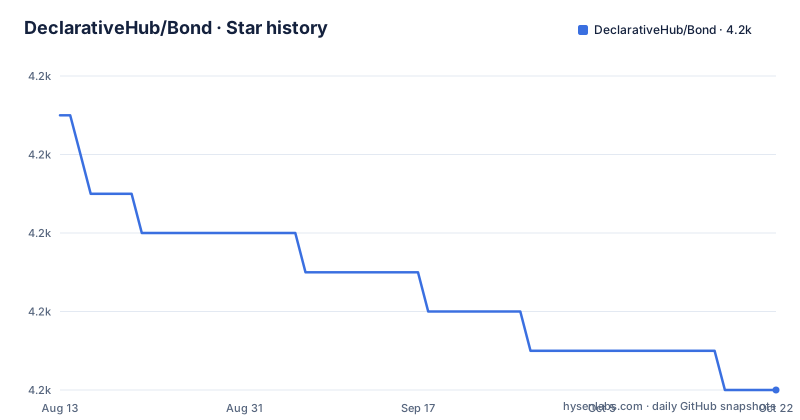
- DeclarativeHub/Bond4,192 ★ · -7
| Repository | 2026-08-13 | 2026-10-22 |
|---|---|---|
| DeclarativeHub/Bond | 4.2k | 4.2k |
-7 Stars in the last 70 days, measured from the daily GitHub snapshot. Compare with other projects
Editorial analysis
What Bond Solves and Who It Targets
Bond attacks a specific pain: wiring UI state to underlying data without writing target-action selectors, KVO observers, or manual data source objects. The README shows how observing a text field's text normally requires setting up target-action machinery. Bond replaces that with a single line: `textField.reactive.text.observeNext { text in print(text) }`. The audience is Swift developers building iOS or macOS apps who want a reactive layer that feels natural with UIKit and AppKit. It bridges the gap between imperative UI code and reactive programming, so it suits teams that want to adopt reactive patterns incrementally without rewriting everything in a full reactive framework. It is also the backbone of the Binder Architecture, a specific app architecture from the same author, so it targets developers who want a structured way to separate business logic from views.
How Bindings Work: The Reactive Proxy and Signals
The core mechanism is the `.reactive` proxy. Bond extends UIKit and AppKit classes with a `reactive` property that exposes observable representations of their properties and events. For example, `textField.reactive.text` is an observable signal of the text field's text. That signal is built on ReactiveKit, so you can apply operators like `map` and `combineLatest` to transform values before binding. The README demonstrates mapping text to add a greeting: `textField.reactive.text.map { "Hi " + $0 }.bind(to: label)`. Binding is not a one-time assignment; it creates a persistent connection that updates the target whenever the source emits a new value. Bond also supports two-way bindings with `bidirectionalBind`, which keeps a view model property and a text field in sync, updating each other on changes. This design lets you chain reactive operators freely, as the framework inherits ReactiveKit's full operator set, making it a functional reactive tool, not just a simple binding helper.
Getting Started: Commands and Basic Usage
The README does not include installation instructions, but the repository is on GitHub and uses Swift Package Manager or CocoaPods, as is common for Swift libraries. To use Bond, you import the module and start using the `.reactive` proxy on any supported UI element. For a button tap, you write `button.reactive.tap.observeNext { print("Button tapped.") }`. To bind a view model property to a label, you write `viewModel.numberOfFollowers.map { "\($0)" }.bind(to: label)`. For two-way binding, use `viewModel.username.bidirectionalBind(to: usernameTextField.reactive.text)`. The README also shows how to observe notifications with `NotificationCenter.default.reactive.notification("MyNotification")`. Each observation or binding returns a disposable, and you can manage lifetimes with a dispose bag, as shown in the collection view example: `.dispose(in: cell.onReuseBag)`.
Observable Collections for Fine-Grained UI Updates
Bond provides `MutableObservableArray`, a type that wraps an array and emits detailed change information. The README shows that when you append an element, observers receive a change event with the full collection, a diff, and a patch. This is designed for collection views and table views where you need to know exactly what changed, not just that the array changed. The example binds an array of repositories to a collection view, and inside the cell configuration closure, it binds repository properties to cell labels and images, disposing them in the cell's reuse bag. This avoids implementing a data source object and manually handling inserts and deletions. The patch mechanism is a key feature because it lets Bond update the UI with animated, incremental changes, which is more efficient than reloading the entire collection. However, the README does not detail how the diff is computed, so you should check the source for performance characteristics on large arrays.
Limitations and When Bond Is the Wrong Tool
Bond's main limitation is its maintenance status. The last release, 7.8.1, came on October 31, 2020, and the repo has not been archived, but there have been no pushes since. This means it may not support the latest Swift versions or new UIKit features, and any bugs you find will likely not be fixed upstream. Also, Bond is tightly coupled to ReactiveKit; if you do not want to adopt ReactiveKit's signal model, Bond forces it on you. For simple one-off bindings, the overhead of learning reactive concepts may be unjustified. The README mentions the migration guide for Bond 7, implying breaking changes from earlier versions, so upgrading existing code could require effort. If you use SwiftUI, Bond does not target that framework; it is for UIKit and AppKit. In that case, you are better off using SwiftUI's own state management. Finally, the collection view binding example uses force casts and a custom cell, which is typical but not type-safe; the framework does not prevent you from making mistakes in cell reuse.
Alternatives: Combine and ReactiveSwift
The most direct alternative is Apple's Combine framework, introduced in iOS 13. Combine provides publishers and subscribers, and it has a `@Published` property wrapper for observable state, but it lacks built-in UIKit bindings. You would need to write your own bindings or use a third-party bridge like CombineCocoa. Bond's advantage is that it ships with reactive extensions for UI components, so you get `textField.reactive.text` out of the box. ReactiveSwift is another alternative; it is a mature reactive framework with a similar signal model, but it does not provide UIKit bindings either. You would use ReactiveCocoa for that, which is a separate library. Bond's approach is to bundle the reactive core and the UI extensions in one package, which reduces dependency management. The trade-off is that Bond's evolution is tied to ReactiveKit, and its maintenance has stalled, whereas Combine is actively developed by Apple and is the standard for new projects.
Maintenance and License Implications
Bond is released under the MIT license, which permits commercial use, modification, and distribution, with the requirement to include the copyright notice. The repository has not been updated since 2020, so you should treat it as a stable but frozen library. This has implications for upgrades: if you adopt Bond, you are unlikely to receive new features or fixes, and you may need to fork it to address compatibility with future Swift or iOS versions. The README points to a migration guide for Bond 7, which suggests that major version changes can introduce breaking changes, so planning for upgrades is necessary if you ever move to a fork. The dependency on ReactiveKit means you also inherit ReactiveKit's maintenance status. Before adopting, check the ReactiveKit repository for its release history. For a new project, you might prefer Combine for long-term support, but for a legacy codebase that already uses Bond, the MIT license gives you the freedom to maintain it yourself.
Editorial conclusion
Adopt Bond if you want a declarative, type-safe way to connect UIKit or AppKit views to view models, and if you already use ReactiveKit or like its operator set. Skip it if you need an actively maintained library or prefer Combine, which Apple ships and updates. Before adopting, verify that Bond's reactive extensions cover the specific UIKit components you use, and check the migration guide for any breaking changes from Bond 6. The last release is from October 2020, so plan for potential forks or your own fixes.
Frequently asked questions
What is Bond?
It is a Swift binding framework built on top of ReactiveKit. It provides bindings, reactive data sources and reactive delegates, and is usable either on its own to simplify state changes or alongside ReactiveKit to complement reactive flows.
How do I use Bond with a text field?
Reach the property through the reactive proxy on the control, then observe it or bind it elsewhere. Transforming is done with a map operator before the bind, and the framework adds a shortcut so you can bind straight to a label rather than to its text property.
Does Bond support two-way binding?
Yes. A bidirectional bind keeps a model property and a text field in step, so a change to either updates the other. The readme uses a username field and a view model property as the example.
How do I observe an array with Bond?
Use the mutable observable array type, which reports fine-grained changes. Each observation receives the whole collection along with a description of the change and a patch, which is what an animated collection view needs, and you mutate the type like the array it wraps.
How do I install Bond?
Four ways are available in the repository: a Swift package manifest with a resolved dependency file, a CocoaPods podspec, a Cartfile with a resolved Cartfile for Carthage, and an Xcode project with a workspace. There is also a version file pinning the expected Swift toolchain.
Is Bond still maintained?
The repository has not been pushed to since May 19, 2022, and the newest release tag is 7.8.1 from October 31, 2020. The readme still carries a banner announcing the seventh major version with a link to its migration guide, and its build badge points at a continuous integration provider rather than a hosted actions directory.
Official sources
Add this badge to your README
If you maintain this project, the badge below links readers to this analysis and shows its maintenance status from the daily GitHub snapshot. Paste the markdown into your README; add ?metric=license or ?metric=stars to the image URL for a different field.

[](https://hysenlabs.com/projects/declarativehub-bond)Star history chart for your README
[](https://hysenlabs.com/projects/declarativehub-bond)